


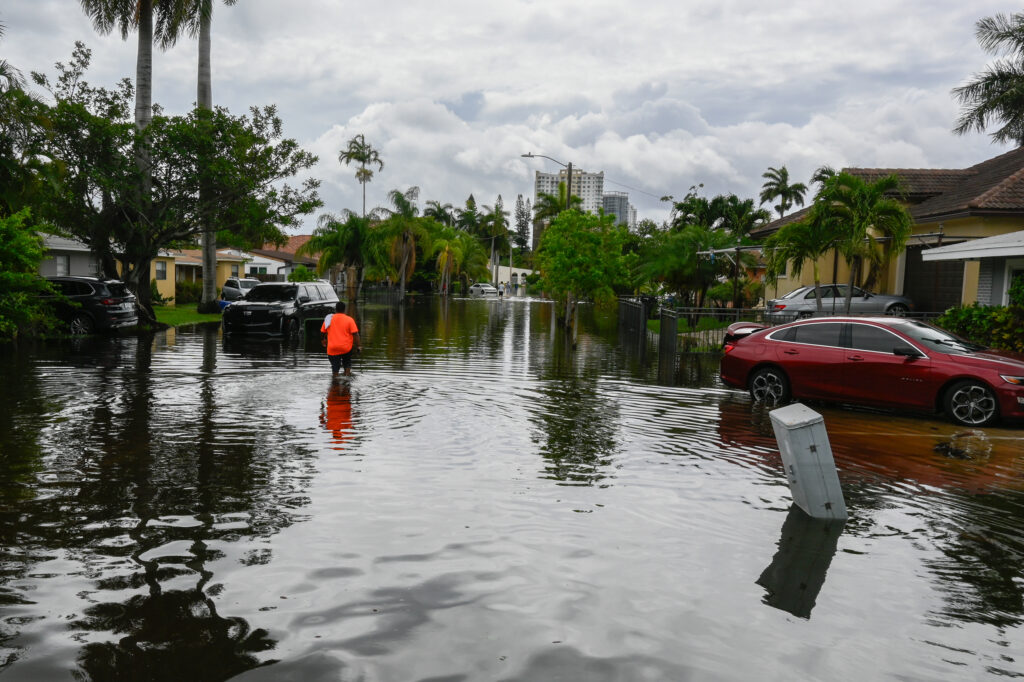
Just in time for Halloween, floodwaters washed into South Florida businesses and submerged roads, forcing residents to drive and walk through shin-high water in what officials called the most intense king tide event ever.
The federal government has an ambitious, multibillion-dollar plan for the Miami area to help ease the pain of future flooding as deluges increase due to sea level rise. It calls for elevating thousands of homes up to a dozen feet, starting in six years, in neighborhoods vulnerable to flooding.
It may be a tough sell.
Neighborhoods in New York City and Louisiana that previously tried this on similarly grand scales fell short of their initially projected numbers. Standing in the way of volunteers were the time it took, the need to have a house in compliance with building codes and the lack of assistance for homeowners who would need to temporarily relocate.
“There’s a substantial barrier to entry for a number of people, even before we get into things like delays and how much do you trust the government to actually do this properly,” said Vivek Srikrishnan, an assistant professor of biological and environmental engineering at Cornell University.
The U.S. Army Corps of Engineers initially rolled out plans two years ago to elevate 2,057 residences in Miami-Dade County, including places such as Aventura, Bal Harbour, Miami, Miami Beach and Surfside.
In August, the Corps added another 2,800 single-family homes and 430 small multifamily buildings to the project, which would start in 2032 and could take 15 years. “It’s not going to be close to that amount,” Srikrishnan predicted.
Raising homes is one of several tactics the Corps plans in a multi-pronged approach to keep buildings in the Miami area safe from flooding in the coming decades. Other tactics include floodproofing scores of critical infrastructure like fire or police stations and relying on nature-based methods like planting mangrove trees to act as a buffer. The federal government would pick up two-thirds of the expected tab of around $7 billion.
But widespread participation is needed for the project to succeed, something even the Corps has acknowledged in previous cases.
“The participation rate for home elevations can impact project benefits, with fewer homeowners participating in the eventual (program) reducing the overall benefits and justification of the project,” according to a Corps report on a similar program in New Jersey, where there are plans to elevate 6,421 houses.
Water, Water Everywhere
Unlike the projects in Louisiana, New Jersey and New York, which were launched in direct response to recent hurricanes, the Miami-Dade County project is being planned in anticipation of future flooding in an area inundated with water from tides, the sky and the ground, through its porous limestone surface.
Miami-Dade County’s 2.8 million residents live between Biscayne Bay, the Atlantic Ocean and the Everglades, many of them along a canal system built to tame the wetlands ecosystem. Residents are spread across 34 municipalities in a place best known for its beaches, glitzy nightlife, global trade, cruise ships and vulnerability to flooding, particularly at this time of year when king tides flood streets even when it’s not raining.
The Biscayne aquifer, the area’s main source of drinkable water, is made up of porous limestone, which is prone to saltwater intrusion.
“As the king tides that we expect this fall arrive, we see that those tidal flooding events last longer, tend to be deeper, and reach farther inland due to recent sea level rise,” Christian Kamrath, Miami-Dade County’s resilience program manager, said during an online public meeting in September. “Sea level rise also makes a storm surge during a hurricane that much more damaging and impactful, so we have to work really hard to address all these issues.”
It’s too early to determine how many residents may sign up for the home-raising in Homestead, where 1,320 single-family homes are listed for possible elevation. If the Corps gives final approval for the elevation and Congress provides funding, the city will conduct outreach with residents to ”ensure residents have the necessary information to decide whether or not they wish to participate,” said Cairo Cangas, Homestead’s director of public works.
None of the Florida homes will be raised more than 12 feet, since the Corps has determined that higher elevations are unsafe.
To elevate the home, crews separate the structure from its foundation, place steel beams under the house, and lift it using hydraulic jacks. Pilings are then placed under the house.
Electrical wiring and plumbing need to be disconnected and reconnected.
Limited Public Awareness
After the federal government announced the addition of newly eligible Miami-Dade County neighborhoods in August, the Corps opened a public comment period that ended in mid-September. It received only 10 written comments, indicating how little awareness there is currently, though the project is still in an early planning stage. Of the 10 comments, only three came from residents. The rest came from businesses and government agencies, according to records obtained by Inside Climate News.
Don Deresz, one of the residents who commented, said he bought his home in Miami’s Silver Bluff neighborhood in the 1970s after ensuring it wasn’t in a flood zone. He objected to using taxpayer money for such a large-scale project, especially since some homeowners in the targeted neighborhoods live in multimillion-dollar houses.
“They bought property there and took the risk and they should pay for elevation and upgrades or move,” Deresz wrote.
This story is funded by readers like you.
Our nonprofit newsroom provides award-winning climate coverage free of charge and advertising. We rely on donations from readers like you to keep going. Please donate now to support our work.
Asael “Ace” Marrero, Miami’s assistant city manager, said code compliance costs, temporary relocation expenses and a requirement that the homes demonstrate adequate structural integrity could be obstacles that keep low-income homeowners from participating.
“Repairs associated with termites, roofs, structural framing, and other deferred maintenance can represent significant barriers for otherwise eligible households,” Marrero wrote in his comments.
Mixed Results
Similar efforts elsewhere in the United States have produced mixed results.
In New York City, Hurricane Sandy damaged or destroyed thousands of homes in 2012. In response, the mayor’s office launched a recovery effort aimed to repair, rebuild and elevate homes, with $2.3 billion in federal funding.
The program initially had 22,400 applicants but only served around 8,100 of them, with half withdrawing because of lengthy processing times, which averaged nearly two years.
Ultimately, just 847 homes were elevated. Of the residents in the program who were temporarily relocated, nearly three-quarters were displaced for more than 14 months. On average, they were displaced for two years. Less than 2 percent were out of their homes for more than four years, according to an audit of the New York City program.
“These temporary relocations also led to dissatisfaction with the program,” the audit said.
In Louisiana, the Corps identified an initial 3,456 homes for elevation in three parishes on the southwest coast, Calcasieu, Cameron and Vermilion. Yet only around 1,000 homes are part of the initial phase at a cost ranging from $65 to $98 per square foot, depending on the number of stories and the type of foundation.
A study examining the low participation rate said the Corps needed to spend time with homeowners building up trust. Homeowners feared their houses would be damaged, questioned why their house was chosen but not their neighbors’ homes and wondered how much control they would have with a contractor.
“They have skepticism of the ability of the government at any level to respond to their needs,” according to the June 2025 study from Fenstermaker, Restore the Mississippi River Delta and the University of New Orleans.
Potential Obstacles
Plenty of obstacles remain before the Miami-Dade County project gets off the ground, so to speak, including funding from Congress. Another obstacle is the Trump administration’s 2025 decision to pause the issuance of final reports for projects like large-scale home elevations.
When asked how the pause will impact plans to elevate homes in Miami-Dade County, a Corps spokesman said the initial focus will be on floodproofing pump stations, wastewater treatment facilities, police stations and fire stations. Home elevations will be included in the plan, but the final version won’t be finished until next summer, said Mark Haviland, chief of public affairs for the Corps’ Norfolk district.
Other options, like government purchases of flood-prone properties or nature-based solutions, may prove more cost effective than raising thousands of homes, said Srikrishnan, the Cornell professor.
“It is unlikely that we are going to see these projects ever fully materialize at scale,” Srikrishnan said. “As we’ve seen, the costs are quite expensive. There can be engineering challenges, and the uptake can be quite low.”
About This Story
Perhaps you noticed: This story, like all the news we publish, is free to read. That’s because Inside Climate News is a 501c3 nonprofit organization. We do not charge a subscription fee, lock our news behind a paywall, or clutter our website with ads. We make our news on climate and the environment freely available to you and anyone who wants it.
That’s not all. We also share our news for free with scores of other media organizations around the country. Many of them can’t afford to do environmental journalism of their own. We’ve built bureaus from coast to coast to report local stories, collaborate with local newsrooms and co-publish articles so that this vital work is shared as widely as possible.
Two of us launched ICN in 2007. Six years later we earned a Pulitzer Prize for National Reporting, and now we run the oldest and largest dedicated climate newsroom in the nation. We tell the story in all its complexity. We hold polluters accountable. We expose environmental injustice. We debunk misinformation. We scrutinize solutions and inspire action.
Donations from readers like you fund every aspect of what we do. If you don’t already, will you support our ongoing work, our reporting on the biggest crisis facing our planet, and help us reach even more readers in more places?
Please take a moment to make a tax-deductible donation. Every one of them makes a difference.
Thank you,
