


- In Brazil, community-based land management of collective territories has produced striking results for conservation.
- The social situation of these communities is less encouraging, though, with nearly half of households living a precarious existence, suggesting income-transfer programs linked to conservation, like the Tropical Forests Forever Facility (TFFF), could make a difference — if implemented well.
- “Community-based conservation, with its proven effectiveness, would be a compelling focus [for] this type of investment, especially in Brazil,” a new op-ed argues.
- This article is a commentary. The views expressed are those of the authors, not necessarily of Mongabay.
More than half a century has passed since Garrett Hardin published The Tragedy of the Commons in Science in 1968. In that influential article, he argued that human greed and short-term thinking would drive societies toward collapse. Hardin illustrated his argument with the well-known example of herders sharing a pasture: each herder would receive all the income from adding another animal, while the cost of consuming the grass would be shared by all. The path toward pasture depletion was therefore set, as some herders would keep adding animals for their own benefit rather than restrain themselves in the name of an abstract collective good. For Hardin, there was no way to change this equation; the solution for the sustainability of life on the planet was population control.
Two decades later, and not by chance, it was a woman who challenged this foretold tragedy, showing that, under certain conditions, human beings can be organized and perceptive enough to cooperate and avert collective failure. Elinor Ostrom developed a theory of cooperation applied to the use of common-pool resources, explaining how locally agreed rules can enable shared benefits. It was an expression of confidence in human social intelligence.
The point is not to decide who was right or wrong. Hardin’s argument helps us understand why reducing greenhouse gas emissions remains so difficult, as do countless examples of the degradation of humanity’s natural heritage and, consequently, of the foundations of our future. Ostrom, in turn, helps explain many successful cases of collective natural resource management — also known as community-based management or conservation — led by the people who live in the places where resources are used.
Collective management arrangements depend on clearly defined geographical boundaries, locally agreed rules for decision-making and conflict resolution, monitoring, and graduated sanctions. Behind these formal arrangements, Ostrom also recognized the importance of factors such as familiarity among members, frequent interactions, shared identity, mutual trust, and reciprocity.
This theoretical framework on cooperation and natural resource use, developed by sociologists, economists, and political scientists through observation of real-world cases, is highly significant. Around 40% of the world’s protected areas are under community-based management by Indigenous peoples and traditional communities, conserving at least one-third of global biodiversity.
In Brazil, community management of collective territories has also produced striking results. Despite intense pressures, over the past 30 years Indigenous lands have lost, at the national scale, just over 1.2% of their natural cover, Quilombola territories, managed by Afro-Brazilian communities descended from formerly enslaved persons, have lost 4.7%, while private areas have lost 17-19.9% based on those same reports.
Brazil’s National System of Conservation Units (SNUC), which governs the management of the country’s parks and reserves, formally recognizes traditional communities for their conservation performance and sustainable use of natural resources, as well as for their territorial and cultural rights. Established in 2000, the SNUC recognizes extractive reserves (Resex) as official categories within the national system: public territories reserved for the exclusive use of the communities that live there and depend on, manage, and conserve natural resources.
Resex emerged from the struggle led by Chico Mendes and his fellow rubber tappers for forest-based agrarian reform in the Brazilian state of Acre. Their demands were later supported by those of fishers, babassu coconut breakers, and other traditional communities, who raised their voices and made their conservation practices visible, demonstrating their need for access to natural resources and gaining recognition in public policy.
Today, Brazil has 98 Resex, covering 15.7 million hectares (nearly 39 million acres), an area nearly twice the size of Scotland. These territories are co-managed by local communities and the Brazilian state through management councils that represent local actors and have deliberative authority. Managing these protected areas therefore requires both government and communities to understand territorial realities, histories of struggle, social organization, the structure of the state and its institutions, ecosystem ecology, the dynamics of natural resource use, and, critically, the art and science of collective organization.
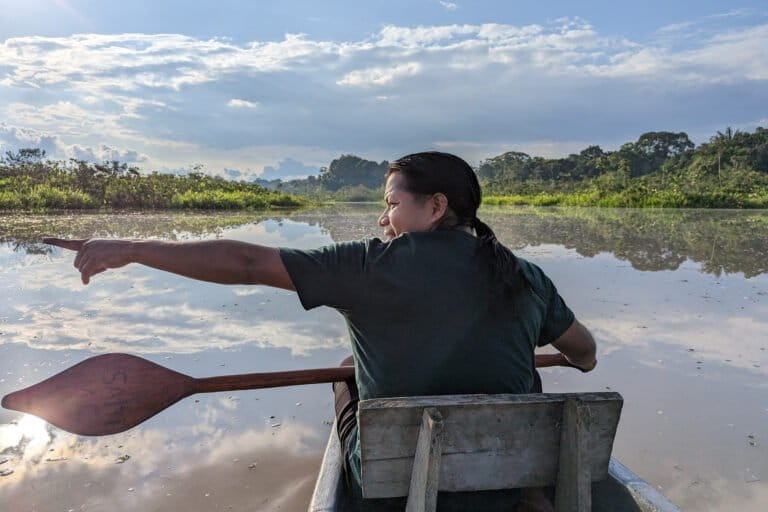
The social situation of these communities, however, is less encouraging. According to Brazil’s 2022 national census, 315,833 people live in sustainable-use conservation units such as Resex, excluding environmental protection areas (APA). Among them, 40% face some form of precariousness, whether related to sanitation or water supply, a finding that points to the potential reach of income-transfer programs linked to conservation.
Among public responses to poverty in protected areas, the Bolsa Verde Program stands out. Created in 2011 and inspired by the Bolsa Família Program, Bolsa Verde paid 300 reais ($58) per quarter to around 100,000 families until it was discontinued in 2016. In 2023, the program was relaunched with higher payments, a broader target population, and nationwide coverage: quarterly payments rose to 600 reais (just over $116) per family for beneficiaries in collective territories of Indigenous peoples and traditional communities.
Through adhesion terms, community members commit to complying with environmental legislation, maintaining vegetation cover and biodiversity conservation in the territories served, taking part in environmental conservation activities, and following territorial management instruments such as use plans, management plans, and fishing agreements. From 2023 to 2025, the program recorded 32,800 beneficiary families in 71 conservation units across the country.
Findings from a 2021 literature review of community-based conservation arrangements show the power of community management to deliver combined environmental and social outcomes. The study reviewed 3,100 publications on the performance of collective-management arrangements, identifying those that provided evidence of environmental outcomes, social outcomes, and the relationships between the two. This resulted in 169 publications containing all three types of evidence. Their analysis showed that local governance arrangements achieved combined environmental and social success in 56% of cases, while arrangements centralized in external management bodies did so in only 16%.
The multiple benefits of community-based conservation, together with the scale which Brazil has achieved through these initiatives, could make an important contribution to global forest-based climate finance. The Tropical Forests Forever Facility (TFFF), coordinated by Brazil and launched at the COP30 climate summit in 2025, aims to raise more than $10 billion to reward countries that keep forests standing. With its operation scheduled to begin in 2027, participating countries have not yet identified the beneficiaries of these investments, leaving transparency gaps, and missing an opportunity to strengthen fundraising around potential results.
Community-based conservation, with its proven effectiveness, would be a compelling focus for fundraising and a deserving priority for this type of investment, especially in Brazil.
Ana Cristina Barros is a graduate student at the National School of Tropical Botany of the Rio de Janeiro Botanical Garden. Carlos Eduardo Viveiros Grelle, Ph.D., is a faculty member in the Department of Ecology at the Federal University of Rio de Janeiro (UFRJ). Katia Ribeiro Torres, Ph.D., is a faculty member in the graduate program at the National School of Tropical Botany of the Rio de Janeiro Botanical Garden, an environmental analyst, and director at ICMBio.
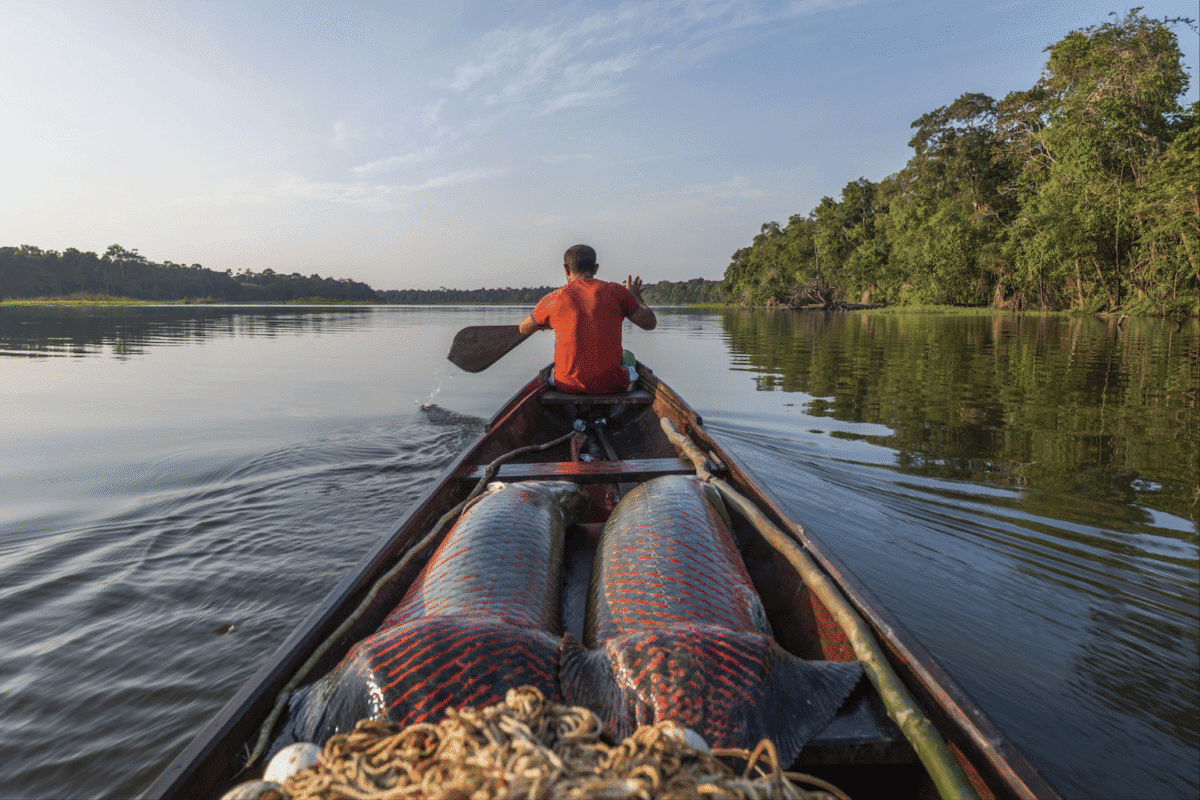
Banner image: The community-based management of pirarucu (Arapaima gigas) in Brazil has helped recover a species that was once on the brink of extinction. Image courtesy of Bernardo Oliveira / Instituto Juruá.
See related coverage:
In the Brazilian Amazon, community conservation success comes with a cost: Study
Brazil has protected much of the Amazon. It now has to pay for it.
How Brazil’s federal fiscal policy hinders Amazon Rainforest conservation (commentary)
Citations:
Hardin, G. (1968). The tragedy of the Commons. Science, 162(3859), 1243-1248. doi:10.1126/science.162.3859.1243
Ostrom, E., Burger, J., Field, C. B., Norgaard, R. B., & Policansky, D. (1999). Revisiting the Commons: Local lessons, global challenges. Science, 284(5412), 278-282. doi:10.1126/science.284.5412.278
Garnett, S. T., Burgess, N. D., Fa, J. E., Fernández-Llamazares, Á., Molnár, Z., Robinson, C. J., … Leiper, I. (2018). A spatial overview of the global importance of Indigenous lands for conservation. Nature Sustainability, 1(7), 369-374. doi:10.1038/s41893-018-0100-6
Dawson, N. M., Coolsaet, B., Sterling, E. J., Loveridge, R., Gross-Camp, N. D., Wongbusarakum, S., … Rosado-May, F. J. (2021). The role of Indigenous peoples and local communities in effective and equitable conservation. Ecology and Society, 26(3). doi:10.5751/es-12625-260319
Cite this article
Ana Cristina Barros, Carlos Eduardo Viveiros Grelle, Katia Ribeiro Torres (2026). Community-based conservation is a good climate investment in Brazil & beyond (commentary). Mongabay Conservation news. DOI: https://doi.org/10.66709/news-330134

