


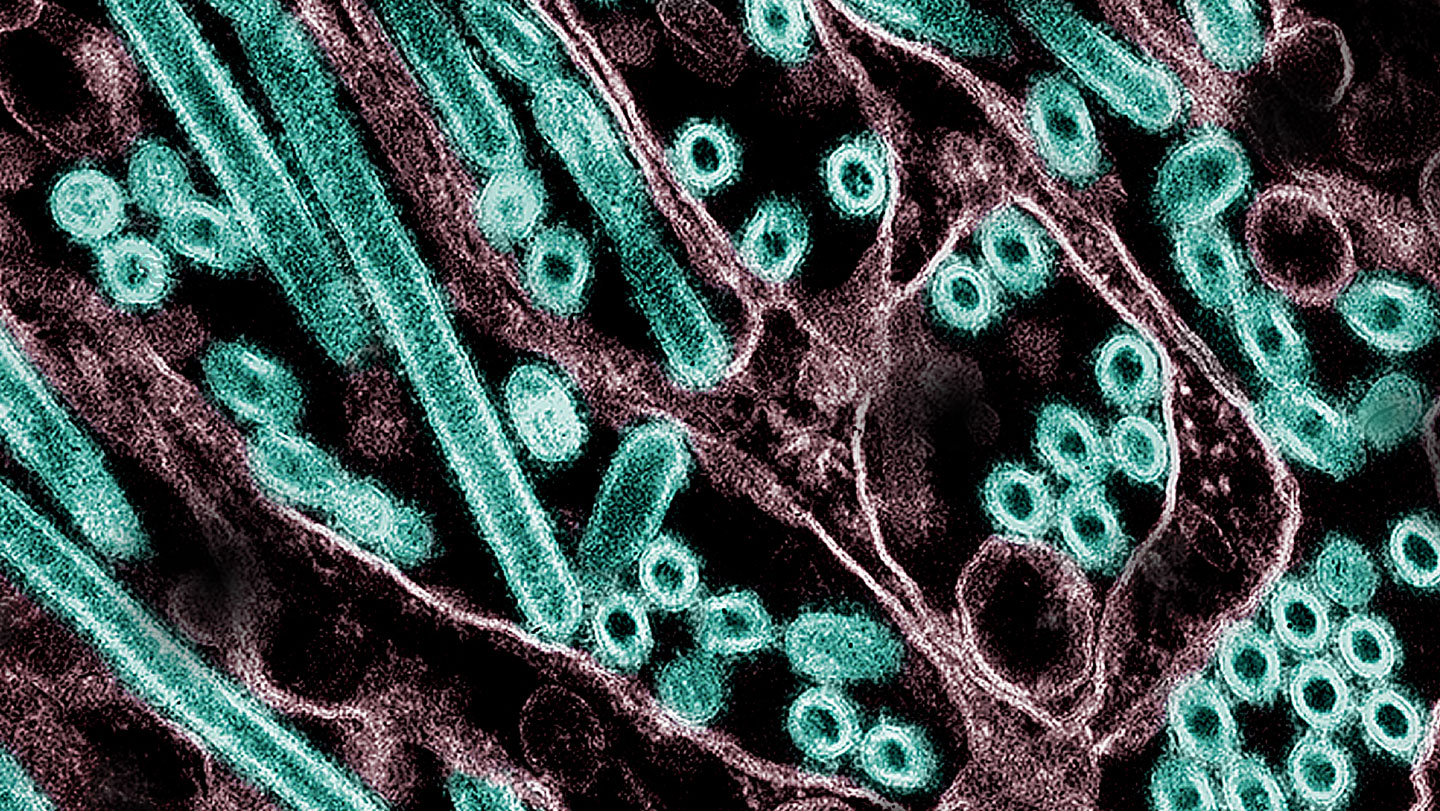
Anthropic’s Claude AI chatbot helped a scientist plan potentially risky bird flu experiments.
The researcher relied on Claude to plan studies, analyze data and choose experiments involving highly pathogenic avian influenza, the company reported September 10 in a threat intelligence report. The work sought to identify and introduce mutations that could help bird flu viruses adapt to mammals and transmit more easily between them. Anthropic says that, to its knowledge, no private company had previously publicly shared evidence of potential misuse of its platform for biological weapons development. But the company did not provide enough detail to determine whether Claude simply sped up work the researcher could already do or gave the researcher a new capability, experts say.
Learning how avian influenza viruses might pose a pandemic risk “is absolutely a normal part of virology research,” says influenza researcher Thomas Friedrich of the University of Wisconsin–Madison School of Veterinary Medicine. Such research can help scientists assess whether emerging bird flu viruses pose a greater risk to humans.
But experiments that deliberately aim to boost pathogen traits such as transmissibility or disease severity draw scrutiny, Friedrich says, because of concerns about accidents or misuse.
Though the report comes amid broader debates about the security of AI models, arguments over this “gain-of-function” research predate generative AI. In 2012, studies involving H5N1 bird flu and airborne transmission in ferrets prompted an international debate over whether the scientific benefits outweighed the risks. Some H5N1 transmission experiments were put on hold for a year while researchers and officials worked out how to handle the risks.
In Anthropic’s case, discovered in May 2026, the bird flu researcher accessed Claude from a region where the service was not supported or available. Anthropic says the researcher used workarounds to access Claude anyway. Material shared with Claude suggested the group probably had physical access to relevant virus samples. Anthropic banned the researcher’s account in May for evading restrictions on access.
Anthropic says it could not tell whether the researcher intended harm because legitimate and dangerous biological research can look similar. The company did not respond to questions from Science News about why it considered the case significant, how it assessed Claude’s role in the research or whether any proposed experiments had actually been performed.
Anthropic released too little information to determine the purpose of the work, says biodefense researcher Gregory Koblentz. “There is no evidence that any of this research was connected to the development of biological weapons,” says Koblentz of George Mason University in Fairfax, Va.
The same kind of biological research can serve very different purposes, from civilian science to military defense. Even work done at a military-affiliated institution does not, on its own, show that researchers are developing a biological weapon, Koblentz says.
Anthropic also did not provide enough detail to show exactly how much Claude helped, Friedrich says. The company’s own account suggests the AI model “did not meaningfully add scientific capability,” he says. In other words, it may simply have sped up the researcher’s work, rather than enabling something they could not have done otherwise.
Even if Claude’s role was only to speed up the work, that can make a big difference in a scientist’s workflow, says virologist David O’Connor of the University of Wisconsin–Madison. Systems such as Claude can help researchers find papers, synthesize results and parse data more quickly, he says. “Work or analyses that would have taken me months can now be done in an afternoon.”
As a result, existing scientific information, including about avian flu viruses, may become easier to find and use, O’Connor says. O’Connor says frontier AI models could let scientists tackle questions they might not have attempted before. “The frontier models will change the ambition of research questions that are asked,” he says.
The bird flu research was one of five instances in Anthropic’s report involving uses of Claude that the company says could support biological weapons development. None of the five look technically sophisticated or particularly concerning to biologist Kevin Esvelt of the MIT Media Lab. Esvelt is more suspicious of the researchers’ motives; he says the five cases showed signs of ill intent. But none “represented a competent attempt at weaponization.”
The poor quality of these particular attempts does not show what a more capable user might be able to do with AI-assisted biology, Esvelt says. AI can help with research and analysis, but turning an idea into a biological threat takes additional work, Koblentz says. “Even if AI is used to design a potentially dangerous pathogen, it is not a threat until the organism can be modified in a lab or synthesized.”
That requires facilities, measures for keeping viruses contained, funding, trained personnel and hands-on experience. Those barriers vary depending on who is doing the work, O’Connor says. They would be a major obstacle for an inexperienced person working alone, but less so for scientists with specialized training and access to a well-equipped laboratory.
Regardless, the remaining laboratory steps are substantial, Friedrich writes in an email. “There is a big gap between identifying mutations that could potentially adapt an avian influenza virus to humans and a ‘harmful biological outcome’.”
