


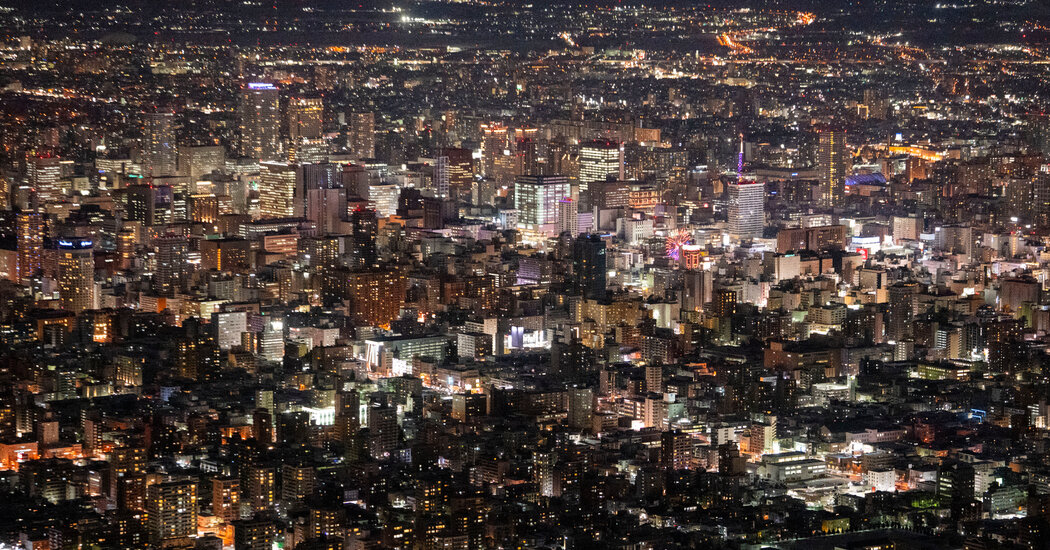
For 158 years, Tokyo has stood as Japan’s glittering capital, a world-famous nexus of food, culture, business and government.
But Tokyo might soon get an understudy. Japan’s legislature recently passed a bill to create a secondary capital that would serve as an alternate center for the government’s operations, ensuring continuity in the case of a natural disaster or other emergency.
With hundreds of millions of dollars potentially in the offing, and the chance for tax breaks, tourism and urban revival, the plan has set off a frenzy in Japan. Thirteen local governments have already entered the race, including the business hub of Osaka, the southern prefecture of Fukuoka and the northern island of Hokkaido. Even the laid-back, mountainous region of Gunma, home to about 1.9 million people, has thrown its hat into the ring.
Mayors and governors have held flashy news conferences to declare their interest. Osaka has even created a mascot for its bid, a talking “welcoming cat” named Nyaniwa Fukumaru.
Masashi Kawai, a senior policy officer at the Tokyo Foundation, a think tank, said the competition had the feel of a grand festival: “A ‘don’t-miss-the-Gold-Rush’ mentality has taken hold.”
The idea has divided Japanese citizens. Supporters of the plan say that Japan, long prone to earthquakes, typhoons and floods, must be prepared for the possibility that its government offices in Tokyo could become debilitated. Opponents say the idea is a misguided proposal meant to reward allies of Prime Minister Sanae Takaichi: One of her closest political partners is the Japan Innovation Party, which has worked for years to establish its home base of Osaka as an alternate capital.
It will be up to Ms. Takaichi to crown the winner. No official timeline has been set, but her cabinet is expected to put together a list of requirements for the secondary capital in the next few months.
Guarding Against Disaster
The idea of a second capital has some precedent in Japanese history. During the Edo period, from 1603 to 1868, Japan had two capitals. Edo, which later became Tokyo, was a political and administrative capital where the shogun ruled. Kyoto was the cultural and spiritual capital, home to the emperor.
In recent decades, the threat posed by natural disasters has led some experts and politicians to revive the idea. Japan is situated along the Pacific “Ring of Fire,” a chain of seismologically active faults encircling the Pacific Ocean. Experts have warned about the possibility of a so-called megaquake in Tokyo and other large cities.
In 2011, a 9.1-magnitude megaquake and tsunami in northeastern Japan killed more than 19,000 people and triggered a nuclear disaster. The quake was a reminder of the vulnerability of Tokyo, which lies about 230 miles southwest from the epicenter.
Designating another capital could also help decentralize Japan’s population and drive economic growth outside the capital. Many people have left rural areas in recent years for jobs and schooling in Tokyo. While the countryside is hollowing out, the population of the Tokyo metropolitan area has grown, rising slightly to 37 million last year.
Concerns About Costs
Experts agree about the threat that natural disasters could pose to Tokyo’s government. But some critics say the plan would do little to address those risks.
Nobuo Sasaki, a professor emeritus at Tokyo’s Chuo University and a former Tokyo official, said the legislation failed to account for important factors like the stability of the ground in the prospective cities.
“It remains entirely unclear what exactly constitutes a ‘secondary capital’ or how it should be developed,” he said.
Opposition lawmakers argue that Osaka, a top contender, is not suitable to serve as an alternate, given its own vulnerability to earthquakes. They have also expressed concern about the costs of building backup structures to house government offices.
Makiko Kishi, a lawmaker for the Constitutional Democratic Party of Japan, said the proposal was “half-baked” and “tainted by partisan maneuvering and the pursuit of vested interests.”
Some experts argue that Japan should focus instead on fortifying Tokyo’s own defenses against earthquakes and other threats. They say that designating a backup capital could also exacerbate problems in rural Japan, causing millions to flee the countryside for another megacity.
The Race to Be Second
Despite the conflicting views, local leaders across Japan have rushed in recent weeks to explain why their regions should be chosen.
In the city of Nagoya, Mayor Ichiro Hirosawa skipped a planned dance festival last month to hold a news conference promoting his city. He has said the city plans to play up its manufacturing prowess and to “do everything in our power to capture the country.”
Officials in the northern prefecture of Hokkaido and its capital, Sapporo City, have set up teams to focus on securing second-capital status. They have emphasized their region’s distance from Nankai Trough, a seismically active zone off southern Japan.
Mr. Kawai, the policy expert, said it would be hard to replicate Tokyo’s success. Regions should instead focus on coming up with creative ways to promote economic growth, he said, to offset the declining population.
