


Welcome to Foreign Policy’s China Brief.
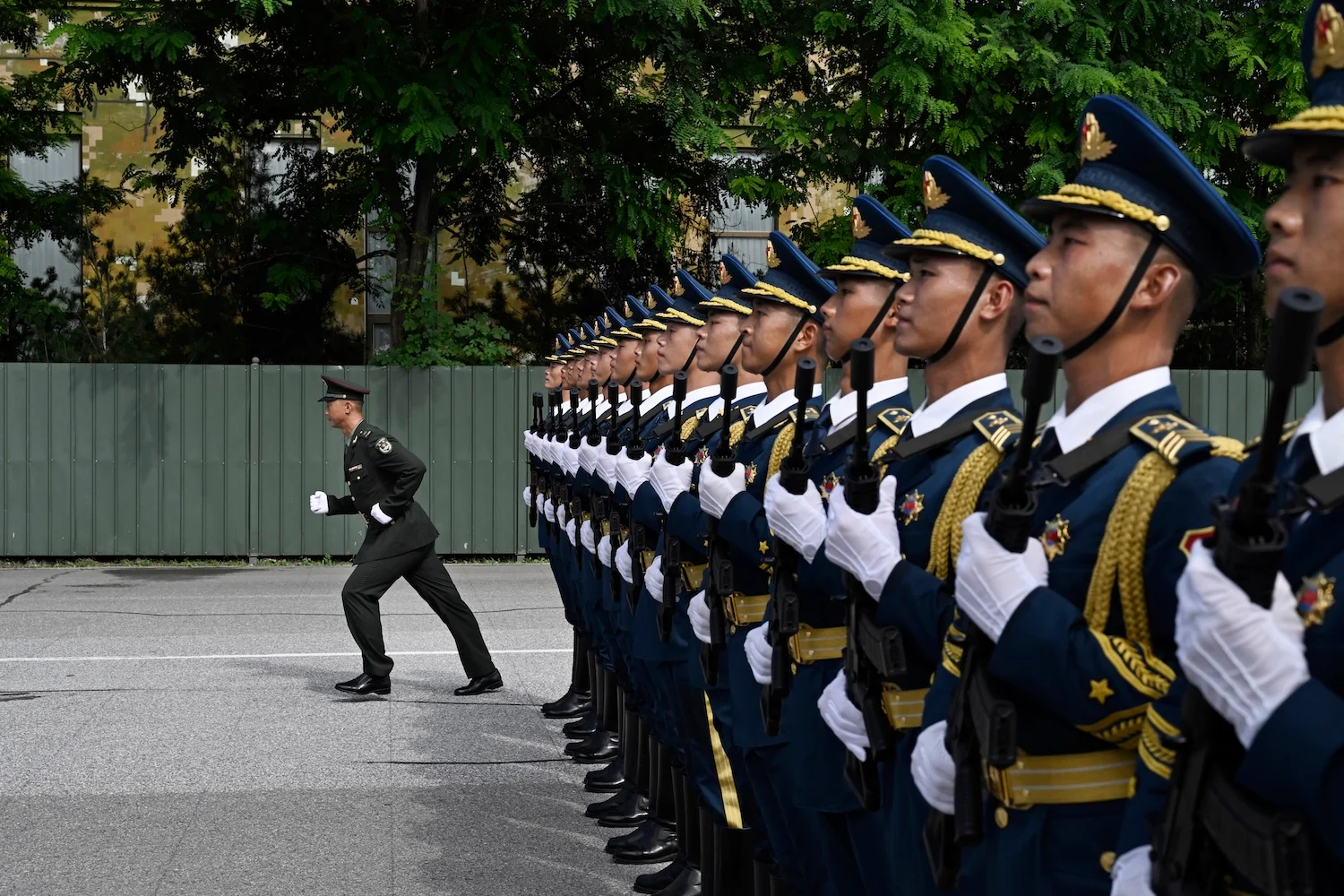
Last year, we explored what life is like for soldiers in the People’s Liberation Army. This week, in lieu of our usual news coverage, we’re turning our attention to the officer corps and what their jobs entail—especially in some of the Chinese military’s more unique roles.
Welcome to Foreign Policy’s China Brief.
Last year, we explored what life is like for soldiers in the People’s Liberation Army. This week, in lieu of our usual news coverage, we’re turning our attention to the officer corps and what their jobs entail—especially in some of the Chinese military’s more unique roles.
What Exactly Is a PLA Officer?
Chinese President Xi Jinping is married to a major general in the People’s Liberation Army (PLA)—sort of.
Xi’s second wife, Peng Liyuan, is a famous singer who joined the PLA’s entertainment corps in 1980, at the age of 18. She spent her career working within the military’s vast entertainment apparatus, which performs for troops as well as operating record labels, film studios, and other commercial media businesses.
Peng never commanded soldiers or wielded a weapon, yet when she was appointed head of the PLA Academy of Art in 2012, she was granted the formal military rank of major general—a title commonly given to entertainers who work for the military. Comedian Huang Hong, for instance, was also made a major general in 2012 after being hired to run the PLA’s August First Film Studio.
These examples are a reminder of just how sprawling the concept of an officer can be in the world’s largest military, where they perform an array of jobs that either don’t exist in Western militaries or are usually handled by civilian contractors.
China has spent decades trying to simplify the officer corps system and reduce the number of personnel with military ranks, but it is still a mess. (I won’t even get into China’s paramilitary forces.)
There are two significant distinctions within the PLA officer corps: the split between command and technical staff; and the division within the command track between regular commanders and political officers, which was formalized in 2021.
As in Western militaries, PLA command officers generally enter through universities or military academies, and those promoted from enlisted ranks are typically sent to military academies before advancing further.
Regular commanders are responsible for battlefield command and military readiness, as in the traditional Western view of a military officer. The latter is especially important, since the PLA hasn’t fought a war since 1979. Even though their roles are not explicitly political, commanders’ careers are shaped by politics; Chinese Communist Party (CCP) membership is effectively compulsory.
Political officers, sometimes called “commissars” in English, are the CCP’s eyes and ears inside the military. They monitor their regular counterparts for signs of disloyalty, run political-education programs, and watch for corruption. They are also responsible for more mundane tasks involving soldiers’ welfare, including living conditions, family visits, and career planning.
The split between command and political officers dates to the Soviet Red Army and was intended to reinforce communist control of the military. Mao Zedong famously asserted that “political power comes from the barrel of a gun,” and China’s early communist leaders understood that an army beyond the CCP’s control could threaten the party itself.
But this divide has never been as absolute in China as it was in the Soviet system. Early-career officers commonly move between the political and regular command tracks, though such transfers become less frequent once officers reach battalion-level command. As a result, there can be admirals—such as Miao Hua or Yuan Huazhi, both purged last year—who have never commanded a ship.
The professional-technical track, meanwhile, encompasses a remarkable variety of jobs, among them rocket engineers, military physicians, military judges, and publishers. In the West, some of these jobs have obvious military equivalents, while others would be held by civilians. (The staffers purged last week from the U.S. military newspaper Stars and Stripes would fall within the Chinese military’s professional-technical ranks.)
One example that causes foreign reporters confusion is China’s military academic system. The PLA maintains three prestigious institutions—the Academy of Military Science, the National Defense University, and the National University of Defense Technology—and numerous subordinate schools.
The universities are the rough equivalent of the United States’ Naval War College or National Defense University. In the United States, about half of the staff of these institutions are regular officers on temporary teaching assignments, while permanent faculty are usually civilian academics.
In China, by contrast, the faculty and staff of military academic institutions were all officers on paper, almost none of which had experience commanding troops, until reforms in 2017 and 2018. They had limited interaction with civilian academia and almost no contact with foreigners, leading to an unusual lack of academic standards.
None of this stopped Chinese media from interviewing these scholars and presenting them in uniform. Foreign outlets would commonly report the work of senior professors—called “colonels” or “generals”—as official PLA doctrine.
The professors at these institutions were temporarily reclassified as civilian staff in 2018 but appear to have returned to professional-technical status after the 2021 reforms that formalized the division with the officer corps.
Professional-technical officers have also been involved with the PLA’s business empire. During the Cultural Revolution, the PLA took over large portions of the Chinese economy, including agricultural and manufacturing enterprises. In 1998, Chinese President Jiang Zemin ordered the PLA’s businesses to be dismantled.
However, since they were such wonderful opportunities for personal enrichment, some military-linked businesses still persist, as does the use of PLA-controlled properties by private firms.
At least into the early 2010s, it was not unheard of for businesspeople to receive commissioned military rank to run PLA factories or manage military properties. One acquaintance of mine, for instance, ascended from civilian to colonel when he was put in charge of running a condom factory.
