


Companies can, in theory, appear to cut the carbon footprint of their supply chains in half simply by changing how they calculate emissions, according to a new paper. Researchers found that differences in accepted accounting methods can change how companies crunch their climate numbers and make it difficult to distinguish real emissions cuts from differences in calculations.
“It is actually possible … in the current framework that a company can either look like a climate pioneer or a climate laggard just depending on which numbers they pick,” lead author Ramana Gudipudi, a guest lecturer at the European School of Management and Technology in Germany, told Mongabay by phone. “If I am a company, all I need to do is to hire a good mathematician and say like, ‘Hey, this is how much I want to show my progress.’”
The analysis, published as a peer-reviewed perspective in the journal Nature Sustainability, looked at 401 European companies and found that 62.5% of their year-to-year variation in supply chain emissions could not be explained by changes to the business, industry, or emission intensity. By contrast, accounting for the companies’ direct emissions only varied by a bit more than 5%.
Gudipudi said companies often publicize a final number, without sharing how they arrived at that figure. The lack of transparency, paired with an array of possible baselines and calculations, means that real action on reducing emissions is obscured.
“We really don’t know whether there is any genuine decarbonization or not,” he said. “There are companies that are doing good. I am not saying that they are not. But at the moment, we don’t know.”
To demonstrate how inconsistent carbon reporting can be, the researchers ran an experiment using a hypothetical food and beverage company. They gave this company a fixed shopping list for the same amounts of chicken, milk, eggs, and wheat.
They then calculated the carbon footprint of that same shopping list using four different, but frequently used, scientific databases.
While database A reported a footprint of 1.7 million metric tons, database D reported 3.5 million metric tons — even though there were no material differences between the two supply chains.
In theory, a company could also use one database one year, and another the next. That would allow them to report a more than 50% reduction, and the public would have no idea the change came from the database used and not actual emissions released.
If accounting is not better controlled, real action can get drowned out by accounting noise, Gudipudi said.
To curb this ambiguity, the paper’s authors propose a new framework that sets universal rules so that every company within an industry measures its footprint the same way and applies a mathematical tool to determine whether emissions are dropping because of real-world action or just clever accounting.
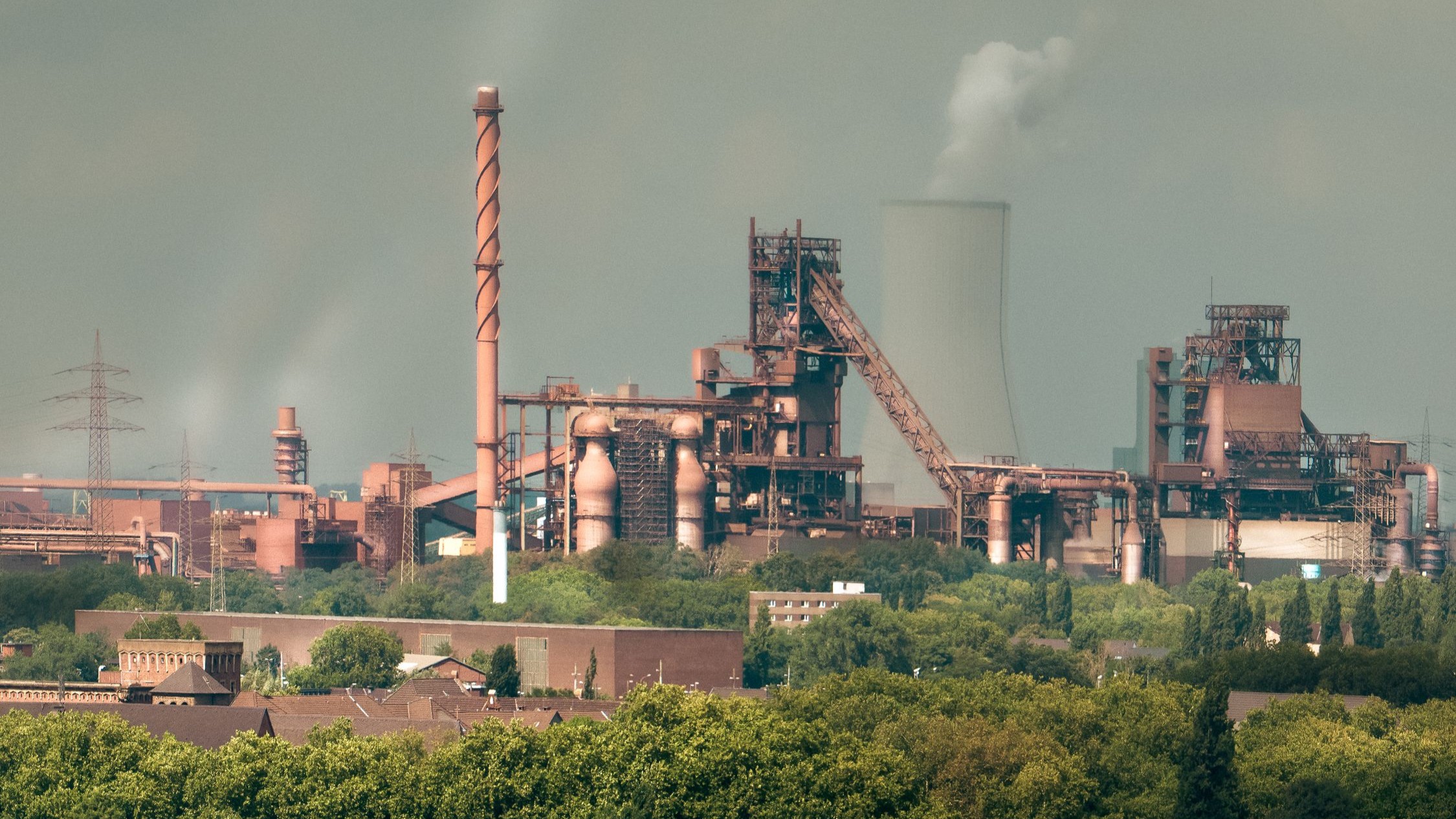
Banner image: Industrial complex surrounded by urban forest in Duisburg, Germany. Image courtesy of Jakub Żerdzicki via Pexels.
