


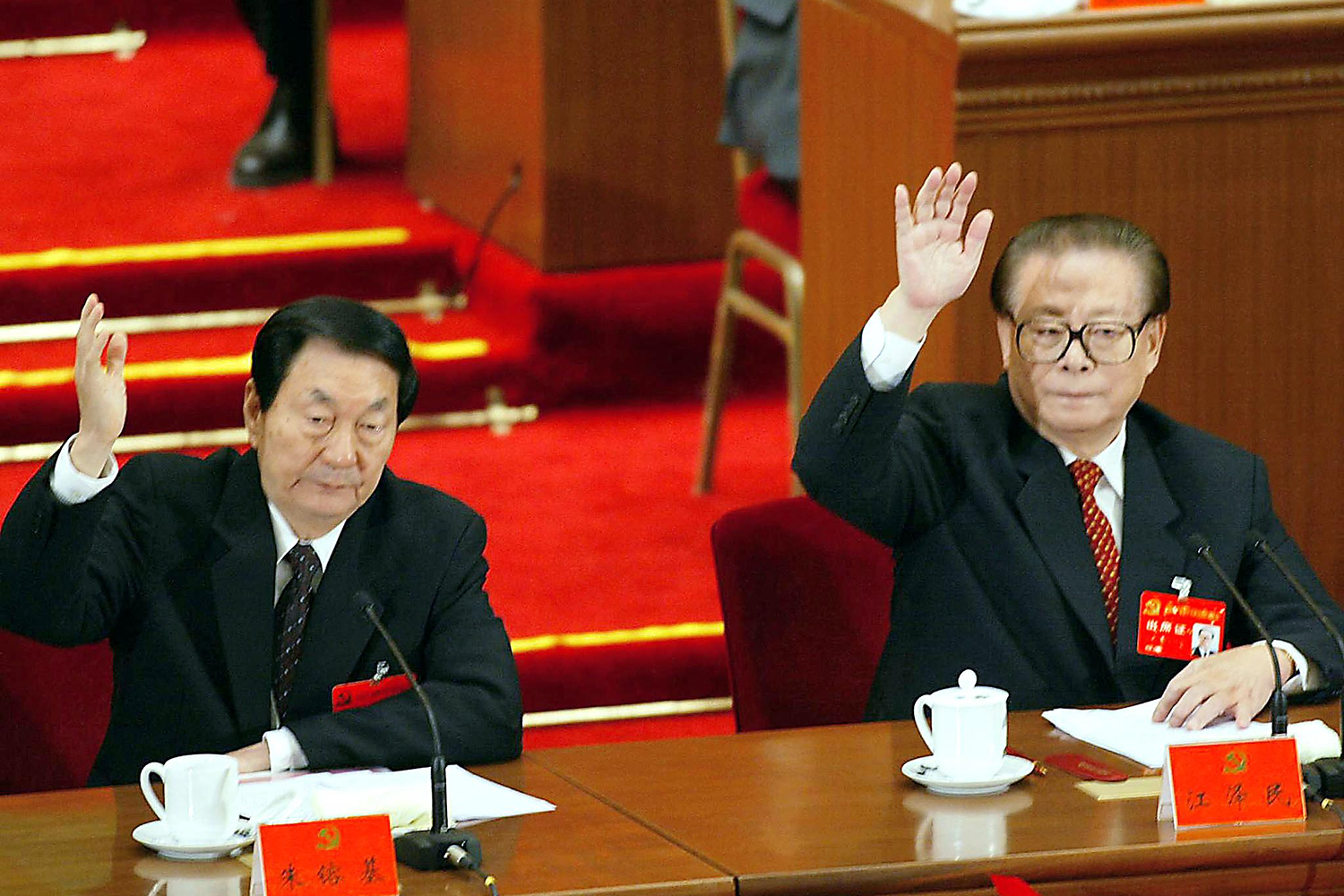
On Aug. 17, China will mark the 100th anniversary of the birth of Jiang Zemin, the former Chinese Communist Party (CCP) general secretary who died in 2022 at the age of 96. In his day, he was officially described as the “core” of the third generation of Chinese leadership. Beijing has already launched a series of high-profile commemorative events.
And now, Jiang’s partner in governance—Zhu Rongji—is gone as well, having died on Aug. 12 at the age of 97. The timing is only a coincidence, but it is being perceived as the definitive end to the era of breakneck reform that the two men came to represent.
Jiang and Zhu were the “golden partnership” of the CCP’s third-generation leadership, which took power in the 1990s. Together, they presided over one of the most sweeping periods of reform in modern Chinese history.
China’s reform did not begin with this pairing, however. Deng Xiaoping launched the reform era in 1979, and rural reform, special economic zones, price reform, and the emergence of the private economy all predated Jiang and Zhu’s work. But it was after Deng’s 1992 southern tour—and especially under Jiang and Zhu—that market-oriented reform moved from partial experimentation to the economic system as a whole, rapidly transforming China from a country still deeply shaped by the planned economy into one with the basic features of a market economy.
The official obituary for Zhu effectively lists the institutional legacies of that era: bringing inflation under control, advancing fiscal and tax reform, rebuilding the financial regulatory system, restructuring state-owned enterprises, reforming government institutions and the housing system, opening the economy further, responding to the Asian financial crisis, and joining the World Trade Organization (WTO). Today, these may look like a series of dry policies. In the context of the 1990s, however, they amounted to a massive restructuring of China’s economic order.
What made the Jiang-Zhu era so effective? To begin with, the extraordinary clarity of market-directed reform. At the time, there was little need to explain what direction reform was supposed to take. It meant less planning and more market, less administrative allocation and greater reliance on prices and competition. The CCP’s 14th National Congress formally established the goal of a “socialist market economy,” while the 15th National Congress further affirmed a system in which public ownership remained dominant but multiple forms of ownership developed together. Today, such formulations may seem unremarkable. But at the time, they signaled a fundamental change.
The Jiang-Zhu years did not eliminate all forms of discrimination based on ownership, and state-owned enterprises were still powerfully situated. But an increasing share of economic growth came from private businesses, foreign investment, and export manufacturing. If capital could create jobs, wealth, and tax revenue, whether it was “state” or “private” did not need to be as politically charged as it had been in the past.
China also actively embraced globalization, culminating in its WTO accession in 2001. The basic assumption was that if China wanted to develop, then it had to enter the world market; accept international rules; attract foreign capital, technology, and management expertise; and use external competition to force domestic reform.
Reformers also moved fast and were willing to tackle the hardest problems.Prices, enterprises, housing, employment, finance, taxation, and foreign trade were all difficult areas, yet reforms advanced simultaneously. Problems that had long been considered too difficult or too sensitive, such as the work unit system or the relationship with Western economies, were tackled head on. Rather than tinker at the margins, reformers directly altered the mechanisms by which the economy functioned.
Part of this was being willing to accept extraordinary social pain. The clearest example was state-owned enterprise (SOE) restructuring and the wave of layoffs that accompanied it. Tens of millions of SOE workers were either laid off or moved to the private sector, often losing benefits, while large numbers of loss-making enterprises were closed, merged, or reorganized. The basic logic of the era was that the creation of a new market system justified significant short-term—and even extremely severe—social costs.
“Efficiency first, with due consideration to fairness” was not merely a slogan. It represented an entire development logic: Allow some regions and some people to become rich first, tolerate widening disparities, use growth to generate more resources, and deal with distributional problems later. This produced rapid growth, but it also brought serious problems, including widening inequality, corruption, unemployment caused by restructuring, and a lack of proper social protections in pensions, health care, labor rights, and many other areas.
Perhaps the most critical element from the CCP’s perspective was that strong government was used to drive marketization rather than replace it. The state did not weaken its own capacity. Instead, it first strengthened central fiscal power, financial supervision, and macroeconomic management, and then it used that strengthened administrative capacity to push forward market reform. The 1994 tax-sharing reform, in which the central government captured a far larger share of revenue, is a classic example.
Politics certainly mattered under Jiang and Zhu, but the language of economic policymaking focused much more heavily on growth, efficiency, inflation, exchange rates, fiscal policy, finance, industrial structure, and international competitiveness. Zhu himself embodied the governing style of a generation of technocrats: faith in professional expertise, data, institutional design, and administrative execution. At the time, an official’s ability to solve economic problems carried considerable weight in political evaluation.
Economic reform advanced rapidly while political reform failed to keep pace. Markets expanded, society became more diverse, and individuals gained greater economic freedom, but the structure of political power did not change correspondingly. The Jiang-Zhu era thus produced a distinctive combination: an economy that became increasingly market-oriented alongside a political system that remained highly centralized.
Beijing today, of course, still talks about reform constantly. The CCP’s Third Plenum called for “further comprehensively deepening reform,” while the 15th Five-Year Plan and the 2026 government work report likewise emphasize a unified national market, the private economy, fiscal and financial reform, and further opening.
Reform in China today comes with a series of qualifiers that are, in practice, more important than reform itself: CCP leadership, high-quality development, common prosperity, technological self-reliance, supply-chain and industrial-chain security, the domestic circulation strategy, new quality productive forces, and coordinating development and security are all given priority. Political, security, and national strategic objectives are set first, and the market is then required to function within the boundaries set by those objectives.
In the Jiang-Zhu era, reform generally meant transferring things previously controlled by the government to the market, pushing a relatively closed Chinese economy further into the world and freeing individuals and enterprises from old institutional constraints. Reform today increasingly means the state reorganizing markets, guiding capital, allocating technological resources, building autonomous industrial systems, and ensuring that the economy remains dynamic and manageable.
Jiang and Zhu presided over an era that now seems almost unimaginable—an era in which the ruling party repeatedly retreated from old economic boundaries, allowed market and social forces to expand rapidly, and believed that as long as China continued to open up and reform, most of its developmental problems could eventually be solved.
That era produced enormous achievements but also enormous costs. It was not a golden age. Yet nostalgia sometimes depends less on how good a period was than on what came afterward.
