


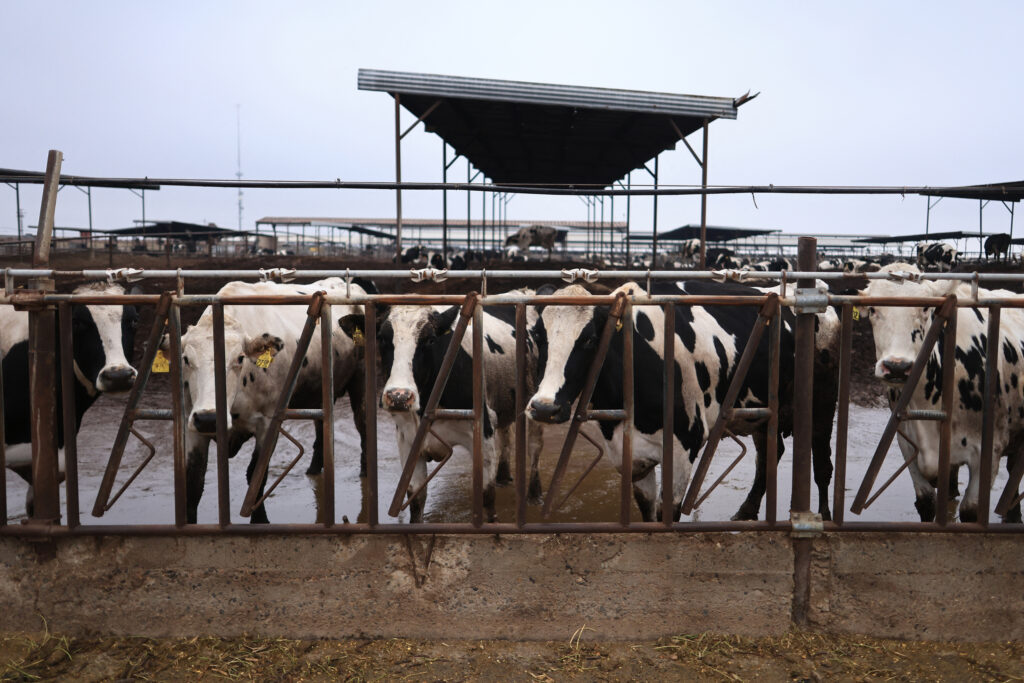
The California valley with the most dairy farms in the state will follow stricter water pollution requirements following years of advocacy and a marathon six-hour meeting this week.
The State Water Resources Control Board unanimously agreed to adopt the regulations under what several environmental groups call a long overdue dairy order.
Nitrogen from the manure dairies produce turns into excess nitrate in soil, waterways and groundwater, and can eventually contaminate drinking water.
Families and children in the Central Valley “are living in crisis,” said Leslie Martinez, of the Leadership Counsel for Justice and Accountability and Defensores del Valle Central para el Aire y Agua Límpio (Central Valley Defenders of Clean Air and Water), a group of San Joaquin Valley residents.
“Low-income rural communities of color rely heavily on shallow groundwater and face the greatest exposure,” Martinez said during Tuesday’s meeting in Sacramento.
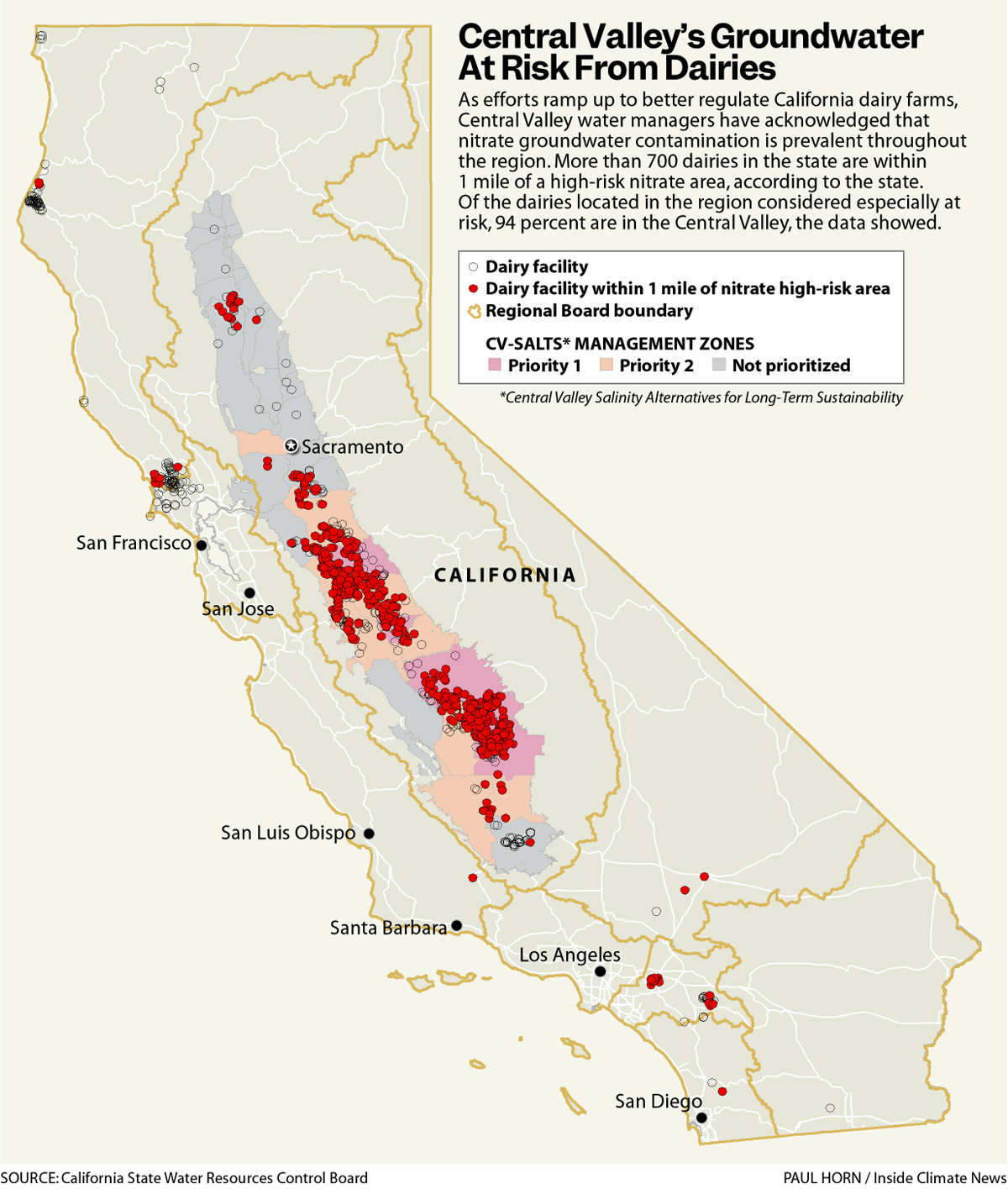
More than 700 dairies in the state—concentrated in the Central Valley—are within 1 mile of an area at high risk for nitrate groundwater contamination, according to state figures from last September.
A 2024 state tally estimated that more than 1.7 million cows generated over $8 billion worth of milk in California. But dairy farms here also pollute nearby waters.
In a 2017 study, the University of California, Davis, concluded that agricultural lands, including those with dairy operations, “are the largest contributor of nitrate to groundwater in the Central Valley.”
The 131-page order that was adopted Tuesday was released at the start of September as a draft and detailed the new requirements limiting water pollution from dairies. In the order, officials acknowledged the “outsized contribution” of dairies to nitrate pollution in the valley.
Environmental groups, while not satisfied with every aspect of the regulations, were happy to see them approved. Some advocates have fought since the early 2000s to increase oversight and management of water pollution from dairy facilities.
In an October 2024 first draft of the new regulations, water board officials proposed requiring that Central Valley dairies comply with a nitrate drinking water standard of 10 milligrams per liter and meet new rules for storing waste, applying manure to fields of crops and providing alternative drinking water to residents when nitrate levels in their water supplies are unsafe. Those requirements held in the newly approved order.
Still, during Tuesday’s meeting, even supporters of the new requirements worried about public participation and whether Spanish-first speakers had been given ample opportunity to comment on the rules being outlined.
The new dairy draft order was released online to the public Sept. 4 and feedback on the latest version was only gathered in-person or via video during the meeting Tuesday. No written comments were accepted.
Environmental groups were also uneasy about whether tribal communities got an appropriate chance to weigh in.
Dairy industry representatives in Sacramento were wary about the new regulations and what impacts they may have going forward.
Michael Boccadoro, executive director of the industry group Dairy Cares, worried the order was “inconsistent” with the Central Valley Salinity Alternatives for Long-Term Sustainability, a collaboration that has worked for 20 years to tackle nitrate and salt accumulation affecting water supplies in the region.
Kevin Abernathy, general manager of the Milk Producers Council, another industry group, believes the new rules will leave smaller dairy farms vulnerable to takeovers by bigger operations.
“This has the potential to further consolidate the dairy industry into the Costco and Walmart world that we all live,” said Abernathy, noting he was concerned about small- and medium-sized family dairies. “Mark my words, what you guys do here today will further consolidate the industry.”
He added, “Ag and dairy has always done our part to protect the environment for all of us and be good stewards of all of our land.”
A Long List of Health Risks
The Central Valley water board oversees dairy farms under a 2013 waste discharge rule. Current state estimates list between 900 and 1,000 regulated dairies in California.
Existing regulations of dairy farms were adopted at the urging of the Environmental Law Foundation and the Asociación de Gente Unida por el Agua, known as AGUA, which sued the regional board claiming its 2007 dairy regulations were inadequate.
A Sacramento court of appeals ruled in 2012 that the board was out of compliance with California’s law to protect clean water.
Under the state Safe Drinking Water Act, the maximum contaminant level for nitrate is 10 milligrams per liter, said Peter Thorne, an environmental health professor at the University of Iowa.
“There’s evidence that if you’re consuming water in the range of, say, 5 to 10 milligrams per liter there’s still an elevated risk of cancer that has been documented in a number of different studies,” Thorne said. “Especially for gastrointestinal cancers, stomach cancer and colorectal cancer.”
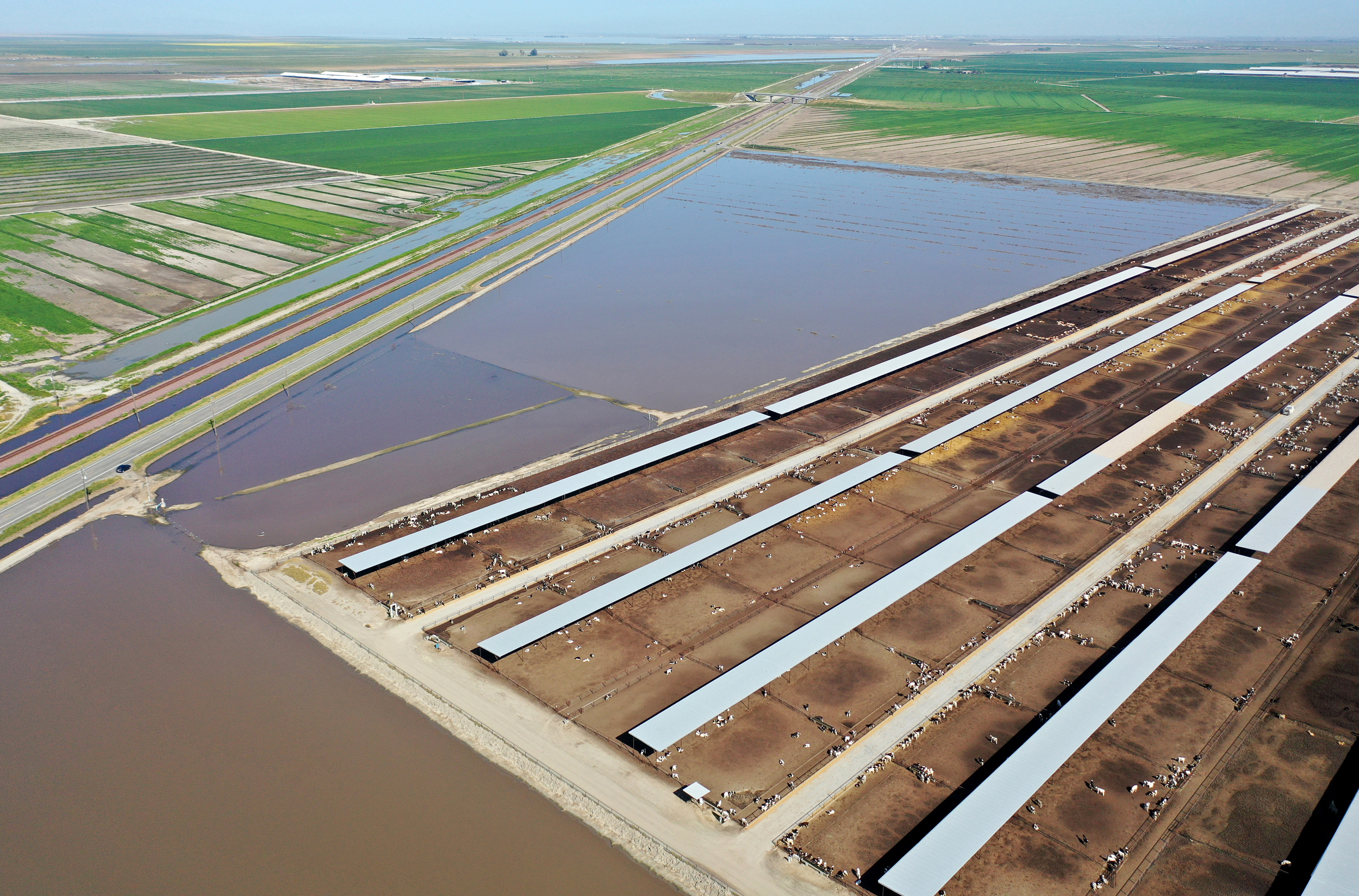
Earlier this year, Stanford University researchers released a white paper outlining frequently underreported levels of wastewater and manure from large dairy facilities in the Central Valley.
The researchers highlighted failures by dairy owners to document where waste goes and by the regulators to properly enforce reporting requirements.
Drinking water contaminated by nitrates “can interfere with red blood cells’ ability to carry oxygen throughout the body,” the Stanford experts noted.
Infants are acutely susceptible to low oxygen levels, including from nitrate impacts to water, which can lead to the potentially fatal “blue baby syndrome.”
Some counties in the Central Valley have seen 40 percent of drinking wells with nitrate levels above the safe limit established by the U.S. Environmental Protection Agency, posing health risks such as miscarriages and infant mortality.
When the Central Valley water board in 2013 revised its rule after the 2007 lawsuit, AGUA and the Environmental Law Foundation petitioned for a review from the state water board, which found over 10 years later that certain parts of the rule were still out of line with California policies.
The state board’s resulting 2024 draft order directed the Central Valley water board to develop revised dairy waste discharge requirements in line with recent findings, including a 2019 report from a group run by dairy operators, which led to what the state board called a “fundamental shift” in its understanding of where groundwater pollution from dairies was coming from.
Leaking waste retention pools were once assumed to be the largest source of nitrogen from dairies in aquifers. But the report found 94 percent of that pollution actually came from spreading dairy waste across crop lands as fertilizer, leading the board to focus on stricter requirements for how manure is applied on land.
The board’s goal is for dairies to stop contributing to nitrate contamination in 10 years, and reach a balance in which all nitrogen produced at a dairy is taken up by crops, exported or treated.
In the two years since the draft order was released, dairy industry groups, families and California environmental justice organizations have weighed in on the regulations.
At Tuesday’s meeting, over two dozen speakers voiced concerns over nitrates and what the new order included.
“It’s critical that residents impacted by dairies and nitrate contamination are supported with both interim and long-term solutions,” said Kjia Rivers, the senior policy advocate for the nonprofit Community Water Center.
Rivers implored the board to revise the order to require that dairies fund more opportunities for households to test domestic wells when nitrate levels are at or above 7.5 milligrams per liter. The board agreed to change the order after the suggestion.
This story is funded by readers like you.
Our nonprofit newsroom provides award-winning climate coverage free of charge and advertising. We rely on donations from readers like you to keep going. Please donate now to support our work.
Dairy industry stakeholders want California to relax the proposal that dairies retrofit their waste retention ponds within three years if they have less than five feet of separation between the pond and the water table.
Retrofitting the ponds carries a large cost, potentially undermining more impactful actions “such as projects to export surplus manure, implement denitrification systems, or improve crop nutrient uptake via improved irrigation systems,” a coalition of dairy groups wrote in an earlier comment to the board.
A Long Time Coming
Now that the State Water Resources Control Board has adopted the order, the Central Valley water board is required to finalize its mandates and adopt revised waste discharge requirements.
The Central Valley water board will have three years to establish the waste discharge requirements and five years to adopt the revised rules.
Environmental groups had called for a shorter timeline, and in a December 2024 letter asked the board to take no more than one year to finalize its groundwater nitrate loading limits.
An industry coalition that includes Dairy Cares and the California Farm Bureau wanted the Central Valley board, not the state, to create the revised rule’s final land application rate formulas, groundwater loading limits and interim performance standards.
The coalition also wanted to see the standards helmed by the Central Valley Dairy Representative Monitoring Program, a dairy operators’ nonprofit, as part of a process that “allows for an iterative, adaptive approach.”
Sean Maguire, a board member on the State Water Resources Control Board, said Tuesday he hoped the new order “sets up future success for advancing water quality protections at dairies, but also the success of the dairy industry as a whole.”
“This is a big deal,” he said as the meeting ended.
On Wednesday, in a summary of the requirements, the state water board said the dairy order will:
- Tighten limits on existing dairies’ application of manure to croplands according to a schedule “that is as short as possible,” no more than 35 years
- Require stricter nitrogen monitoring and ensure that dairy manure retention ponds are not leaking at rates that affect groundwater
- Require the Central Valley water board and the state water board’s Division of Water Quality report implementation milestones every six months
Nathaniel Kane, executive director at the Environmental Law Foundation, had wanted limits on manure application to croplands to be required on a shorter timeline and regulation of pond seepage to be more stringent.
Nonetheless, he supports the new requirements. It’s crucial that new oversight be implemented effectively, he said—especially in light of the past two decades.
“That’s 20 years of pollution, of water quality that is much worse than it could have been, had there been a permit in place,” Kane said, referring to waste discharge requirements known colloquially as permits.
“We supported [this] decision,” Kane said of new dairy requirements. “It has been so long.”
About This Story
Perhaps you noticed: This story, like all the news we publish, is free to read. That’s because Inside Climate News is a 501c3 nonprofit organization. We do not charge a subscription fee, lock our news behind a paywall, or clutter our website with ads. We make our news on climate and the environment freely available to you and anyone who wants it.
That’s not all. We also share our news for free with scores of other media organizations around the country. Many of them can’t afford to do environmental journalism of their own. We’ve built bureaus from coast to coast to report local stories, collaborate with local newsrooms and co-publish articles so that this vital work is shared as widely as possible.
Two of us launched ICN in 2007. Six years later we earned a Pulitzer Prize for National Reporting, and now we run the oldest and largest dedicated climate newsroom in the nation. We tell the story in all its complexity. We hold polluters accountable. We expose environmental injustice. We debunk misinformation. We scrutinize solutions and inspire action.
Donations from readers like you fund every aspect of what we do. If you don’t already, will you support our ongoing work, our reporting on the biggest crisis facing our planet, and help us reach even more readers in more places?
Please take a moment to make a tax-deductible donation. Every one of them makes a difference.
Thank you,

Reporter, California
Steven Rodas covers water, wildfires and agriculture throughout California for Inside Climate News. Based in Los Angeles, he previously reported on the environment in New Jersey, covering energy, pollution, wildlife and development. Steven’s work has appeared in the San Francisco Chronicle, NJ.com/The Star Ledger and Grist. He worked as a copywriter at Google. Steven has a master’s degree from Syracuse University’s S.I. Newhouse School Of Public Communications. He is fluent in English and Spanish (and welcomes your tips).
