


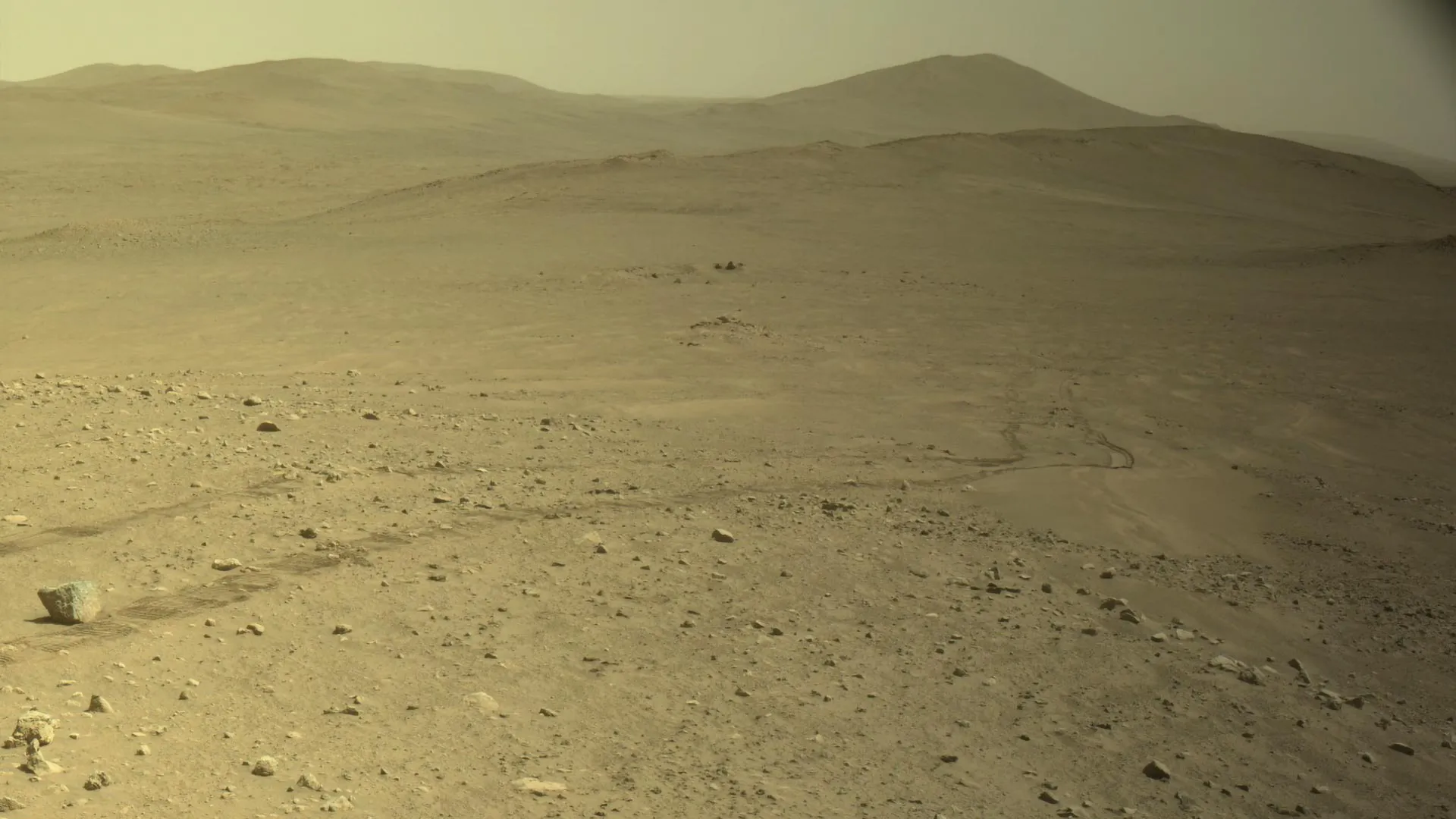
NASA’s Perseverance rover has reached an impressive new milestone, traveling farther across another world than any vehicle before it. On Sol 2006 (Oct. 11, 2026), the rover’s total driving distance reached 45.22 kilometers (28.10 miles), establishing a new record for travel on another celestial body. The achievement was even recognized by Guinness World Records, which presented a commemorative plaque to Perseverance’s engineering twin on Earth.
The rover had actually come close to breaking the record about two months earlier. On Sol 1947, Perseverance was just 200 meters short of the milestone, a distance it could have covered in a single trip using its Autonomous Navigation (AutoNav) system.
But reaching the record was not the team’s immediate priority. Perseverance was exploring an area filled with scientifically valuable ancient rock formations, so it spent weeks making short trips between locations to examine exposed rock surfaces. These investigations included grinding away thin layers of rock and conducting detailed measurements up close. Once the scientific work was complete, the rover resumed its journey and soon surpassed the previous distance record.
“Two months ago, (Perseverance) sat about 200 meters away from the milestone, a distance easily achievable with a single drive… However, the rover found itself in a very scientifically interesting area and spent time (investigating) ancient rock outcrops. When Perseverance was finally ready to move on to a new site, it sailed past the record.”
How NASA Improved Perseverance’s Driving Capabilities
Covering more than 28 miles on Mars has required Perseverance to overcome difficult terrain while testing new approaches to robotic driving. Its journeys through tightly packed boulder fields and across steep hillsides have given NASA engineers valuable experience, helping them improve the rover’s ability to navigate hazardous landscapes.
To expand what Perseverance can safely handle, engineers conducted thousands of computer simulations and adjusted several operating limits. The rover can now tolerate tilts of up to 24 degrees, while the minimum clearance beneath its protective belly pan has been reduced to 20 centimeters (about 7.9 inches).
The team also introduced several important improvements to the driving system. Updated braking software helps the rover avoid collisions with rocks, and the electrical current limits for its steering motors have been nearly doubled. Engineers also added “dynamic slip tables” to its flight software, allowing the rover to better anticipate how much its wheels might slip on different surfaces.
Another technique involves driving across slopes in ways that help keep the wheels securely positioned on exposed bedrock. Together, these changes allow Perseverance to handle challenging terrain more effectively as it continues exploring Mars.
A Mars Rover That Can Navigate Without GPS
Among the rover’s most significant technological advances is a system called onboard Global Localization (GBLC). This technology gives Perseverance a way to determine its position on Mars without relying on directions from Earth.
The system uses a powerful commercial processor originally installed in the Ingenuity Helicopter Base Station. By comparing images captured from the Martian surface with pictures taken from orbit, it can calculate the rover’s location in global coordinates after completing a drive (as though we had GPS on a world without it).
Knowing its position independently is a major advantage. It allows Perseverance to cover greater distances without needing people on Earth to repeatedly determine its location, potentially making future exploration faster and more efficient.
However, this approach introduced an engineering challenge. Unlike the rover’s main flight computer, the additional processor was not specifically designed to withstand the intense radiation conditions on Mars. The planet has a thin atmosphere and no global magnetic field, leaving electronics exposed to radiation that can interfere with their operation.
In particular, radiation can cause “transient bit flips” that unexpectedly change information stored in computer memory, potentially disrupting software. To address this problem, engineers developed software protections that help the processor operate reliably despite the harsh environment.
The Next Frontier in Autonomous Mars Exploration
NASA is also investigating how generative AI could make the rover even more independent. As missions involve longer journeys and increasingly complex operations, the team wants to reduce the time and resources needed to plan safe routes.
The technology could help generate driving plans for the many individual segments of a longer journey, providing guidance that Perseverance’s AutoNav system can use to navigate the terrain.
After traveling 45 kilometers (more than 28 miles), Perseverance has already provided engineers with extensive experience in navigating the Martian landscape. Those lessons are now shaping new technologies that could transform how robotic explorers operate on distant worlds.
And the journey is far from over. As Perseverance continues climbing higher along the rim of its Martian crater, NASA is preparing for the next major advances in autonomous exploration.
