


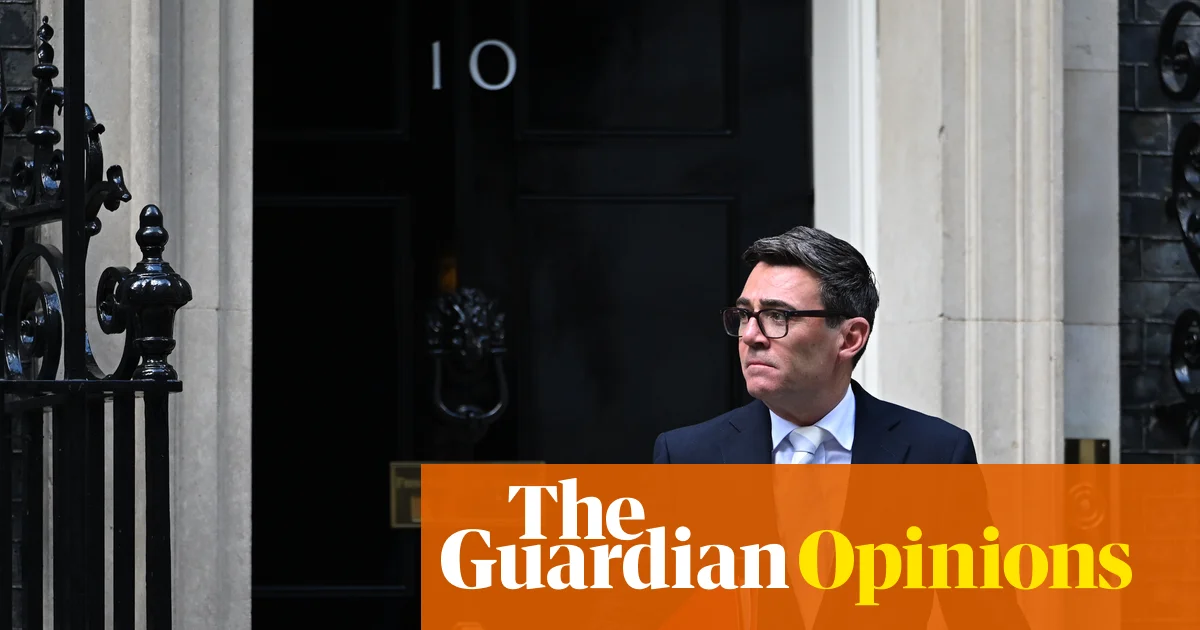
Nothing stays fresh for long in parliament and no one sounds normal. The air, thick with convention, suffocates originality, tuning every voice to the same Westminster pitch. The need to escape that climate is one reason why Andy Burnham quit his Commons seat to run for mayor of Greater Manchester. Or that is how he tells the story.
Returning after nearly a decade away, the prime minister says he wants to throw open the windows, let in some air. He thinks devolution can cultivate a healthier political culture. He intends to rebalance England’s centre of gravity with a power base in the new No 10 North.
The timing of Burnham’s arrival in Downing Street, just before the summer recess, suited those arguments. He replaced Keir Starmer, then promptly went on tour, posting chatty videos on social media, appearing as the antidote to a stuffy predecessor who, perhaps unfairly, had come to be seen as the archetypal Westminster mechanoid. Starmer, who today announced his intention to stand down as an MP, may find his authentic voice on the outside.
Meanwhile, Burnham has to bring his free-range prime minister act into the battery farm of the Commons. His mandate and legislative programme are inherited from the Starmer era. He is stuck with the same squeezed budgets in the same sluggish economy imperilled by the same turbulent global climate. His room for fiscal manoeuvre is constrained by Labour’s 2024 manifesto prohibition on broad-based tax rises and by the bond market’s punitive vigilance towards anything that looks like undisciplined spending.
In such conditions, politics is reduced to a zero-sum competition for scarce resources. Every promise made to satisfy the needs of one department or constituency contains an undeclared threat to deprive someone else.
Starmer’s leadership was ruined by many things, but few were as crippling as his failure to grapple with those dilemmas. He wouldn’t pick sides between irreconcilable demands within his cabinet. When his own ministers couldn’t read his political instincts or decrypt his priorities, the public had no chance. It was a recipe for paralysis, delivering a congealed gruel of continuity to voters who thought they had ordered piping hot change.
Determination not to repeat that mistake has shaped Burnham’s approach from his first moments in office. He declared a moral mission – the elimination of rough sleeping – before even crossing the threshold of No 10. He followed it up with emblematic policies to demonstrate that regime change brought a new focus on the cost of living.
No one in Downing Street pretends that capping bus fares or cutting VAT on fuel bills is enough to win affection from a sceptical public. The function of modest retail policies is to show that Labour, renewed by fresh leadership, has snapped out of despondency and started listening. A bounce in opinion polls suggests it is working.
But the transition from small-change symbols to big-ticket policy choices is not easy.
It is especially hard if the prime minister is conflict averse and prone to flights of empathic urgency. That is the hazard flagged by Burnham’s critics, based on observation of his career as a minister in the New Labour government and later as Manchester mayor. They are traits that generate spontaneous promises that later have to be diluted or retracted.
In June, Burnham got himself into just such a tangle over a commitment to compensate “Waspi women” who feel they were mistreated by the Department for Work and Pensions when their retirement age was raised. In May, he told a campaigner for party finance reform that he supported the principle of a cap on donations to guard against big money exerting undue influence in politics. A cap has been proposed as an amendment to the representation of the people bill, currently on its way through parliament. But the government, following trade union lobbying, is not backing the move.
The learning curve for any new prime minister is brutally steep.
Things that seem obvious from outside No 10 are revealed to be fearsomely complex. What seems compelling on the campaign trail can feel like a ruinous drain on time and political capital in government. The road is especially hard to navigate for those who arrive midterm, scrambling over unfinished and unpopular business bequeathed by an ousted predecessor.
The retreat from plans to free up prison capacity by releasing offenders early is a revealing case. Burnham understandably doesn’t want his first months in office marred by a parade of stories about villains walking free. But swerving unfriendly headlines isn’t a plan for reforming the justice system or growing its shrivelled budget.
Likewise, the prime minister’s appearance in Kyiv to celebrate Ukraine’s independence day, while important as a display of solidarity with Volodymyr Zelenskyy, came with no account of the sacrifices Britain faces as the price of ramping up its own defences against Russian aggression.
No one is better briefed on that challenge than the chancellor. As defence secretary, John Healey resigned from Starmer’s government in protest at the former prime minister’s reluctance to boost military spending. Relocated to the Treasury, he finds himself managing a downgrade in rearmament expectations ahead of the autumn budget.
The seasonal migration of politics back to parliament threatens a sudden narrowing of Burnham’s options. The prime minister has a theory to counter that threat. His argument is that devolution, as well as bringing fresh air to politics, spurs economic growth.
after newsletter promotion
Loosening the dead hand of Whitehall control over public services is supposed to promote innovation and efficiency. A more responsive government, attuned to local market conditions, will unlock investment.
Assuming that can work, the mechanism is slow. Burnham accepts that it is a 10-year plan. The opposition calculates that the fiscal walls will close in on Labour a lot faster than that.
Kemi Badenoch thinks the economy is the issue that will rehabilitate Tory fortunes. To sharpen her attack on that front, she has sacked her shadow chancellor, Mel Stride, for insufficient pugnacity with the Treasury brief. His replacement, Andrew Griffith, is deemed more dynamic, a quality he once displayed in cheerleading for Liz Truss’s disastrous 2022 “mini-budget”.
In Badenoch’s view, Burnham is a “people-pleaser” who lacks the resolve to whip his MPs behind tough budget choices. He will rely on tax rises to pay for policies that the left see as essential maintenance to the social safety net and the right decry as profligate subsidy for fecklessness. The impossibility of feeding Labour’s big-government appetite with hands shackled by the 2024 manifesto will force the prime minister to seek his own mandate with an early election.
It is a plausible scenario. It is also unclear how the Tories get match fit on that timetable when they are running third in national polls. Badenoch’s personal ratings aren’t so bad, but she lacks insight into the reasons why so many voters think her party is unfit to govern. Discounting Griffith’s contamination by the Truss project when appointing a shadow chancellor is a symptom of that blind spot.
The Tories are flattered into feeling relevant by a sympathetic press and the constitutional crutch of official opposition status. In parliamentary arithmetic, the Conservatives still eclipse Reform UK.
Badenoch welcomes the enclosure of politics in the Commons chamber as much as the Labour leader resists it. The theatre of ritual combat is more her style than his. But the prime minister’s judgment is better in thinking voters are turned off by the whole spectacle. Burnham’s fresh manner has breathed life into a government that was expiring. It will take a different order of political skill to dispel the older miasma of cumulative failure that hangs heavy over Westminster.
Do you have an opinion on the issues raised in this article? If you would like to submit a response of up to 300 words by email to be considered for publication in our letters section, please click here.
