


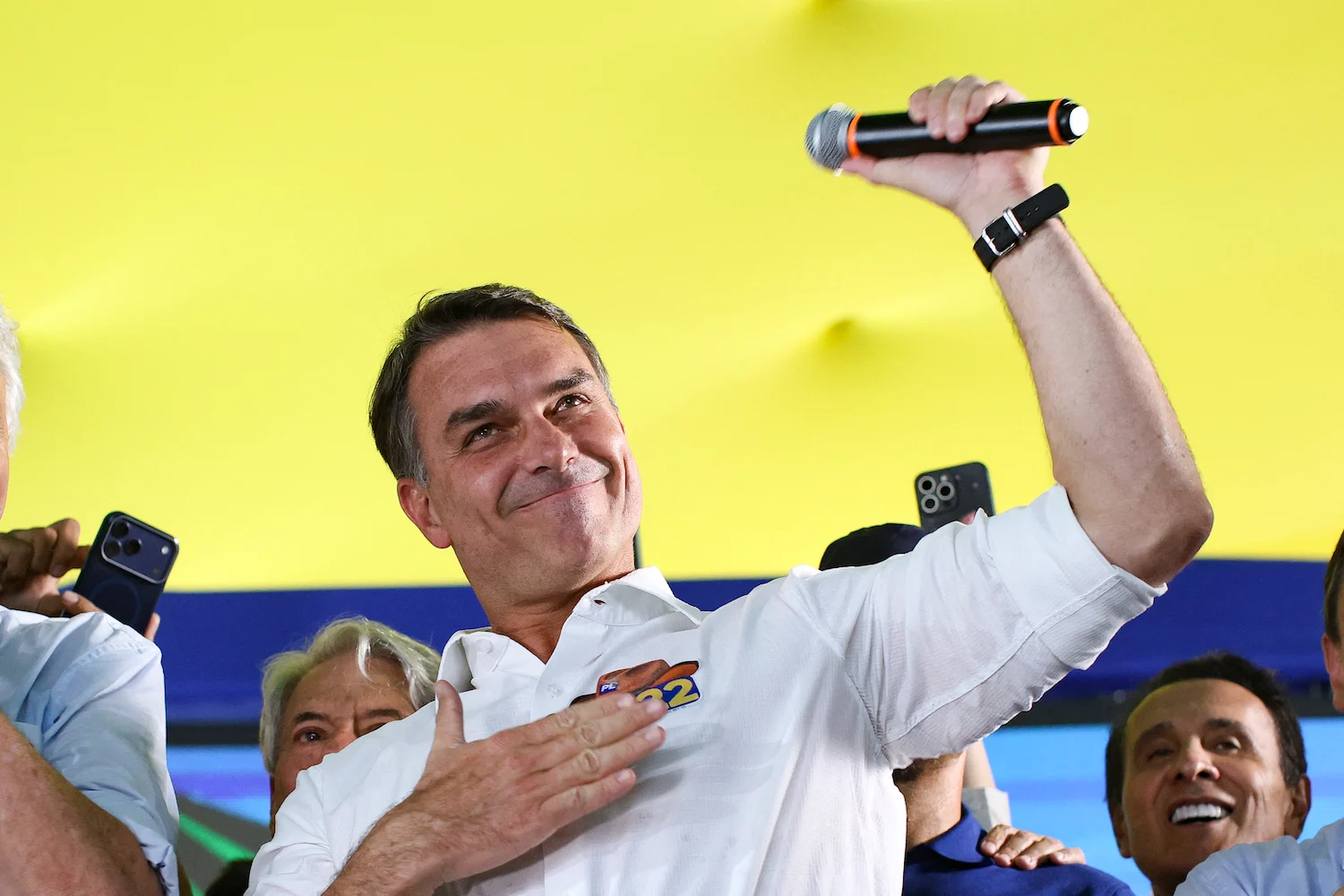
Welcome back to Foreign Policy’s Latin America Brief.
The highlights this week: Brazil’s far right sweeps general elections, the Organization of American States ups the pressure on Nicaragua, and K-pop group BTS lands in South America.
Brazil’s general elections last Sunday unleashed a right-wing wave at the polls. Though most surveys projected President Luiz Inácio Lula da Silva narrowly leading in the first-round presidential race, right-wing Sen. Flávio Bolsonaro instead beat Lula by around 2 percentage points.
Bolsonaro and Lula are now headed to an Oct. 25 runoff, after knocking out 10 other candidates. Analysis by Felipe Nunes of pollster Quaest suggests that many Brazilians who initially intended to support less prominent right-wing candidates voted for Bolsonaro on Sunday, hoping to propel him to a first-round victory.
They almost succeeded: At one point early on Sunday night, it looked possible that Bolsonaro could win outright by earning at least 50 percent of valid votes.
By the time all votes were counted, Bolsonaro had earned 47.03 percent to Lula’s 45.16 percent. Bolsonaro’s Liberal Party won the most governorships in elections that were settled on Sunday—rather than also proceeding to a runoff—and grew its numbers in both houses of congress, maintaining its status as the largest party in each.
Though it is numerically possible for Lula to win the runoff, history stands against him. No presidential candidate since Brazil’s redemocratization in the 1980s has won a runoff election after losing in the first round. What’s more, the candidates who placed third, fourth, and fifth on Sunday were all right-wing, and many of their supporters will now likely back Bolsonaro.
Sunday’s results show that bolsonarismo is a movement “that has put down deep roots in Brazilian society,” Brazilian journalist Bernardo Mello Franco told the Guardian. The Liberal Party booted several center-right lawmakers out of office Sunday, furthering its takeover of the Brazilian right.
Offering another hypothesis for the results, Lula himself said on Wednesday that his campaign “was the least organized I’ve participated in since 1989 and we reaped what we sowed.”
As the Lula camp soul-searched, they reached at least one consensus: Their messaging needed a reboot, both in style and in substance. Campaign leaders quickly summoned Millennial and Generation Z congresswomen-elect with large social media followings to Brasília to teach them how to make better selfie videos.
Ahead of first-round voting, Lula’s campaign leaned on his history as an organizer in the 1970s and 1980s, but he debuted a more future-oriented slogan on Wednesday: “For working people, protection; for criminals, jail.” This new, tough-on-crime motto is an implicit acknowledgement that the right has dominated messaging around insecurity, even as Lula’s government has made some progress on the issue.
Nevertheless, Sunday’s results reveal deep voter rejection of Lula, even among groups that he purports to favor in his policies. Demographic data shows he performed worse on Sunday among lower-middle-class Brazilians than among the richest. (He won among the poorest.)
Brazil’s lower middle class includes many people who live on the outskirts of big cities, who are evangelical, and who work gig jobs such as driving for Uber and making motorcycle deliveries. In 2024, Felipe Krause wrote in Foreign Policy that Lula did not understand this growing lower middle class, even though he helped create it with anti-poverty policies during his previous tenure as president.
Krause pointed to the fact that in 2024, Lula was pushing a law to regulate gig work that some gig workers opposed because they feared it would decrease their income.
“The problem is that [Lula’s Workers’ Party]—and its associated unions—are unable to see these workers as anything other than exploited labor, even though they prize their autonomy,” Krause wrote, arguing that the lower middle class was looking for less red tape, more protection from violence, and respect for their religious beliefs.
Now, Lula has thrown his energy behind legislative efforts to outlaw standard work contracts that allow six-day workweeks. It’s a policy that some 70 percent of Brazilians support—but it doesn’t cover gig workers.
Bolsonaro, meanwhile, has continued to base his messaging around broad ideas of being pro-change, pro-business, and pro-security. His lack of details hasn’t turned off voters—so far. But both candidates will be under a closer microscope as the runoff approaches.
Monday, Oct. 12: The United Nations Security Council discusses Colombia.
Monday, Oct. 19: The Security Council discusses Haiti.
Sunday, Oct. 25: Brazilians vote in runoff presidential and gubernatorial elections.
Panama’s mining politics. In Panama, a giant copper mine that was shuttered after nationwide protests in 2023 moved closer to reopening last week after a government panel recommended conditions for doing so—with a catch. The panel called for a “reopen to close” plan that includes the phaseout of the plant’s activities with environmental monitoring.
Such a phaseout could reasonably take 25 years, analysts familiar with the panel’s report said. Environmental groups responded with skepticism to the plan but did not immediately stage protests, suggesting that it could be a viable way for Panama to reactivate a commercial asset that accounted for around 1.5 percent of global copper production prior to its closure.
The phaseout plan is designed for Panama’s government to recoup some of the lost revenue from the mine’s abrupt closure. It could put the country back on the global map of critical minerals suppliers. Although the government has studied how it might replace its mining revenue in the future, its energy transition plans are vague.
Chileans disapprove of Kast. Chile joined U.S. President Donald Trump’s Shield of the Americas militaristic, anti-crime initiative in September. Far-right President José Antonio Kast, who took office in March, made the decision—but polls show that many Chileans don’t agree with it. A survey conducted last week found that among Chileans familiar with the measure, 47 percent reject it, while 31 percent support it.
The numbers come amid high overall discontent with Kast. Only seven months into his term, he has a 60 percent disapproval rate, according to the same poll. High fuel prices triggered by the Iran war have worsened the pain of his cuts to public spending for households.
Amid the dissatisfaction with Kast, former left-wing Presidents Gabriel Boric and Michelle Bachelet are trying to reassert themselves in Chile’s political arena. They released a joint declaration last month criticizing Kast’s decision to join Shield of the Americas, saying that it was in Chile’s best interests not to pick a side in great-power competition.
Though Bachelet withdrew from the U.N. secretary-general race a few weeks ago, her latest moves suggest she is not bowing out of politics.
Fans of the K-pop group BTS pose for a photo ahead of a concert in Bogotá on Oct. 2. Andrea Ariza/AFP via Getty Images
BTS in Bogotá. A global cultural phenomenon has landed in South America. K-pop band BTS is visiting the region, and their itinerary is extensive. Their tour underscores the rise of Korean music in a neighborhood that has traditionally looked to the United States or Europe for its overseas cultural references.
The current BTS tour is visiting more Latin American countries and cities than Taylor Swift’s 2023-24 Eras Tour, one of the largest global concert runs in history. After a handful of shows in Mexico City in May, BTS landed back in the region last week, playing in Bogotá’s largest soccer stadium.
The concert in Colombia is part of a 14-show run that also takes BTS to Peru, Chile, Argentina, and Brazil—some of the countries that most streamed the band’s new album and most watched BTS-related videos on YouTube after its release in March, Yonhap reported.
Latin American fans are also remixing K-pop culture to intertwine with their own musical and political habits. In Peru, artist Lenin Tamayo—who sings in the Indigenous Quechua language—has created crossover songs in a genre that he dubs “Q-pop.”
K-pop fans have encouraged one another to attend political demonstrations in multiple Latin American countries in recent years; they called for participation in Brazil’s 2024 municipal elections, for example. It should come as no surprise that struggling Lula supporters have embraced the help of “K-pop warriors” to campaign for him online in recent days.
BTS played its first South American concert in Bogotá’s El Campín Stadium. That’s the home of which soccer club?
Atlético Nacional
Independiente Santa Fe
Deportivo
Once Caldas
The club shares the stadium with their rival, Millonarios.

The Organization of American States headquarters in Washington on Sept. 22, 2023. Daniel Slim/AFP via Getty Images
Last Friday, the Organization of American States (OAS) held a rare foreign ministers’ meeting to discuss how to respond to autocracy in Nicaragua. Nicaraguan President Daniel Ortega’s July declaration that there would be no more elections in the country in part triggered the meeting.
At the meeting, OAS countries unanimously announced eight things they wanted to see change in Nicaragua, from releasing political prisoners to moving toward elections. They pledged to seek dialogue with the Ortega regime and, if nothing changes, to reconvene in up to 120 days to consider applying unspecified punitive measures (excluding military force).
The punishments could include economic penalties, Inter-American Dialogue political scientist and longtime Nicaragua observer Manuel Orozco told Confidencial. Last Friday’s move amounted to an escalation by the OAS and not “more of the same” verbal condemnations, he said.
What was especially striking was that the Trump administration seemed to be on board with a collective regional approach toward Nicaragua—unlike the unilateral moves it has made toward other left-wing autocracies in Cuba and Venezuela. The United States captured Venezuelan leader Nicolás Maduro in January; he faces U.S. criminal charges in New York that have now grown to include torture.
Nicaragua, however, does not loom as large as Cuba in U.S. domestic politics, nor does it hold major oil reserves like Venezuela.
“There is a pro-Trump majority today at the OAS, so letting the organization deal with the Nicaragua issue doesn’t take much political investment and can even free up [U.S. Secretary of State Marco] Rubio to deal with other things,” said a senior OAS official, who spoke on the condition of anonymity to discuss a sensitive subject.
The OAS move sparked some optimism among Nicaragua’s exiled opposition. Several OAS delegations asked members of that group if they would be open to returning to the country if there were a pressure campaign to allow it, U.S.-based Nicaraguan democracy activist and professor Félix Maradiaga told Confidencial.
There is an opposition delegation “ready to enter the country the moment international pressure opens the doors” for them to be able to work there, Maradiaga said.
