


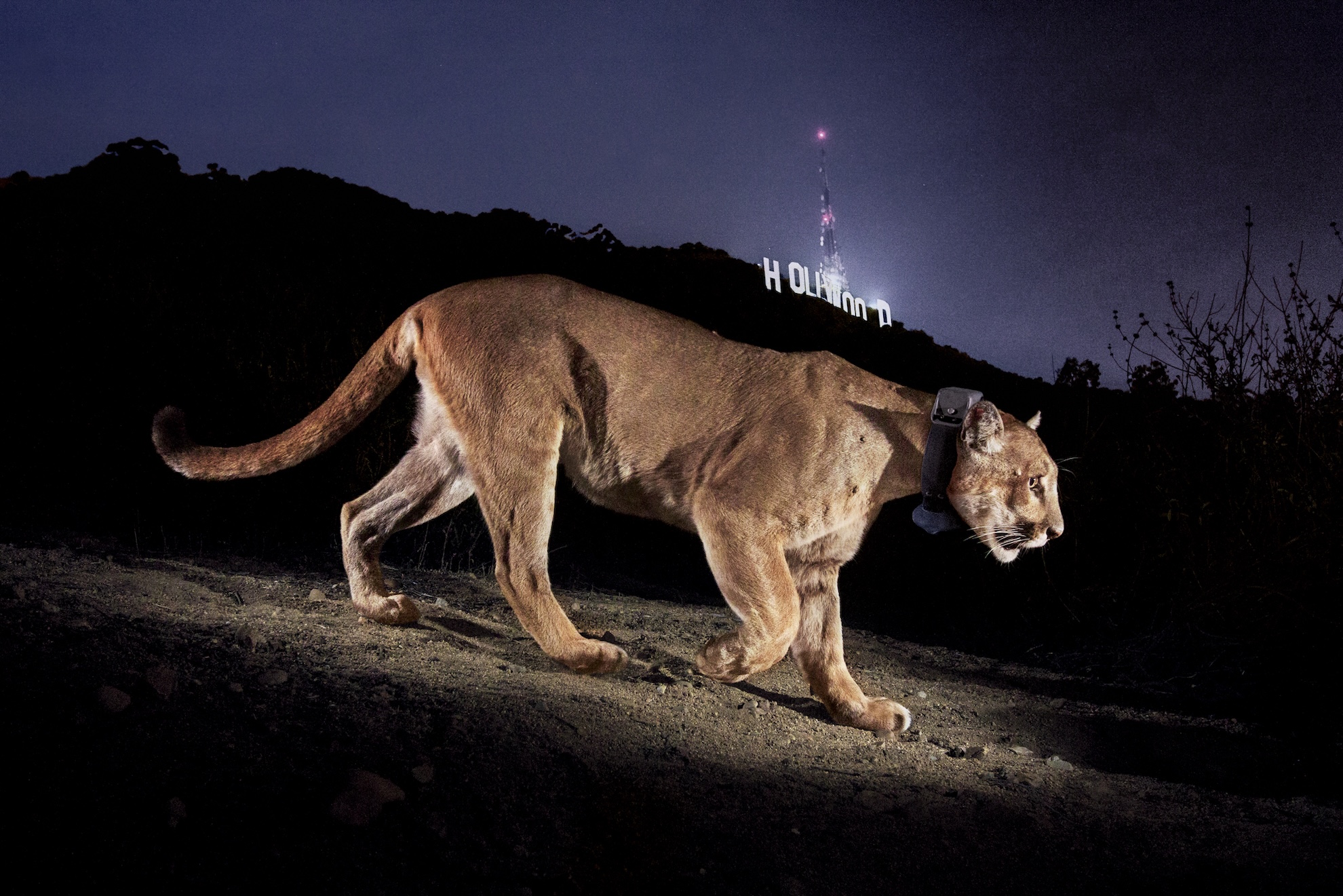
Jeff Sikich, the biologist for the National Park Service in Griffith Park, Los Angeles, thought that Steve Winter “was crazy” for wanting to capture a photograph of a mountain lion in front of the Hollywood sign.
“He looked at me like I was crazy because he said, ‘There are no mountain lions in Griffith Park.’ But I knew in the past that there had been,” Winter says.
It took him around a year, but Winter managed to do it. He captured the famous mountain lion, named P-22 by scientists, sauntering down a hill at night wearing his tracking collar, with the Hollywood sign shimmering in the background. This helped spark a conservation movement in L.A. and eventually inspired funding for the Wallis Annenberg Wildlife Crossing over U.S. Route 101, which will be the world’s largest wildlife crossing when it opens on Dec. 2.
Winter and Mongabay contributing editor Sharon Guynup join the Mongabay Newscast this week to detail this story and others that are featured in her and Winter’s upcoming book of impactful photojournalism, Big Cats from Nat Geo Books. Each of the nine stories in this book was selected specifically for the conservation outcomes these stories helped inspire.
“We really wanted to emphasize that storytelling and photography can change the world. And beyond that, we all can have impact, so we all need to contribute our skills, whatever they are,” Guynup says.
After reading all 25,000 words, this book stands out to me as more than a collection of top-tier wildlife photography. These are stories of honest hope for big cats on the brink, and for conservation in general. Whether it’s the fact that Guynup and Winter spent a year investigating a $3 million tourism operation at a Buddhist temple in Thailand that was a front for tiger trafficking, exposing it, leading to it being shut down; or Winter spending devastatingly cold months in the Himalayas to photograph snow leopards and hand-deliver vaccines to the farmers who lived in the Zankar Valley, helping them preserve their livestock and reduce retaliatory killings of leopards, the impacts tell a larger story to me.
People do care, and will take action to protect charismatic species and the ecosystems that depend on them when they’re given the right information. The book releases worldwide on Oct. 6. You can find it here.
Mike DiGirolamo is the host & producer for the Mongabay Newscast based in Sydney. Find him on LinkedIn and Bluesky.
Banner image: This photo of P-22 the mountain lion took Steve Winter 15 months to shoot. After its publication, the cat became a worldwide icon. Image courtesy of Steve Winter.
Notice: Transcripts are machine and human generated and lightly edited for accuracy. They may contain errors.
Sharon Guynup: What this book became, rather than just a book of Steve’s cat photographs, this book looks at nine different stories that either he worked on or we worked on together that have had tangible impact. So whether that means better local conservation of snow leopards in India, or in jaguars in the Brazilian Pantanal, or it helped move forward what will be the world’s largest wildlife overpass in Los Angeles. We really wanted to emphasize that storytelling and photography can change the world. And beyond that, we all can have impact, so we all need to contribute our skills, whatever they are.
Steve Winter: I kind of look at them as an umbrella species because people love big cats. You talk about them, people want to get involved, they want to hear more. But if you save big cats, you save everything that lives underneath them, and that to me is really important.
Mike DiGirolamo: Welcome to the Mongabay Newscast. I’m your host, Mike DiGirolamo, bringing you weekly conversations with experts, authors, scientists, and activists working on the front lines of conservation, shining a light on some of the most pressing issues facing our planet, and holding people in power to account.
This podcast is edited on Gadigal land Today on the Newscast, we speak with Mongabay contributing editor, Sharon Guynup, and photographer and photojournalist, Steve Winter. They join me to speak about their upcoming publication for Nat Geo Books, Big Cats. Now, before sitting down to read this book, which is much more than a collection of Winter’s best photography, I didn’t expect to learn so much about big cat conservation and stories of honest hope for these species, but that’s precisely what this book is.
Guynup tells me they selected these stories specifically because of their impact. Each of the nine stories highlights a particular big cat, the threats they face, how the impact that they’re reporting unfolded, and the lengths both of them had to go to achieve it. Whether it was the two of them going undercover to document the conditions of the Thai Tiger Temple and exposing it as a source for the trafficking of tigers, or Winter spending as much as a year to capture that iconic shot of the mountain lion P-22 with the Hollywood sign in the background.
The stories, while often thrilling in and of themselves, they tell a deeper story of how when science and communication are melded together, they can inspire communities to come together to protect the environment and ecosystems. The Wallis Annenberg Bridge, which will be the world’s largest wildlife crossing when it opens this December, is partly a result of that iconic photo of P-22.
The state of Thailand raiding the Thai Tiger Temple and shutting it down is a result of Guynup’s and Winter’s reporting. Jaguar populations in the Pantanal wetlands are rebounding in part because of Winter’s reporting and the work of diligent scientists. But the bigger story around big cats is that when you protect a big cat, you’re protecting a whole ecosystem, and this is something they both say people are starting to wake up to.
Sharon Guynup and Steve Winter, welcome to the Mongabay Newscast. It’s a pleasure to have both of you with us.
Sharon: Thank you. My- Thank you very much … pleasure. Great to be here.
Mike: Yeah. We are big fans of big cats here on this podcast, so I’m excited to talk about this with you today. But before we get into the story behind your stories, can you tell us why, from both of your perspectives, that big cats are vital and an important part of nature, and what they mean to the two of you?
Sharon: Any top predator or wide-ranging animal that gets focused conservation saves the entire landscape they live with, so the plants, the trees, the other animals. So by choosing umbrella species to focus conservation efforts on, it has much broader impact, and not just on conservation. It also saves land that protects settlements from flooding.
It absorbs carbon and slows climate change. There’s many, many services that these ecosystems give us, and the ambassadors of those are often tigers or lions or snow leopards.
Mike: And Steve, what do big cats mean to you?
Steve: everything that Sharon just said, number one. I kinda look at them as an umbrella species because people love big cats.
You talk about them, people wanna get involved. They wanna hear more, many of them. But if you save big cats, you save everything that lives underneath them, and that, to me, is really important. And I’ve been working with big cats now for 20 years, and I’ve been very lucky to be able to hang out in the field, documenting the stories of the big cats of the world.
Mike: Yeah, and I have to say, this collection is… It’s… One, it’s impressive, but also it’s just massive. And so I wanna know when did the idea occur to the two of you to put this body of work together? Because, as I mentioned, it’s enormous. Uh, it’s incredibly insightful in the details of the experiences you had on these trips and also the context.
It’s very educational. And it did take me a long while to get through this book, even though it’s a book of photos. I mean, I had to sit with it for weeks. It’s almost part memoir, I’d say. So putting this together must have taken a lot of effort. So when did the idea occur to the two of you, and how did that take shape?
Sharon: Steve and I started talking to Lisa Thomas at National Geographic Books in 2017 about doing this, and we were starting to move it forward. And then the pandemic hit, and that kind of put everything on hold for years. I’m really glad it didn’t happen then because we’ve done more work since, and there have been other impacts from our work.
What this book became, rather than just a book of Steve’s cat photographs, this book, Big Cats, is 280 pages, it’s 25,000 words, and it looks at nine different stories that either he worked on or we worked on together that have had tangible impact. So whether that means better local conservation of snow leopards in India or in jaguars in the Brazilian Pantanal, or it helped move forward what will be the world’s largest wildlife overpass in Los Angeles, which opens December 2nd, the Wallis Annenberg Wildlife Crossing.
Another group of work shut down a tiger trafficking and tiger tourism venue, the Thai Tiger Temple, and onward from there. But we really wanted to emphasize that storytelling and photography can change the world. And beyond that, we all can have impact, so we all need to contribute our skills, whatever they are.
Mike: Steve, do you have anything to add to that?
Steve: yeah. I wanted to do Big Cats because I had just switched over. I was a photojournalist and switched to wildlife. And I only knew how to work one way, so I didn’t change what I was doing. I was telling the stories of the big cats that I was around. And I first started with jaguars and found problems, trouble that these cats were, would be having in the future, and that became part of the story, and it became part of the impact the story ended up having.
And at the time, people were like, “Why are you working with scientists? Why are you doing these things?” And it was like, I’m spending so much time with these cats that I want to be sure that they have a future And they didn’t think it was my job as a photographer to do that. But that became the spark that was lit within me to do more than just report.
Mike: That’s really interesting to hear you say that, Steve. When you say they, who is the they that they didn’t want you to- they didn’t see it as your job as a photographer to do that?
Steve: Some of my colleagues.
Sharon: Well, at the time, most wildlife photography was animal portraits or documented animal behavior. But Steve was a photojournalist.
He worked for the Black Star Agency. When I met him, he was photographing a coup in Haiti. you know, he was used to telling a story. And he brought that to wildlife photography, but that wasn’t the way it happened at that point in time. And it since, you know, has become that. And it’s really important because, again, if you’re going to make a difference, you need to talk about and depict the people that share the landscape with these animals, the threats that face them, the scientists that are studying them, and the conservation efforts to save them.
Mike: So I wanna start by talking about P-22, because I think this is something that a lot of our listeners might be familiar with. But I wanna talk about how Steve got– There’s two shots that are particularly iconic. One of them is with P-22 and the city lights in the background, and the other one is with the Hollywood sign.
The first shot I saw was the one with the city lights. That’s the one I remember. I remember distinctly when that happened. It was, it was everywhere. It’s– I think it’s worth talking about this. How did you go about getting these iconic shots, Steve?
Steve: in the end, well, no, in the beginning, I had to learn how to use remote cameras.
And along with using remote cameras was how you set them up and the composition and idea that you were trying to bring across if you were lucky enough to get the picture. Because I want the first frame when the animal breaks the beam. There’s a transmitter and receiver on these. It breaks the beam and takes 10 photographs usually.
That’s what I have it set for. The first one is mine because that’s the picture that I set up to be mine. So every time we do one of these stories, I come at them differently, but one thing is pretty true. I’m not an expert on any of these animals, so I go to meetings of scientists and biologists that work with different species of cats.
So I went to a mountain lion meeting in Bozeman, Montana to meet the scientist working with the cats in LA. He was working in the Santa Monica National Recreation Area, the largest park in the United States, urban park And I went there to ask him questions because you saw the cat in front of the lights of LA.
He was walking on a trail. So I asked Jeff Sikich, the biologist for the National Park Service, I said, “Jeff, do you have any trails where the cats walk and you can see, like, the lights of LA in the distance?” And he said, “No.” And I said, “What about the trail above Malibu? Can you see Santa Monica and all the lights in the bay behind?”
“No.” He kept saying, “No, no, no.” And I had thought about what I could maybe get, and I said to him, “To really tell the story of urban wildlife and make a difference would be if we could get a mountain lion with the Hollywood sign.” And he looked at me like I was crazy because he said, “There are no mountain lions in Griffith Park.”
But I knew in the past that there had been. And it turns out, then I learned something new, that at, there is all these mountains and valleys where the houses are just hanging on. And the catwalk’s down at the bottom of it. And one of ’em, the closest one to Los Angeles, goes right into Griffith Park.
Mike: Mm.
Steve: So he didn’t want anything to really do with me.
He said, “Photographers ask for a lot and I get really nothing.” And I said, “Well, can I come and you could show me around your project?” And after hanging out with him for a week or 10 days, he knew that I was serious. But still there was no cats in Griffith Park. And I said, you know, “Let me know if something changes.”
And he knew how serious I was. And eight months later, he sent me a text. It said, “Call me now,” all in caps with, 10 exclamation points, and said li- “We just got a picture on a trail cam.” That we’re using to, for a bobcat census. And there was the rear end of a mountain lion. So then I had to figure out how to put up cameras in an urban park in downtown LA without them getting stolen.
Sharon: But they did. That’s right. They did- They did get stolen.
Mike: They did get stolen many times, so that was really- Yeah. So it took you, it took you an incredibly long time, and at- we could talk about it for the rest of the podcast, but let’s fast-forward to what happened after the photo was actually released.
You wrote in the book that you’ve never seen an animal transform a community like P-22 did for Los Angeles, and that is really saying something. Please, for the uninitiated in the audience, can you tell them how this transformed Los Angeles, and what do you think this says about the power of animals to bring people together?
Sharon: first off, I wrote the text, but I wrote it first person in Steve’s voice, because I wanted to be able to tell his field stories. And we’ve both been very involved with P-22. There’s many things that happened. the LA school system incorporated urban wildlife into its school curriculum. There’s a permanent exhibit at the LA County Natural History Museum.
The closest Saturday to October 22nd every year is P-22 Day in LA, and there’s a festival. But the big thing is that- People fell in love with this cat. I’ve never seen conservation cross neighborhoods, socioeconomic situations. Just people from across LA fell in love with this cat. There were murals all over the city, and- There
Steve: still are.
Yeah …
Sharon: and there still are. When P-22 died, there was a memorial service, music and talks at the, uh, Greek Theater in Griffith Park, and it sold out in two hours and crashed Ticketmaster. Tickets were free, but you had to book them. The biggest thing, however, is that it focused attention on the fact that massive freeways cut the landscape in LA, and many, many cougars die on the highways.
And they really needed a place to cross because they were becoming isolated, inbred, and if this population was gonna survive, they needed to move, as cats do. So Jeff Sikich and his colleagues found a place that linked the two largest protected areas, and that wildlife overpass has been created by Beth Pratt, an incredible conservationist.
Yeah. Steve donated his pictures to her- Amazing. And
Steve: video …
Sharon: to use to, to drum up the support. It’s … I don’t even know what the cost is at this point. A lot, a lot of money. Public/private partnership, and it’s opening December 2nd. A ribbon cutting it will be that day, attended by all kinds of dignitaries and, you know, certainly the governor, congressmen, state legislature, and many who contributed to funding this project, including Leonardo DiCaprio.
Steve: Uh, he was one of the some of the first money was what Leo donated. He’s just, he’ll be there.
Mike: Yeah. It, I’ll insert a note into the f- into the total cost of the bridge, but I believe the amount raised was 92 million USD, was the, was the amount that was raised. Yeah. But I think the total cost is probably something different.
The total cost of the project ended up at around 114 million USD. It was initially estimated at 92 million, which is the amount that Beth Pratt helped raise, but weather delays and other factors pushed the project over budget. And as Guynup says, it opens on December 2nd this year.
Hello listeners, and thank you for tuning in. As I always like to mention, Mongabay is a nonprofit news organization. We rely on funding from listeners like you. I encourage you to support the work we’re doing, but I also encourage you to directly support this podcast. You can do so by going to patreon.com/mongabay, and you can pledge to become a monthly donor of the show.
Even donating as little as a dollar or five dollars a month makes a very big difference to us, and it helps us offset costs. So if you’d like to donate, go to patreon.com/mongabay. If you’d like to find where you can purchase a copy of Big Cats, I’ve put the link in the show notes It’s an incredible story.
It’s a great way to start the book off. The next chapter I wanna talk about, though, is the one on snow leopards. This one really hit me hard. I’m not sure why. I feel like it’s because I could feel your pain and what you went through to get those images. Of any chapter in the book, this is the most gut-wrenching one.
And I have to say, the photographs you capture of the communities in, I believe the pronunciation is the Zangkar Valley, they’re just amazing.
Steve: Yeah. I-
Mike: if not more so than the photographs of the animals. So can you talk about that experience in general, and what stuck out to you the most about visiting the Himalayas, Steve?
Steve: Well, thank you very much for in- liking my people pictures. I like it when people that don’t know that I was a photojournalist… This, uh, in my leopard story, I have a really great picture I love, and people go, “You took that, too?” And I go, “Yeah.” So, um, snow leopards was really difficult. And, uh, I worked with scientists again to learn, go to the school or university of being a photographer for National Geographic, which is learning in the field from the different scientists and working with local people.
And it was so difficult. It was so cold. I was going down to 50 below for, like, a couple weeks, and then 30, 20. You know, sleeping in tents. But we had a great situation that I’d gone to a recce there once, and there was a scientist there, so I knew I was going to get pictures us- using these remote cameras.
But I had to figure out how I was gonna do it to get what I had said earlier, a Steve Winter photo. So once I figured out you’ve got this incredible landscape, and set up the cameras like if I was laying on the ground and the cat walked by, how would I take the picture in this location with this background?
I figured that out. We started getting pictures after three days Which was a huge psychological moment to actually know that it was working, and then we could tinker with the- I could change the composition, the lighting, as I saw what was going on. But it was just so difficult.
Sharon: Tell us about the adventure, Steve.
Tell us what it was, what it was like.
Steve: Oh, it was, it was cold. We came in, spent four days in Leh to get accustomed to the altitude. Came in, now you can drive into where I was at. We walked on a frozen river and hiked in for hours, and finally got to our first campsite. People put the tents up and everything, and I tried to learn.
But then all of a sudden, the nighttime comes, and on the recce trip, I was cold, and I vowed, “I will not be cold doing this story.” So I had three sleeping bags and slept in layers of underclothing, couple hats, two pair of gloves. And- Your coat. Yeah. Nah, I, three sleeping bags wasn’t enough.
Sharon: But one story that I love about that is that the cook would br- There had to be a cook tent.
He had a team, and they camped out at about 15,000 feet for three months in the winter. But the cook would bring a hot water bottle and put it, at his feet inside the first sleeping bag, and by morning, it was frozen.
Mike: And so this is a lot of pain to go through. So the question I would love for you to explain to the audience is, why go through that for snow leopards?
Steve: Well, it was really important to me because I’d read Peter Matthiessen’s book about George Schaller, and we knew George luckily enough. And in 1999, long time ago, my editor sent an email out to a bunch of us ph- na- natural history photographers, “What would your dream assignment be?” And I thought, why not snow leopards?
If I’m gonna stick with big cats, I need to make…” I never really thought of it like this, but you really need to make a name for yourself, because I thought, “I wanna stick with big cats,”
Sharon: you know?
Steve: And if you do stories that maybe haven’t been done before, like my first cat story, jaguars, you’re never gonna get a no when you put your proposal in.
So that was really part of my thinking, ’cause we’re freelancers, so it’s important. And the people stuff you were talking about is really vitally important. The people things for jaguars where I found that The cowboys were killing all the jaguars because they thought every dead cow was the fault of a jaguar.
And the scientist I was working with, her boss happened to be my best friend, Alan Rabinowitz, and he put money in to get GPS sat collars to try to track these animals to, if someone had a dead cow, they could find out by the GPS points whether the cat was in that location the night before.
Sharon: I just want to jump in and say one thing about both of those stories, jaguars and snow leopards, is that Steve identified one of the biggest problems facing each of those species, which was retaliation killings for-
Steve: Right
the
Sharon: cats that sometimes preyed on livestock. And in each situation, he was able to show that there were other ways to deal with the problem than killing the cats. And in the case of jaguars, he and a scientist were able to prove that cats were responsible for very few dead cows and, um, that the Pantanal was one of the few places you could see jaguars.
So that started a, an ecotourism industry, and now they’re worth a lot more alive than dead. The same thing in the Himalayas. Couple of things. Certainly now there’s snow leopard tourism, but also he, um, he helped start a vaccination program, and those people lost many more animals to disease than they did to- To
Steve: snow
Sharon: leopards
kill leopards. So if they agreed to not kill snow leopards, they got free vaccination. It’s a program that I think is still going on. Yeah. So I mean, I think, I think the issue here is that Steve and I really looked to identify the threats that face these animals and explore with conservationists, scientists, and local people what the solutions might be.
Steve: And that is super important. Now, I, the last thing I’ll say is they were losing, in the Himalayas, 30% of their livestock to disease, and the writer had a friend at USAID in New Delhi. They actually were cowboys together in Montana in the past. And I got it. I got the vaccine. We vaccinated their animals.
And for the few that they might lose to wolves or snow leopards, as long as they promise not to kill snow leopards, you got 30%- More animals that aren’t dying from disease every year. And after three years, they take over the program. They still get the vaccine, and it costs me $10 to bring a vet up the one day.
So they can take over the project, which is really important. And it’s good for them and for snow leopards. You take a economic negative, turn it to a economic positive.
Mike: Yeah, it’s an incredible story, and it’s why I brought it up. And I just think it’s really indicative of what can happen when science is communicated well to communities and incentives are provided for protection.
And so the next example that I wanna talk about was a dual investigative story between the two of you, and it’s the Thai Tiger Temple. This one really hit me hard as well. This is such an incredible story. Can you sort of paint the picture of what this temple was like when you went in? I know I’m skipping over a ton of context here, but you went in to document what was happening behind the scenes.
Can you sort of paint the picture of what this temple was like when you went in to do that investigative work?
Sharon: Steve had been there photographing just for a couple of days because he’d heard there was worrying things going on at the temple. But he was doing a bigger tiger story. He found out about this only a couple days in his schedule, shot some pictures that showed, like, how crazily unsafe it was, with people in very close contact with adult tigers as well as the bottle-feeding cubs.
But we had a book come out-
Steve: Drug the tigers …
Sharon: Yeah. So we had a book come out some years back on tigers, and we mentioned that and ran those pictures in the book. And, um, someone reached out to me and said that she could help us prove that they were illegally trafficking wildlife into black market trade, tigers specifically.
So we spent a year investigating, and we were able to get hard ev- evidence. We got CCTV, we had an audio tape of the abbot talking about the trade, and we also had a trade document that the Tiger Temple had sold a tiger across the border to a tiger farm in Laos. But to answer your question, the Tiger Temple is a Buddhist monastery with perhaps the most venerated form of Buddhism in Thailand.
And, um, it also claimed to be a sanctuary that rescued tigers, but it was a tiger tourism Attraction that brought in about $3 million a year. And you could bathe tigers. There are tigers, massive tigers were chained to the ground on short chains, and you could do selfies with them. You could walk them.
I mean, all these terribly unsafe things. But there was also cubs. And, um, again, if you’re gonna pet cubs, they have to be little, so there has to be a constant supply. And, you know, we found that interestingly enough, even though there were constantly new cubs to pet, the number of tigers that were reported never changed.
So Steve and this woman, Sybille Foxcroft, a conservationist, and I went to the Tiger Temple once we had all this evidence in hand. Steve shot a video that ran about seven and a half minutes with the story when it came out, and we confronted them and videotaped and also interviewed our main source in a safe house, ’cause it was really dangerous.
I mean, this was, again, a $3 million a year tourist attraction in Thailand, and Buddhist, and investigating both a religious institution and wildlife crime. Pretty crazy. But we were able to prove what was happening there, and it kicked off incredible, an incredible uproar. The Thai officials were under incredible domestic and international pressure, and four months after the story came out, Thai police and wildlife officials went in and confiscated all the tigers, which altogether there had been 178, and they shut it down.
Now, the important thing here is that this was both, like, kind of a Blackfish moment for, tiger cub petting and wildlife handling, like looking at the dark underbelly, but also these captive breeding venues, especially in four Southeast Asian countries: China, Thailand, Vietnam, and Laos. They feed tigers into the illegal wildlife trade that is poaching wild tigers towards extinction.
So I mean, had this literally just been an animal welfare story, it wouldn’t have been the kind of thing that we do. We’re, we focus on conservation stories, but this really, really was important. ‘
Steve: Cause people have to realize that, uh, no captive-bred tiger has ever successfully been returned to the wild.
Never. And so when the first thing you saw when you walked into the Tiger Temple was a giant sign that just said conservation. And I was like, “Conservation of what? Your bank account?” Because it has nothing to do with saving these tigers, and it was really sad. But the government closed it, so it’s great, because Sharon kept writing one story after another.
They took the, uh, video off the Nat Geo site and ran it on the nightly news program all over Thailand, took my pictures off Instagram, and I wrote them and said, “You know, you can have anything you want
Mike: It was really heartening to read about the situation in India with tigers, and they’re doing an incredible job with tiger conservation.
I I think we can safely say that. But something that really I was not expecting to read was the situation with the Asiatic lion, and I really think this could perhaps be a bit of an unsung big cat. So I’d like to talk about the Asiatic lion. What about this big cat stuck out to you the most?
Steve: I think for me, just, uh, one of the main things was that the population had gone down to about 24 individuals, and then right when, right before we left, they did a census, and the population was up to 900.
And so that was a conservation success story, and after working so long in India, that I thought this would be a great thing to cover.
Sharon: One of the reasons that we did this story was that we found out there were such a thing as Asiatic lions. most people don’t know that there is another species of lion.
There’s African lions, as we all know. Well, there’s a population, the last in the world, of Asiatic lions living in Gujarat, India. And learning that there was this one last population, we really wanted to look into it because we wanted to find out what kind of hope there was for their future and how India was going about trying to save them.
And what we learned is that over the last decades, there have been incredible efforts, and the Gujarati state government and Indian govern- federal government have invested a lot of money and come up with a really extraordinary raft of conservation measures that really make it worthwhile for people to coexist with lions because their communities benefit.
They’ve incorporated high-tech monitoring. They’ve really upped patrols. I think that area, the Gir National Park, the main place where these lions are, may be the only place I know of where there really has not been poaching of anything in maybe two decades. Poaching is rampant worldwide, but these animals are so closely monitored that they’re safe.
I think one surprising thing was that they have recovered so well that now they’re moving out of the protected areas, and that brings up next level conservation issues. You know, let’s face it, they’re animals that move in prides. A bunch of lions coming to villages or farms, it’s a, it’s a public safety issue, and that is the focus now.
Mike: Something that I think was really significant that was highlighted in the book is that there was a man who is permanently injured from a lion, and he said, and I’m quoting what was written directly in the book, he said, “I still have immense respect for the big cats.” And I think that’s just an incredible amount of compassion and also tolerance for something that permanently changed his life.
I think it’s an astonishing display of coexistence, and so I would love to hear what you two saw in India about the communal understanding of coexistence with big cats.
Steve: The– there’s a spiritual connection between these animals and the local people, whether it’s tigers, leopards, or lions, and elephants and monkeys.
And so I’ve never been anywhere like it. People in many other parts of the world, I don’t think they would just naturally live next to 58 tiger reserves or these parks that where the lions live Or leopards. Yeah, I just find it amazing that they understand that there are issues. Trust me, they do get angry when they’ve lost a livestock, so these different programs are vitally important that help them.
So yeah, that’s just something that I found, the spiritual connection.
Sharon: Well, yes, many of these animals are venerated in Hinduism. But I’ve, I will agree with Steve. I’ve never been anywhere that people will coexist so readily with dangerous animals. ‘Cause let’s face it, these are carnivores, and sometimes people do get killed, and they do lose livestock.
There are compensation programs from the government, but compensated for losing a family member? Or compensated for losing the livestock that is your livelihood, where maybe you don’t get as much as it’s really worth? You may. I just think about the United States, where I live, and the uproar in California and Wyoming and other states over wolves.
Here, we have so curated our Noah’s Ark to pretty much eradicate these kinds of large or dangerous animals. But in India- Their ability to coexist is truly extraordinary.
Mike: Yeah, we’ve, uh, we’ve highlighted on this podcast before about the persecution that coyotes face despite them being relatively harmless.
But I do wanna point out that wolves were introduced into Yellowstone with, I think we can say, pretty good success. So that’s something- Yeah … that’s, that’s worth highlighting here. I wanted to ask you about broadly, the situation can seem pretty dire for big cats, I think.
Do you feel like there’s a trend building where maybe people on a more individual lev- level, and perhaps collectively, are starting to open themselves more up to the possibility of things like rewilding or reintroduction?
I mean, we’re seeing wolves being reintroduced into Europe, for example. I was a little incorrect here, as wolves aren’t being directly reintroduced by humans per se. Rather, they are recovering in Europe due to the strict legal protections and some other factors, and their numbers currently stand around 23,000.
Every mainland European nation is seeing them. I plan to explore this topic further on a later podcast, so stay tuned for that. I mean, this is something I think that is worth discussing ’cause you have both worked in this field for quite some time.
Steve: I think in many instances people are starting to understand the importance of intact ecosystems, that if you take the top predator out of an ecosystem, you’re overrun with, like in the Eastern United States, deer.
Then you have other problems with deer ticks. You have issues with so many deer crossing the roads at dawn and dusk, and a danger that comes from that. But the economic benefits of having intact ecosystems are really important Whether it’s the higher yields that you get having large scale agriculture next to places that still have predators and intact ecosystems with the pollinators that we need for the, uh, farming.
Yeah, I read this FAO study about that, and we’re seeing it all over the world that places are being rewilded and people seem to be more accepting of living next to predators. I– except for wolves, there’s always people that feel differently.
Sharon: I think there’s certain situations where income from protecting these animals acts as true incentive.
However, one of the biggest threats to these animals is wildlife trafficking.
Steve: Yeah.
Sharon: And that’s not going away. And depending on the species and the location, they’re doing better or worse. Some species of leopards, for example, are bouncing back, others are not. And again, it’s human-wildlife conflict, poaching.
And for all the cats, they share these same threats. It’s habitat loss, ninety-three, ninety-five percent of their historical habitat, poaching, and human-wildlife conflict. I mean, that– it’s across the boards with all of these animals. So I think the more that conservationists focus on landscape scale conservation that gives animals the ability to move as they need to, but hopefully in ways where they don’t come in conflict with humans, and economic incentives, again, to make it worthwhile coexisting with these animals, the more that we can move forward.
But there have been some incredibly successful conservation efforts, and the Asiatic lions, tigers in India are two of those examples. The jaguars in the Brazilian Pantanal, snow leopards in India. There are places where these populations have really grown and have really come back. So yes, there’s a lot of challenges in trying to protect a large carnivore, but there is hope and there is progress.
Mike: Sharon and Steve, where would you like to direct listeners to either pre-order or purchase a copy of the book?
Sharon: The book is being distributed through Penguin Random House. You can pre-order on that website. There’s a lot of books named Big Cats. You gotta Google it with- … Big Cats and one of our names to find it.
It comes out October 6th, and we’re really, really excited to get this work out there, not only because it’s Steve’s Big Cat opus, but also it gives us the chance to spread the word about big cat conservation. And we’re hoping that this work inspires other people to contribute in some way to causes they care about, whether it’s environmental or something else, because the bottom line is that we can all make a difference, and we all- Right
need to contribute. you know, the bottom line for us in doing this is inspiration.
Mike: Well, Steve Winter, Sharon Guynup, it was a pleasure speaking with the two of you, and fabulous work on this book. It’s really something, and I really enjoyed reading it.
Steve: Thank you
Sharon: very much. Thank you. Thank you, thank
Mike: you. As always, if you are enjoying the Mongabay Newscast or any of our podcast content and you wanna help us out, we do encourage you to spread the word about the work that we’re doing by telling a friend and leaving a review.
Word of mouth is a really great way to help us expand our reach. But as I mentioned earlier, you can also support us by becoming a monthly sponsor via our Patreon page at patreon.com/mongabay. But you can also read our news and inspiration from Nature’s Frontline by going to mongabay.com, and you can also follow us on social media.
Find Mongabay on LinkedIn at Mongabay News, and on Instagram threads, BlueSky, Mastodon, Facebook, and TikTok, where our handle is @mongabay, and on YouTube at Mongabay TV. Thank you as always for listening
