


- The Philippines has stopped accepting electronic waste imports from the United States, following months of campaigning from activists who said the country risked becoming a dumping ground for hazardous foreign waste.
- The restriction on U.S. e-waste may not resolve a broader enforcement problem caused by a 2025 court ruling, which pointed out that the Subic Bay freeport lies outside Philippine customs jurisdiction, and that environmental authorities can’t require importers to secure pre-shipment clearances.
- The Subic Bay freeport is a key hub in the U.S.-led Pax Silica initiative, which aims to secure supply chains for semiconductors, artificial intelligence, and critical minerals.
After months of scrutiny, the Philippines has closed its doors to electronic waste from the United States, ending, for now, a stream of shipments that environmental groups have tracked since March 2025.
This move marks the clearest government response yet to controversy over suspected U.S. e-waste shipments entering the Philippines via the Subic Bay freeport, with environmental groups questioning whether cargoes were being properly screened and regulated.
The Department of Environment and Natural Resources (DENR) told Mongabay on Oct. 12 the restriction is not a new U.S.-specific ban. Instead, it said, the policy, which was publicly announced on Sept. 22, will see customs officials enforcing existing rules under the Basel Convention.
The convention, an international treaty governing cross-border waste shipments, prohibits e-waste imports from the five countries that are not parties to the treaty — including the United States.
Michael Drake Matias, who heads the DENR’s Environmental Management Bureau, said customs has stopped allowing waste shipments from all nonparty countries to be unloaded at Philippine ports.
Customs-free zones?
It remains unclear whether the reinforced restriction resolves a broader enforcement problem created by a 2025 Manila court ruling that disrupted normal pre-shipment controls in the Subic Bay freeport.
The case began in 2024, when the customs bureau held shipments belonging to three recycling companies operating inside Subic, a former U.S. naval base turned major Philippine industrial port. Under a DENR administrative order, each shipment of imported recyclable material had to be covered by an importation clearance issued by environment authorities before it could be shipped. Customs seized the cargo after the three companies failed to secure the required import documents.
The companies challenged the seizures, and the Manila Regional Trial Court decided in their favor in April 2025.
According to the ruling, the Subic Bay freeport lies outside customs jurisdiction, which meant the agency didn’t have authority to seize the shipments there. The court also declared unconstitutional a provision in the DENR administrative order requiring advance import clearance for the shipments.
The government’s motion for reconsideration was denied, and the case is now pending at the Court of Appeals. But while the legal fight continues, the DENR said the court decision changed how regulators monitor shipments entering Subic.

The reinforced restriction on U.S. e-waste imports doesn’t fully settle the matter, the DENR said, noting that importers could still invoke the April 2025 court decision to challenge government efforts to stop unregulated discarded electronics from entering Philippine soil.
In addition, the DENR and customs have been unable to screen shipments before they enter Subic since the 2025 ruling, leaving regulators more dependent on alerts from watchdog groups and other external sources to spot suspicious cargo. “With information beforehand, we can easily prepare and execute monitoring activities,” Martin Jose Despi, of the DENR’s Environmental Management Bureau in the Central Luzon region, told Mongabay. “Now, that is the main difficulty.
“Right now as we speak, are there certain shipments coming in?” Despi said. “That is something that we do not know.”

A freeport problem beyond Subic
Subic is not the first free-trade zone in Southeast Asia to raise concerns over e-waste controls. The United Nations Office on Drugs and Crime (UNODC) documented as early as 2013 how e-waste smugglers used Indonesia’s Batam free-trade zone to avoid confiscation. More than a decade later, a joint UNODC and United Nations Environment Programme study found that Southeast Asia remains a target for illegal waste shipments, citing weak traceability and limited enforcement capacity as persistent vulnerabilities.
According to the UNODC, free-trade and special economic zones can become vulnerable in situations where high trade volumes, complex logistics, and fragmented oversight reduce authorities’ ability to track shipments.
“Where there are gaps or uncertainties regarding oversight responsibilities, criminal actors may seek to exploit them,” Ioana Cotutiu, the UNODC’s waste crime focal point for Southeast Asia, tells Mongabay.
For Jim Puckett, founder of the Basel Action Network (BAN), a U.S.-based watchdog group that monitors international hazardous waste trade, the Subic case could have implications far beyond the Philippines.
“The scariest thing for us is a precedent where a free-trade zone will be used as an excuse to avoid international law,” he tells Mongabay.

Since March 2025, BAN has tracked suspected e-waste shipments to Subic through a monitoring campaign using trade data and GPS trackers placed inside discarded electronics in the U.S.
BAN said some of those tracking devices ended up at recycling facilities inside the Subic Bay freeport.
By June 2026, the group said it flagged 234 containers of suspected e-waste from the U.S. BAN later detected 184 additional containers scheduled to arrive between August and September.
The issue prompted a broader response. BAN joined environmental groups in the Philippines and across the region to call for an end to U.S. e-waste shipments, warning against turning the Philippines into a “dumping ground” for foreign waste. Three lawmakers, meanwhile, sought a congressional investigation.

Inside Subic’s recycling industry
The Subic Bay Metropolitan Authority (SBMA) frames the controversy differently. Officials say the discarded electronics entering Subic are not simply waste but materials with recoverable value. Recyclers dismantle imported scraps to extract copper, aluminum, and gold-plated components for reuse or export.
SBMA officials cast the recycling industry as part of a broader circular economy, arguing that recovering metals from e-waste can reduce the need for new mineral extraction.
There are currently 13 active e-waste recyclers in Subic, and officials estimate that the sector supports around 6,000 jobs. SBMA chief of staff Von Rodriguez said the agency has an obligation to support and protect companies that have invested in the freeport and passed its evaluation process. He said failing to do so could erode investor confidence in Subic.
Officials also said that e-waste recycling in the freeport is highly regulated, with every shipment tested and tracked from processing to disposal. “We categorically state that there is no dumping of toxic or hazardous materials in Subic Bay,” SBMA deputy administrator Amethya Dela Llana said.
Environment authorities, however, said their own inspections have found violations among some recyclers. Matias said notices had been issued over adverse findings, but he declined to specify the companies or the violations while cases remain ongoing.
The SBMA also plans to expand the industry by welcoming smelting companies into Subic. But the DENR said it would not support the move while pending issues remain unresolved.

The Pax Silica connection
The U.S. e-waste controversy comes as Subic takes on a larger role in the Philippines’ industrial strategy.
In August, the Port of Subic Bay was designated the “preferred maritime gateway” for Pax Silica, a U.S.-led initiative launched in December 2025 aimed to secure supply chains for semiconductors, artificial intelligence, and critical minerals that don’t depend on China’s dominance of the sector. This means the freeport will serve as the main portal for moving materials in and out of Pax Silica’s first physical hub in New Clark City (NCC), around 100 kilometers (60 miles) from Subic.
The proposed 4,000-acre (1,619 hectare) AI hub is being developed to house semiconductor and advanced manufacturing facilities, with government officials framing it as an opportunity for the Philippines to move into higher-value parts of the technology supply chain. The site sits within the Luzon Economic Corridor, launched by the Philippines, the U.S., and Japan to connect Subic Bay, Clark, Metro Manila, and Batangas through improved logistics, infrastructure, and investment.
Local environmental groups such as BAN Toxics have raised concerns that Pax Silica could encourage the influx of e-waste imports into the country under the guise of critical mineral recovery or “urban mining,” adding further pressure on communities and the environment.
But Matias said the DENR can’t yet say whether Pax Silica would increase demand for imported e-waste. He said the department would be better positioned to assess its environmental implications once specific projects seek environmental clearances from it.
Environmental groups are now pressing the government to disclose the Pax Silica agreements and subject the project to independent environmental and social review. They’re also calling for tougher safeguards, transparent monitoring, corporate accountability, and a larger role for affected communities.
“E-waste is not merely a source of minerals. It contains toxic substances that contaminate air, water, soil, and threaten the health of surrounding communities,” said Mayang Azurin of GAIA Asia Pacific, a regional environmental network working on waste and pollution. “We refuse to trade our health, environment, and sovereignty for a place at the bottom of a global supply chain.”

Can the Philippines close the enforcement gap?
Pax Silica and the Luzon Economic Corridor may transform Subic as a gateway for the industries of the future. The immediate test, however, is whether regulators can control what enters the freeport.
While stopping the U.S. shipments addressed the immediate problem, it hasn’t restored the pre-shipment controls authorities exercised before they were disrupted by the court ruling. Regulators still depend on outside alerts to know what may be headed for Subic, and environmental groups say a new law may be needed to fix the situation.
“Chasing containers one by one is a losing game,” said the EcoWaste Coalition. “To permanently secure our borders, we need a legal shield. We must seal the regulatory loopholes that these waste traffickers use.”
A proposed amendment to the Philippines’ hazardous waste law is still pending in Congress.
BAN Toxics, meanwhile, welcomed the latest development as “a significant milestone,” but said the government still needs to determine how the imports were allowed to enter in the first place, as well as what environmental damage they may have caused.
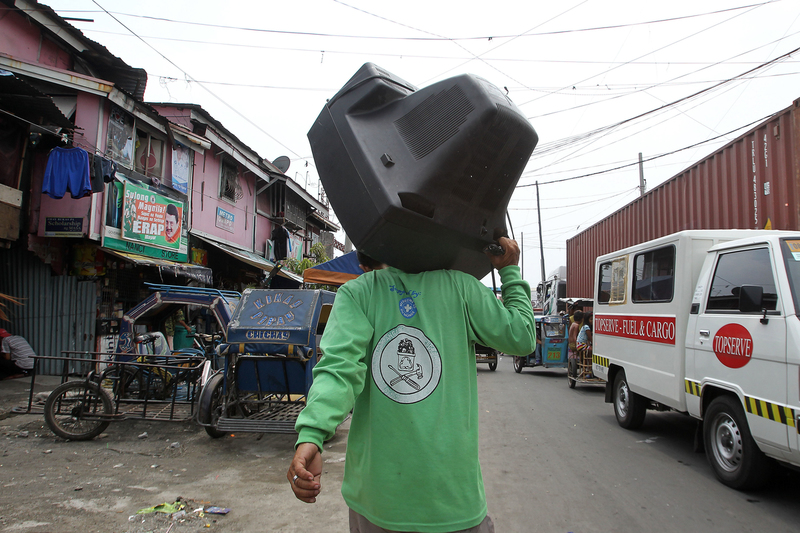
Banner image: A man carries a discarded television set that he bought in Tondo, Manila. Image © Greenpeace.
Planned US tech hub in Philippines hit over environmental and Indigenous land concerns
The digital graveyard: Is Bangladesh becoming China’s e-waste back door?
FEEDBACK: Use this form to send a message to the editor responsible for this story. If you want to post a public comment, you can do that at the bottom of the page.
Cite this article
Biena Magbitang, Gabriele Di Donfrancesco, Helena Rodríguez Gómez, Louis Boyd-Madsen (2026). Philippines halts U.S. e-waste imports but struggles to police customs-free zones. Mongabay Conservation news. DOI: https://doi.org/10.66709/news-333738

