

Close Menu
NCIJ Network NCIJ Network
    What's Hot

    4 Best Alexa Speakers I’ve Tested (2026)

    September 5, 2026

    Thousands of OpenAI Agents Quietly Turned an Abandoned Wiki Into Their Coordination Channel

    September 5, 2026

    Poland Upholds Crypto Bill Veto as Zondacrypto Probe Widens

    September 5, 2026
    Facebook X (Twitter) Instagram
    Trending
    • 4 Best Alexa Speakers I’ve Tested (2026)
    • Thousands of OpenAI Agents Quietly Turned an Abandoned Wiki Into Their Coordination Channel
    • Poland Upholds Crypto Bill Veto as Zondacrypto Probe Widens
    • Dying radio galaxies fade faster than scientists expected
    • Beetle larvae trick bees into feeding and sheltering them by smelling like flowers, study finds
    • Trump envoys arrive in Moscow ahead of Ukraine talks
    • Gaza refugee says sister-in-law ‘would be alive’ if Home Office had let her come to UK | Immigration and asylum
    • Farage and Jenrick to speak on final day of Reform conference marred by scandal and protests – UK politics live | Politics
    • About
      • Our Team
      • Editorial Policy
      • Editorial Independence
      • International Support
    • Trust & Standards
      • AI Usage Policy
      • Conflict of Interest Policy
      • Corrections Policy
      • Ethics Policy
      • Fact-Checking Policy
      • Source Protection
    • Get Involved
      • Guide for Sources
      • Support Independent Journalism
    • Legal
      • Cookie Policy
      • Privacy Policy
      • Terms of Use
    Facebook X (Twitter) Instagram
    NCIJ Network NCIJ Network
    Saturday, September 5
    • Home
    • World
    • Ai
    • Business
    • Politics
    • Health
    • Crypto
    • Science
    • Technology
    • Cybersecurity
    • Defense & Security
    • Economy
    • Energy
    • Europe
    • More
      • Fact Check
      • Investigations
      • Opinion & Analysis
      • Environment
    NCIJ Network NCIJ Network
    Home»Environment

    Beetle larvae trick bees into feeding and sheltering them by smelling like flowers, study finds

    NCIJ NETWNCIJ NETWORKBy NCIJ NETWNCIJ NETWORKSeptember 5, 2026 Environment No Comments3 Mins Read
    Share
    Facebook Twitter LinkedIn Pinterest Email

    European Black oil beetle larva lures unsuspecting bees by manufacturing smells that mimic floral scents, new research suggests. The larva then hitches a ride on the bee to its burrow, where it eats the bee’s eggs and pollen, and develops into an adult beetle. This is the first known instance of an animal hijacking the smell of a flower to lure another animal to parasitize it, the study’s authors say.

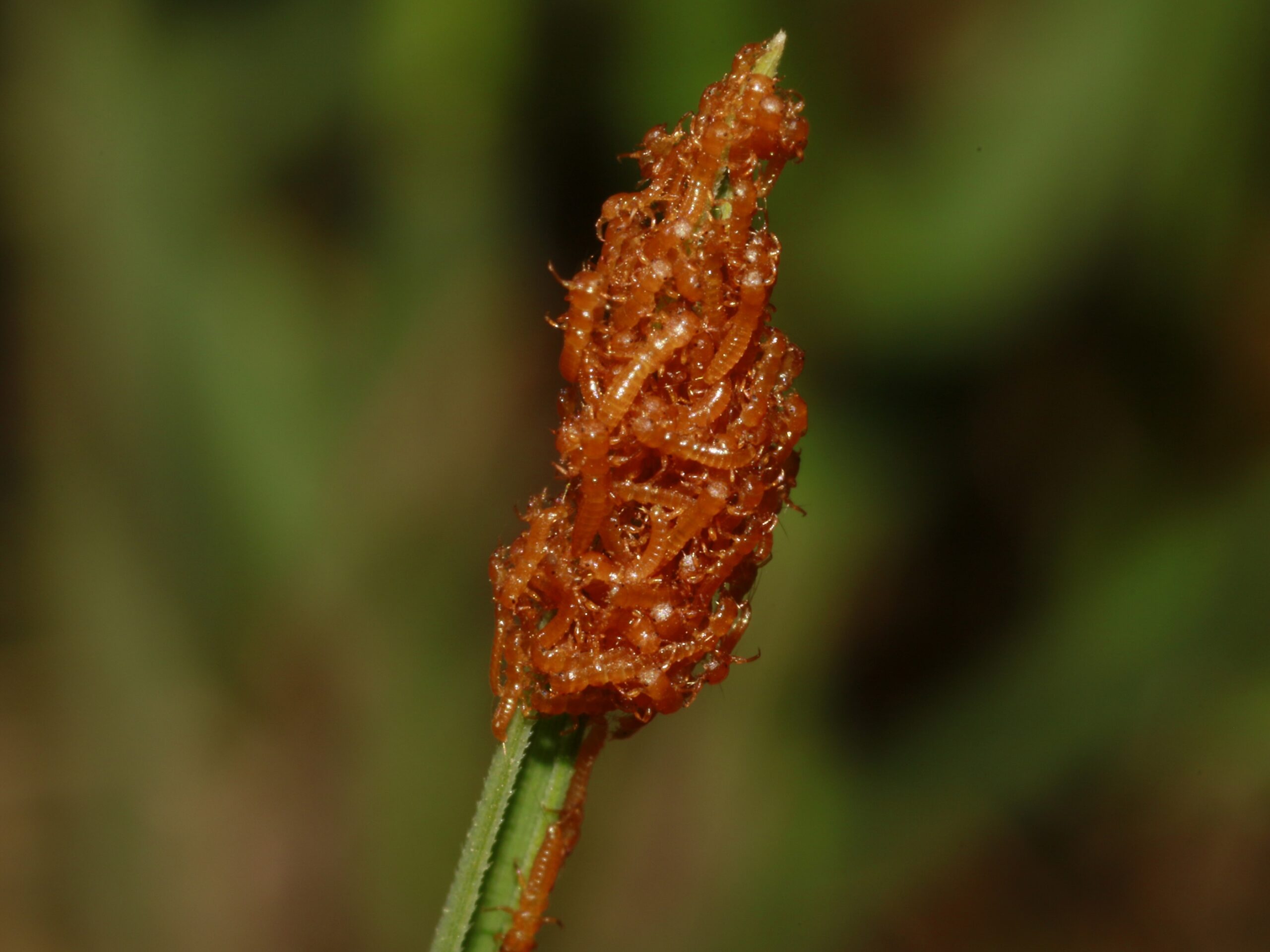
    Larvae of the European black oil beetle (Meloe proscarabaeus) are orange and gather on the tips of plants to attract bee hosts, which they then parasitize. The research team hypothesized that the larvae emit some kind of chemical to attract the bees. 

    Using chemical analysis, the researchers found that the beetles emit compounds called floral monoterpenoids, the same chemicals that produce the scent of flowers in many plant species. 

    The researchers prepared a synthetic mix of the compounds in the lab and found that bee species in the wild were attracted to them, supporting the hypothesis that the beetle’s larvae imitate flowers to lure bee hosts. 

    Ryan Alam, the study’s lead author from the Max Planck Institute for Chemical Ecology in Germany, told Mongabay by email that the team hasn’t identified a specific flower with a scent that matches the floral chemical profile the larvae emit. However, he added that the compounds are known components of the scent of willow flowers, which makes the plants an intriguing candidate.

    “Determining the precise floral source (if any!), and understanding how closely the larval scent matches it, would be an exciting next step,” Alam said.

    He added that there’s a closely related beetle species in North America that releases chemicals that mimic the sex-pheromones emitted by female bees to lure male bees and parasitize them. This suggests that chemical-based mimicry has evolved in multiple beetle species, Alam said.

    The researchers suspect that chemical mimicry may be more widespread in beetles than currently known, but may be much harder to detect than visual mimicry, Alam added,  “It is quite possible that similar examples exist in other groups of insects, or even in other animals, but they may have gone unnoticed so far.”

    Jim McLean, an evolutionary biologist at Macquarie University in Australia not involved in the study, told Scientific American that Alam’s research “presents a convincing case that the beetle larvae are mimicking flowers chemically, and perhaps visually, so as to deceive and attract bees.”

    A male European black oil beetle (Meloe proscarabaeus) by Furu Maru via Wikimedia Commons (CC BY-SA 3.0).

    Banner image: A cluster of European oil beetle (Meloe proscarabaeus) larvae on a blade of grass: Not only could they be mistaken for a flower at first glance, but to wild bees, their smell cannot be distinguished from the scent of many flowers. Image courtesy of Danny Kessler, Max Planck Institute for Chemical Ecology.


    bees Beetle feeding finds flowers larvae sheltering smelling study trick
    NCIJ NETWNCIJ NETWORK
    • Website

    Keep Reading

    Error in a Recent BLM Lease Sale Has Wyoming Residents Concerned Over New Oil and Gas Rules

    As Extreme Weather Worsens, Black and Hispanic Homeowners Are Paying More for Insurance

    Manx space group urges election election candidates to back treaty

    Urban water quality pose challenges to low-income communities in Sri Lanka’s commercial capital

    Women farmers in Sumatra find a gentler way to keep elephants at bay

    Comparing green space for urban cooling, study

    Add A Comment
    Leave A Reply Cancel Reply

    Editors Picks

    4 Best Alexa Speakers I’ve Tested (2026)

    September 5, 2026

    Thousands of OpenAI Agents Quietly Turned an Abandoned Wiki Into Their Coordination Channel

    September 5, 2026

    Poland Upholds Crypto Bill Veto as Zondacrypto Probe Widens

    September 5, 2026

    Dying radio galaxies fade faster than scientists expected

    September 5, 2026
    Latest Posts

    Interpol Leverages Global System to Curtail Fraud Payments

    July 31, 2026

    Repeat founder Ryan Williams raises $10M seed for an AI startup for private credit managers

    July 31, 2026

    Concerns raised over Northumberland council’s £900m debt

    July 31, 2026

    Subscribe to News

    Get the latest sports news from NewsSite about world, sports and politics.

    NCIJ Network is an independent digital news platform delivering trusted investigative journalism, European and global news, in-depth analysis, and fact-based reporting with accuracy, transparency, and integrity.

    Facebook X (Twitter) Instagram Pinterest YouTube

    4 Best Alexa Speakers I’ve Tested (2026)

    September 5, 2026

    Thousands of OpenAI Agents Quietly Turned an Abandoned Wiki Into Their Coordination Channel

    September 5, 2026

    Poland Upholds Crypto Bill Veto as Zondacrypto Probe Widens

    September 5, 2026

    Subscribe to Updates

    Get the latest creative news from FooBar about art, design and business.

    Type above and press Enter to search. Press Esc to cancel.