


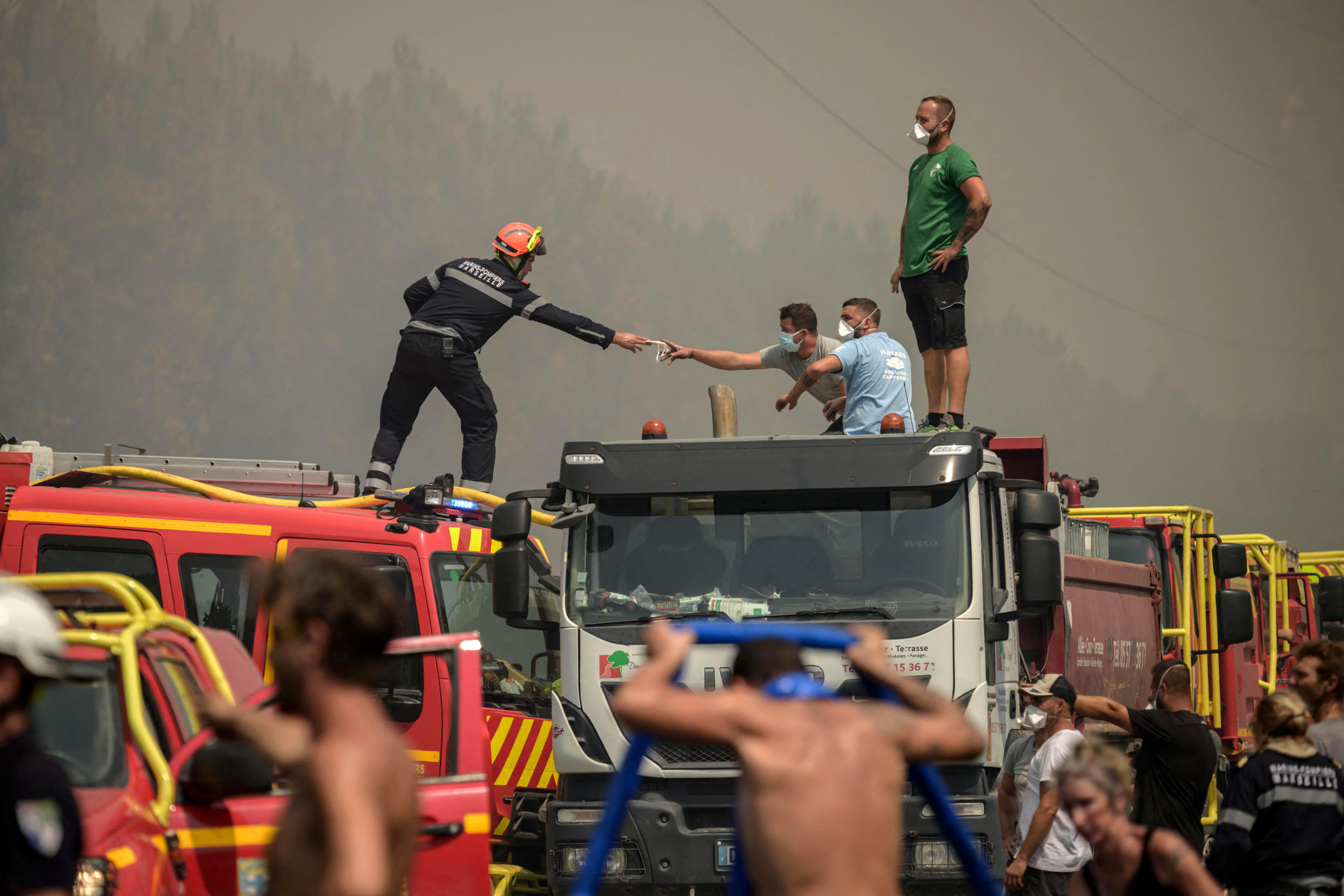
On July 22, Aurélie Filleau and her husband were given 10 minutes to get their children and a few possessions into the car before evacuating their house in Le Porge, a town near Bordeaux, France.
The family managed to bring their dog but left behind two cats and a parrot. “I wanted to protect them from the toxic smoke,” said Filleau, 40. “I never imagined the house would actually burn.” All three animals died.
The following day, while staying with family members in Bordeaux, Aurélie watched what she thought might have been her home burn live on French television. She and her husband hoped it wasn’t theirs and decided not to tell the children. Before they could, however, Timothe, 13, and Thibault, 11, learned the truth when classmates sent them photos of the house circulating on social media.
Filleau’s family was among thousands confronting an exceptionally destructive wildfire season across the world.
Since January, wildfires have burned more than 1.7 million acres across Europe and more than 8.5 million acres in the U.S. “The risk is growing more severe. We’re seeing phenomena that are more violent, more intense and more brutal,” said Christine Bouisset, a wildfire researcher at France’s National Centre for Scientific Research.
As the threat grows, researchers are also questioning whether the way communities prepare for fire needs to change.
In June, the CNRS published a scientific report on wildfires in which experts argued that climate change is challenging France’s current approach and its lack of community organizations. They pointed to Montecito, California, as an example of successful collaborative wildfire governance. “The question of sharing responsibility between institutions and citizens is a crucial governance issue,” the report said.
The dominant wildfire-risk governance systems in Europe, according to the report, remain largely structured around top-down institutional frameworks that do not adequately account for the complexity of social dynamics, local stakeholders or land-use practices, and struggle to involve residents in decision-making. “In France, citizens are very rarely involved. There are rules to follow, but they’re never asked for their input,” said Bouisset.
Across the U.S., a range of community organizations work alongside public agencies to help residents prepare for wildfires and reduce risks at the local level.
The Wildfire Adapted Partnership in Colorado was one of the first organizations to “develop the idea of volunteer neighborhood ambassadors, with community members who serve as examples to their neighbors on what fire-adapted living means,” said Bill Trimarco, Archuleta County program manager at WAP.
Different states have different programs. “These are tools,” said Kris King, a wildfire mitigation specialist at Lake Wenatchee Fire and Rescue in Washington state. “They’re all trying to do the same thing: to encourage residents to do something.”
One focus of these community organizations is making homes more resilient to wildfire. The idea is to encourage residents to make simple changes so that, even when a wildfire strikes, their homes are less likely to burn. “Start from the home and community, and work outward,” said Ralph Bloemers, director of Fire Safe Communities in Oregon.
That can mean screening attic and crawl-space vents with fine metal mesh to catch flying embers, keeping gutters clear of leaves and other combustible material, using fire-resistant roofing and getting a wildfire assessment. That’s where community organizations play an important role. “People know each other. They organize. They help the elderly. They have work parties. They share tools,” said Bloemers. “The places that I’ve seen where I drive around, I’m like, this place will survive fire.”
Washington has had plenty of reason to put those ideas into practice. This year, more than 900,000 acres have burned in the state, according to the Washington State Standard.
Alongside firefighters responding to those blazes, residents, fire districts, land managers and local organizations have spent years preparing communities for fires before they arrive.
The Washington Fire Adapted Communities Learning Network connects those groups across the state, helping them share strategies and learn from one another.
Keegan Fengler, who manages the network’s learning program, said there is no single blueprint. In some communities, residents organize around neighborhood projects; elsewhere, fire districts offer home assessments, vegetation removal or community meetings. The idea is to give local communities a role in deciding what wildfire preparedness should look like where they live.
The area near Lake Wenatchee in the mountains of central Washington is a case in point. The landscape is idyllic: In winter, snow blankets the lake and surrounding mountains; in summer, residents and visitors come to swim, hike and spend time along the shore. But the warm, dry months also bring a recurring threat: wildfire.
This story is funded by readers like you.
Our nonprofit newsroom provides award-winning climate coverage free of charge and advertising. We rely on donations from readers like you to keep going. Please donate now to support our work.
At Lake Wenatchee Fire and Rescue, the district has spent a decade expanding beyond responding to fires to helping residents prepare for them. “Today, they’re one of the most trusted sources of wildfire information for their residents,” Fengler said.
King, a mitigation specialist in the district for four years, works with the county, the U.S. Forest Service, the state Department of Natural Resources and the state Cascadia Conservation District in a program that is mostly funded through the federal government. “Because we’re so high risk, we’re seeing a lot of money and work directly in our area,” she said.
A recent grant is also funding a six-person local crew to clear vegetation and other potential wildfire fuels. “That’s been cool; it’s a pilot year for us,” she said.
King’s work often comes down to building relationships with residents, sometimes one household at a time. “One of my first years on the job, there was a local resident who saw that his neighbor had a bunch of brush and fuel right up against his house,” King said.
The resident knocked on his neighbor’s door and asked if he was willing to clean up. “It ended up working out. We had 10 volunteers on site, including two of our crew members; we brought our chipper, and it was just this sweet moment of community showing up to these guys they didn’t even know. We made a nice buffer around his home, and they had lunch and brought pizza for everybody,” she said.
In Lake Wenatchee, many residents appear to be taking those steps. The 2024 U.S. Forest Service research report, “Living with wildfire in Lake Wenatchee, Chelan County, Washington,” showed that 46 percent of the survey respondents said that they had made their homes more fire-resistant, with examples including replacing roofing or siding or adding hardscaping. Eighty-nine percent said they regularly mowed and raked around their homes.
Across the Atlantic, France’s own experience underscores how consequential vegetation around homes can be.
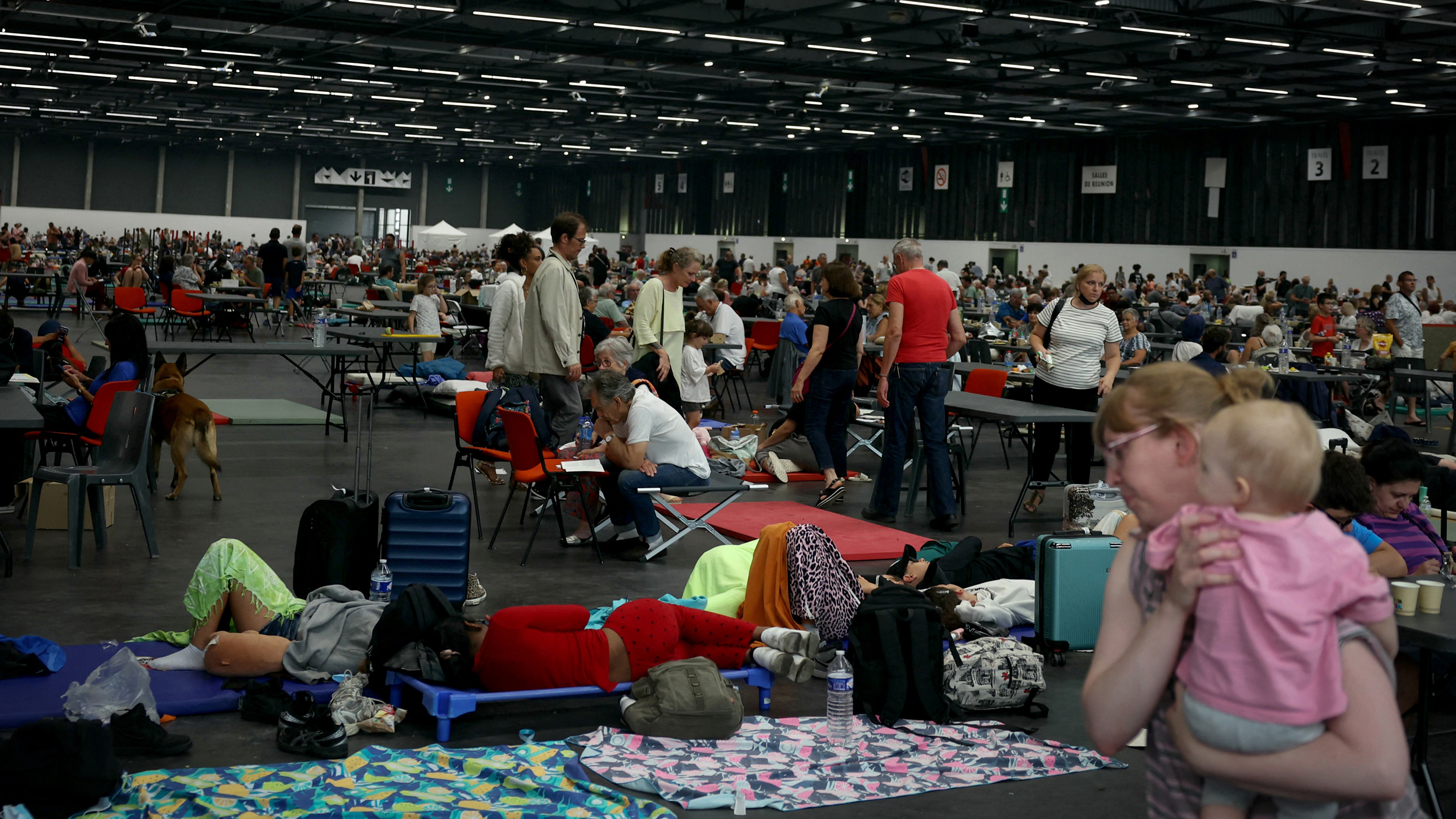
In a press release in early 2026, the French government said that “in 2025, nearly 190 buildings in France were severely damaged or destroyed by forest or vegetation fires. Yet 90 percent of homes destroyed in wildfires had either not been cleared of surrounding vegetation or had been inadequately cleared.”
France’s approach to wildfire preparedness relies more heavily on national rules and public institutions, which Bouisset said has the advantage of creating more uniform protections across the country. In the United States, local governments and communities have more autonomy—creating room for experimentation, but also wide disparities in how prepared one community may be compared with another.
The American approach has its own limits. Bloemers said local wildfire-preparedness organizations are often understaffed and dependent on volunteers. “Are our fire safe councils doing good work? Yes. Are they up to the task? Probably not,” he said. “State and local governments who they work with are also chronically underfunded.”
As wildfires become more intense, the challenge for both countries may be less about choosing between government action and individual responsibility than figuring out how the two work together. In Lake Wenatchee, King has seen what that can look like on the smallest scale: neighbors helping neighbors prepare before the flames arrive.
Since leaving their home in Le Porge on the coast in southwest France, Filleau and her family have moved six times, bouncing between rental homes. They are now staying in Andernos, a nearby town.
Life remains difficult for the whole family. Her younger son often cries, asking for his home and his cats. Insurance representatives have visited the town and inspected what remains of their house, but the family is still waiting for a second assessment before they know how much they will receive—and whether they will be able to rebuild.
Filleau said there is no comparable community organization in her town. “It sounds stupid to ask someone from the big town, sitting in an office, to deal with those fires,” she said.
About This Story
Perhaps you noticed: This story, like all the news we publish, is free to read. That’s because Inside Climate News is a 501c3 nonprofit organization. We do not charge a subscription fee, lock our news behind a paywall, or clutter our website with ads. We make our news on climate and the environment freely available to you and anyone who wants it.
That’s not all. We also share our news for free with scores of other media organizations around the country. Many of them can’t afford to do environmental journalism of their own. We’ve built bureaus from coast to coast to report local stories, collaborate with local newsrooms and co-publish articles so that this vital work is shared as widely as possible.
Two of us launched ICN in 2007. Six years later we earned a Pulitzer Prize for National Reporting, and now we run the oldest and largest dedicated climate newsroom in the nation. We tell the story in all its complexity. We hold polluters accountable. We expose environmental injustice. We debunk misinformation. We scrutinize solutions and inspire action.
Donations from readers like you fund every aspect of what we do. If you don’t already, will you support our ongoing work, our reporting on the biggest crisis facing our planet, and help us reach even more readers in more places?
Please take a moment to make a tax-deductible donation. Every one of them makes a difference.
Thank you,

Fellow
Alissa de Chassey is a French journalist and a fellow at Inside Climate News. Previously, she covered science and health for Le Figaro in Paris. She is currently pursuing a master’s degree in Science, Health, and Environmental Reporting at New York University. Her work has also appeared in Nature, The Guardian, and The Transmitter.
