


For three painful years, Israel’s genocidal war in Gaza, in retaliation for the Hamas terror attacks on 7 October 2023, has killed more than 74,000 Palestinians, wounded thousands more and reduced most of the territory to rubble. It has changed views of Israel across the world, increased support for Palestine and raised questions about US power.
Europe’s failure to hold Israel’s government to account has cost it global credibility and influence. But I fear something even more consequential than that: Gaza is changing Europe itself.
European governments did nothing to try to stop the genocide; there have been no collective sanctions, no trade restrictions or ending of arms sales to Israel. The EU sanctions Russia over its war in Ukraine but retains almost-business-as-usual ties with Israel, a blatant double standard.
Gaza has exposed how Europe’s supposedly universal commitment to human rights is now conditional on whose suffering is recognised, whose resistance is considered legitimate and whose demands for justice are considered worthy of attention. EU policymakers are selective even in the groups of women they choose to celebrate as heroic in struggles against occupation and the children whose right to life they defend.
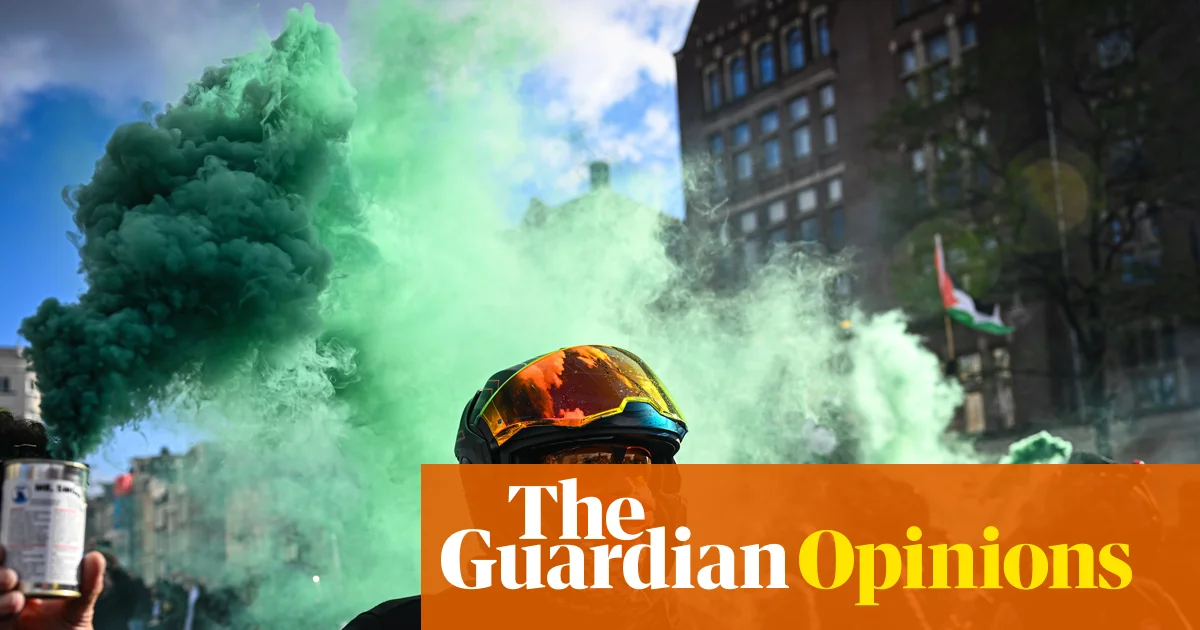
After these three years I am convinced that the question of Palestine has become a stress test for European democracy itself. Democratic societies can only thrive when there is space for dissent, including dissent that is uncomfortable, disruptive and politically inconvenient. Yet today, across Europe, governments – which speak up against undemocratic conduct abroad – are now unapologetic in imposing restrictions on free expression and peaceful protest at home. Police violence at pro-Palestinian demonstrations has become the norm, and those whose only crime is to speak up publicly for Palestinian rights are increasingly criminalised or made the target of suspicion.
When this happens repeatedly it undermines public trust in the legitimacy of democratic governments and institutions. As Rabin Baldewsingh, the Netherlands’ national coordinator against discrimination and racism tells me: “Governments and public institutions have a responsibility not to reinforce polarisation when society is deeply divided.” Sadly, the opposite appears to be happening.
Many societal fractures existed before Gaza, but they have received new oxygen and traction over the past three years. The EU’s Fundamental Rights Agency has long warned of both anti-Muslim racism and antisemitism. What has become increasingly troubling over the past three years is the political framing under which antisemitism in connection with Gaza is rightly treated as a threat to democracy, while Islamophobia is viewed through a security and anti-terrorism lens.
This can’t all be blamed on the far right, either. True, some extremist groups hide their age-old prejudices behind accusations that it is Muslims and refugees who have “imported” antisemitism into Europe. But the European People’s party (EPP) – the EU’s largest political “family” for pro-European centre-right and conservative politicians, including Ursula von der Leyen and Magnus Brunner, the EU’s most senior official for migration – is also giving old and debunked Islamophobic tropes a new and dangerous lease of life.
The party backed a resolution in June condemning the “interference of political Islam” in European democratic processes. If “political Islam” was interfering in European democracy, the resolution may have some validity. But there is no evidence for the claim, and certainly none advanced in this document, which merely echoes French conspiracy theories about “Islamist entryism” and calls for a crackdown on alleged members of Muslim Brotherhood networks. It claims to make a distinction between “political Islam” and the Islamic faith itself but it reads more like the start of a witch-hunt of European Muslims.
An even tougher EPP resolution, backed by a majority in the European parliament on 8 October, goes a step further by casting suspicion on Muslim civil society groups’ loyalty, activity and participation in European democracy.
Hiba Latreche, president of Femyso, a pan-European network of young Muslim organisations that is explicitly mentioned in the EPP’s attack, points out the double bind of such unfounded allegations. “When we are not active we are accused of communitarianism, separatism and lack of integration. When we engage and exercise active citizenship we are accused of having a hidden agenda.”
Such an environment demands even stronger anti-discrimination action. Yet Europe’s most powerful pro-equality body, the European Network Against Racism (ENAR), has just lost European Commission funding. Worried that this could mean it has to cease operations by the end of the year, ENAR has launched a legal challenge against the decision at the EU’s general court.
after newsletter promotion
Beyond the visible, there are many unwritten post-Gaza codes being applied inside the EU’s corridors of power that are harder to measure and challenge. Islamophobia has become “quite blatant”, EU officials tell me, with micro‑aggressions and remarks about Muslims’ supposedly “irrational and emotional” behaviour. Like von der Leyen in her recent “state of the union” speech, many now talk about Gaza as a humanitarian emergency, but not as a human-made genocide. There is agreement on the need for action against settler violence and illegal settlement in the West Bank, which is framed as the work of “extremists”, but confronting the Israeli government remains difficult.
For many, it has also been a time of uncomfortable conversations, ruptured personal relationships and disillusionment. But there are also moments of intense solidarity, as across Europe pro‑Palestinian movements have extended to include trade unions, faith groups – including Jewish activists – students, celebrities and senior politicians. Every Thursday, members of the EU Staff for Peace gather for a vigil outside the commission and the EU Council. Former EU commissioners, ambassadors and senior staff continue to write to their bosses urging stronger action against Israel.
So all hope is not lost. But Gaza has stripped away a great deal of self-soothing assumptions that many of us harboured about Europe. As the far right becomes more influential, too many have forgotten that democratic freedoms rarely disappear all at once. They begin to erode when some voices are silenced, some suffering is ignored and the rights of some citizens are treated as less deserving than others.
-
Shada Islam is a Brussels-based commentator on EU affairs. She runs New Horizons project, a strategy, analysis and advisory company
-
Do you have an opinion on the issues raised in this article? If you would like to submit a response of up to 300 words by email to be considered for publication in our letters section, please click here.
