


- Cambodian monkey farms have once again come under scrutiny as the global wildlife trade regulator warns the risk of fraud and corruption persists within the industry.
- A loosely regulated trade of long-tailed macaques, which spiked to fuel the development of COVID-19 vaccines, has seen wild populations plummet in Cambodia.
- The CITES Secretariat, the international wildlife trade authority, set Cambodia a series of targets last year to prevent monkey laundering, but the latest assessment shows progress is minimal a year on.
- Animal rights experts say Cambodia’s involvement in the trade continues to pose a threat to human health and wild monkey populations globally.
CHIANG MAI, Thailand — Global wildlife trade authorities say Cambodia has made little progress in cleaning up its monkey export industry, a year after the country was flagged as needing major reforms in how it manages the capture, breeding, and export of monkeys used in biomedical research.
In November 2025, following years of controversies, the secretariat of CITES, the global wildlife trade convention, issued a series of recommendations to Cambodia.
In a document released Oct. 5, CITES stated that limited improvements to Cambodia’s monkey farm governance mean it “cannot confirm or rule out the occurrence of fraud or corruption” in the country’s trade of long-tailed macaques, a species listed as endangered.
The statement comes ahead of the Nov. 2-6 CITES Standing Committee meeting in Geneva, where parties to the convention will assess progress made by countries placed under review. Countries unable to meet CITES standards can face trade bans.
Cambodia has faced widespread condemnation since a five-year United States Fish and Wildlife Services (USFWS) investigation found substantial evidence of Cambodian monkey farms laundering wild-caught monkeys as captive-bred. This, experts have warned, heightens the risk of zoonotic disease spillover — the transmission of pathogens from wildlife to humans — while also posing a threat to Cambodia’s wild population of long-tailed macaques (Macaca fascicularis), which dropped between 50% and 70% in the last three decades.
In the Oct. 5 document, the wildlife trade regulator said it “remains concerned about the limited progress achieved” in meeting the list of six recommendations issued to Cambodia in 2025.
The CITES Secretariat stated that the Cambodian government has failed to produce enough evidence that any of the recommendations have been fully implemented.
According to the secretariat, the Cambodian government had failed to update national legislation from 2006 in line with CITES standards. The document also noted that Cambodia was continuing to take macaques from the wild to restock breeding farms without having conducted population surveys to assess the impact this could have on wild populations. The CITES Secretariat noted that “Cambodia appears to consider animals captured in public areas as falling outside of the definition of ‘wild’ for the purposes of the Convention,” and complained of having explained “on several occasions” that these are still wild animals under CITES regulations.

When asked to provide copies of all export permits so that CITES could review whether permits listed individual monkeys’ ID numbers, the Cambodian government provided only five sample permits for review. CITES deemed this insufficient to determine whether this recommended policy was universally applied.
Cambodia also provided no information as to what happens to neck tags, which list an ID number for each monkey. These tags are supposed to be destroyed after export to prevent fraudulent misuse, such as being reused to establish a “captive-bred” pedigree for a wild-caught animal. CITES additionally found that these neck tags are often loosely attached to cages at export, rather than being systematically destroyed.
A microchipping program that was intended to replace the neck tag system also appears to have been delayed. Implementation was initially anticipated by the end of 2026, but Cambodia reported to CITES that this had been pushed back to 2028.
Due to the failure to implement these recommendations, the CITES Secretariat said Cambodia had also failed to prove its export permits reflect the accurate number of long-tailed macaques entering or leaving the country.
It was also too early to tell, according to the CITES Secretariat, whether Cambodian monkey farms were in fact providing accurate monthly reports of their stocks, with Cambodian authorities unable to produce evidence that new measures introduced were actually being followed.
The CITES Secretariat told Mongabay in an email it could not comment on ongoing compliance issues.

Long-tailed lawlessness in Cambodia
“The Secretariat’s statement speaks for itself,” Khim Finan, spokesperson for Cambodia’s Ministry of Agriculture, Forestry and Fisheries, which regulates the country’s monkey farms, told Mongabay by Telegram, a messaging app popular in Cambodia.
“Unproven claims do not constitute fact. Rather than addressing speculative premises, our attention remains fully focused on continuing our constructive cooperation with CITES,” he said.
When questioned on specific instances of fraud and criminality that have emerged from Cambodia’s monkey farms, Finan did not respond directly, instead saying “That’s all we have.”
Mongabay also reached out directly via message to officials listed as CITES Management Authorities in Cambodia, but none responded.

Cambodia narrowly avoided losing its ability to trade in long-tailed macaques back in February 2025 after the CITES Secretariat recommended a suspension of the exports of Cambodian macaques due to mounting evidence of irregularities persisting, even after the USFWS investigation concluded.
The global trade of long-tailed macaques reached $1.25 billion between 2010 and 2019, predominantly for pharmaceutical and biomedical research. Demand skyrocketed during the COVID-19 pandemic, which saw China, one of the world’s largest suppliers of long-tailed macaques, ban exports of monkeys to bolster its own vaccine development program.
Cambodian monkey farms stepped up to fill the global gap in supply, exporting more than 182,000 of the animals between 2020 and 2024, according to figures from the CITES trade database. Data from the United States International Trade Commission show that more than 56,000 of these long-tailed macaques, purchased for almost $355 million, were exported from Cambodia into the U.S. over the same period.
But in 2022, when Cambodia exports to the U.S. alone were valued at $213 million, high-level corruption and the laundering of wild-caught monkeys as captive-bred was exposed. Although USFWS failed to secure any convictions of those charged, exports dropped as key U.S. companies like Charles River Laboratories suspended their own sourcing of macaques from Cambodia. Trade data from Cambodian customs show that the U.S. and Canada combined imported fewer than 10,000 monkeys, valued at $37.7 million, across 2025 and 2026.

“Cambodia was given a roadmap for cleaning up this trade, and [the CITES Secretariat] shows it still hasn’t gotten there,” Lisa Jones-Engel, chief scientific adviser for primate experimentation with People for the Ethical Treatment of Animals (PETA), wrote in an email to Mongabay. “Wild monkeys are going into breeding farms, the risk of fraudulent reuse of identification tags has not been eliminated, and CITES says evidence that the reforms are actually working remains limited.”
PETA has long campaigned to end the trade of long-tailed macaques, and has routinely highlighted abuses, criminality, and irregularities within Cambodian monkey farms. Most recently, the animal rights organization wrote to U.S. Secretary for Health and Human Services Robert Kennedy Jr., warning him of the CITES Secretariat’s assessment of Cambodian monkey suppliers. Kennedy has previously voiced support for banning imports of live long-tailed macaques into the U.S. for research purposes, but hasn’t enacted any policy shifts so far.
“Last year CITES went into the Cambodian farms, laid out what needed to change, and gave Cambodia every opportunity to show that this trade could be cleaned up,” Jones-Engel said. “[The CITES Secretariat’s assessment] tells us they still haven’t. Years after the U.S. exposed how monkey laundering worked, the same vulnerabilities remain. At some point, oversight that never stops the trade stops being meaningful oversight.”
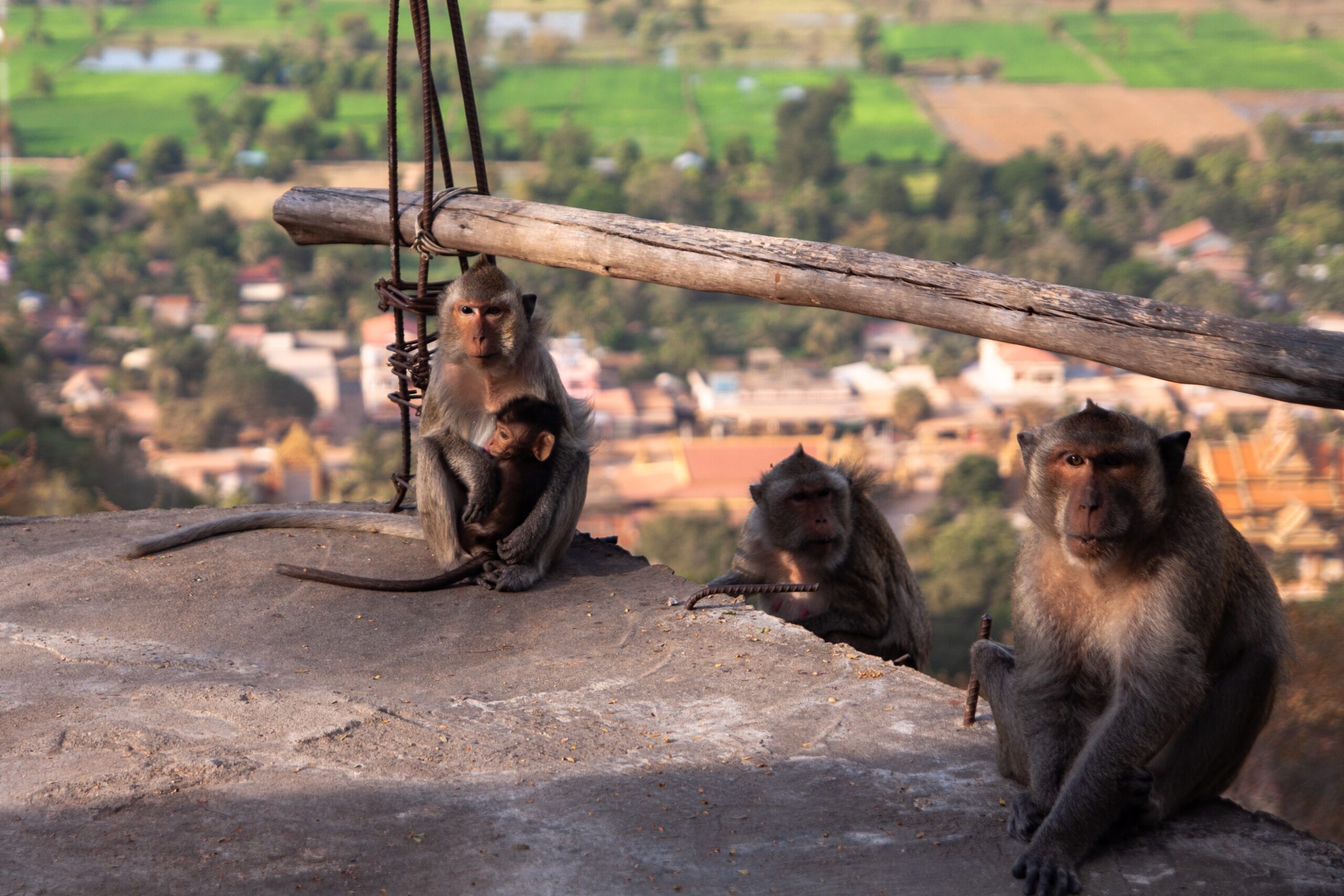
Banner image: Long-tailed macaques living in the mountains of Cambodia’s Battambang province. Photo by Gerald Flynn / Mongabay.
Cite this article
Gerald Flynn (2026). Cambodia was told to clean up its monkey trade. Regulators say it still hasn’t. Mongabay Conservation news. DOI: https://doi.org/10.66709/news-332680

