


Across Cukurova, the alluvial plain in southern Turkey that lines the easternmost inlet of the Mediterranean Sea, farmers till land so fertile that it bears three harvests a year. Rivers feed cash crops of cotton, corn, wheat, sunflowers, rapeseed, and soybean; the muggy climate warms greenhouses filled with tomatoes, bananas, and avocados; and the mineral-rich soil supports a wide array of produce—citrus, peanuts, lemons, olives, pomegranates, watermelon, and more.
It is also, however, a key node in a newly vital route for oil otherwise blocked by the wars in Ukraine and Iran. The Fertile Crescent’s last great expanse of farmland spared by centuries of drought, war, and mismanagement is now vulnerable as Turkey moves to accommodate some 850,000 extra barrels of oil per day, with plans for much more.
Across Cukurova, the alluvial plain in southern Turkey that lines the easternmost inlet of the Mediterranean Sea, farmers till land so fertile that it bears three harvests a year. Rivers feed cash crops of cotton, corn, wheat, sunflowers, rapeseed, and soybean; the muggy climate warms greenhouses filled with tomatoes, bananas, and avocados; and the mineral-rich soil supports a wide array of produce—citrus, peanuts, lemons, olives, pomegranates, watermelon, and more.
It is also, however, a key node in a newly vital route for oil otherwise blocked by the wars in Ukraine and Iran. The Fertile Crescent’s last great expanse of farmland spared by centuries of drought, war, and mismanagement is now vulnerable as Turkey moves to accommodate some 850,000 extra barrels of oil per day, with plans for much more.
Existing oil and industrial facilities have already displaced many of Cukurova’s farmers and fishers. But the expansion underway could complete the plain’s transition from an area that can still live off its arable land and abundant waters—now a luxury in the drought-strained region—to an energy shipping and petrochemical hub. Not only could these industries nearly replace farming; they could permanently alter the land and water that sustain it, making it unfeasible for it to ever return.
A worker harvests cotton in the Cukurova district of Adana, Turkey, on Sept. 12, 2019. Ibrahim Erikan/Anadolu Agency via Getty Images
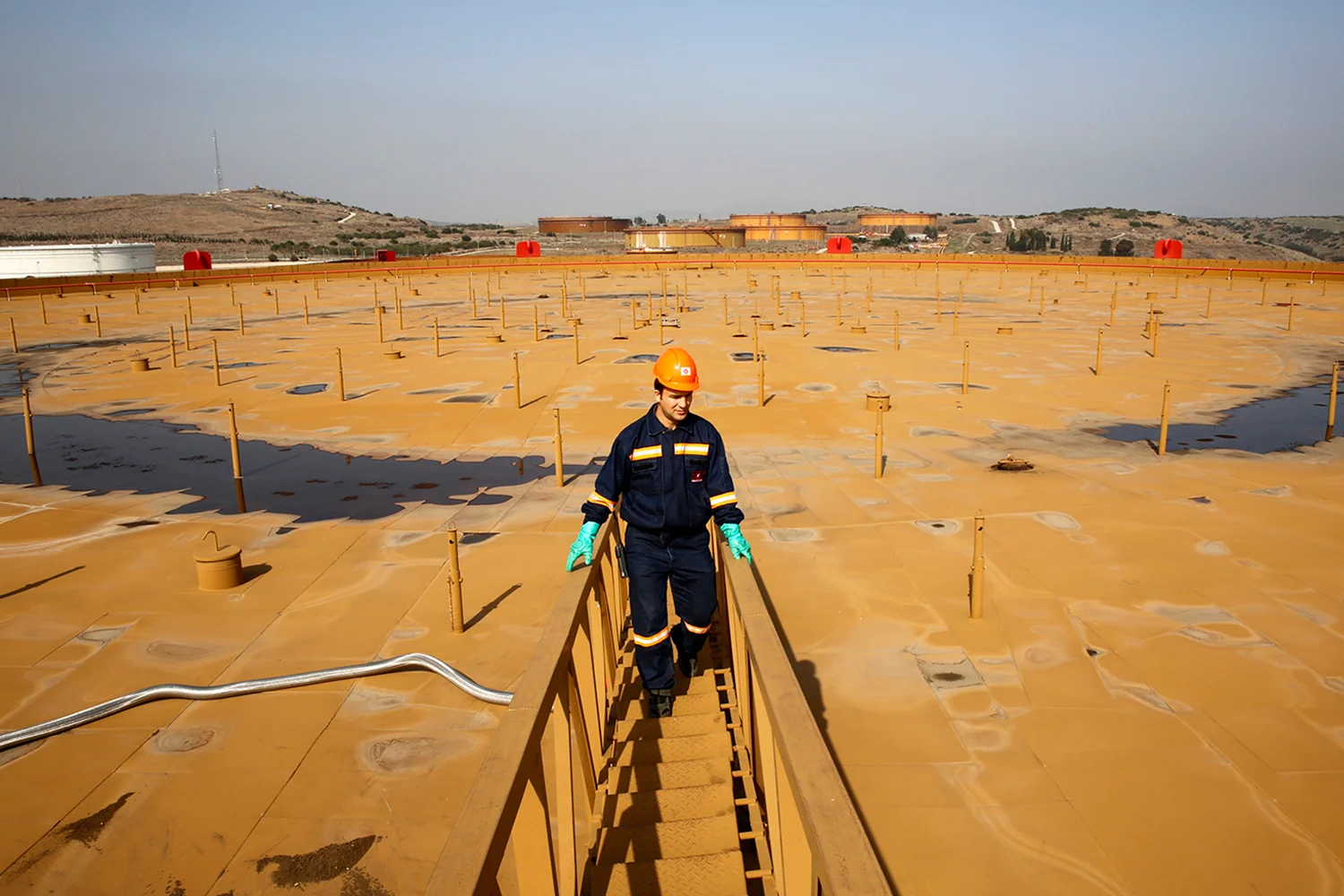
The center of this transformation is Ceyhan, a district in Adana province with a stretch of villages along the coastline. Known for having some of the most productive farmland in Cukurova, Ceyhan also hosts one of the Mediterranean’s busiest energy ports, where two major crude oil pipelines terminate: the Baku-Tbilisi-Ceyhan (BTC) pipeline, which routes from Azerbaijan through Georgia, and the Kirkuk-Ceyhan pipeline, which brings oil from northern Iraq. In recent months, with Ukrainian drones striking Russian pipelines and Iraqi oil vessels blocked in the Strait of Hormuz, Turkey’s pipelines have offered an alternative to traditional export routes.
Other countries, including Israel, Romania, and Syria, claim that they will be able to bypass these blockages, but the alternative pipelines, both existing and planned, connecting to the Mediterranean or to the Black Sea are low volume, unsafe, or unrealistic. Ceyhan, at least, has two active pipelines that are cheaper and faster than other current options.
“I don’t think that there is a transit route or a hub that is entirely risk-free,” said Carole Nakhle, an energy economist and the founder of Crystol Energy, a British advisory firm. “That’s one area where Turkey perhaps has an advantage.”
Many countries are reacting to the stoppages by turning to alternative energy sources; Turkey is instead doubling down on its oil industry. While demand for oil as a fuel is slowing, demand for it as a raw material for petrochemical products is surging. Turkey is capitalizing on this by scaling up, consolidating, and formalizing oil-related development. It is quadrupling oil storage capacity around the Ceyhan terminals, aiming to meet and eventually exceed the pipelines’ combined capacity of 2.7 million barrels per day. It is also fast-tracking environmental and zoning permits for energy-related projects—including highways, a high-speed rail, logistical centers, and mines—and reviving plans for a massive expansion of petrochemical production.
The largest of the planned petrochemical zones, backed by new multinational financing secured by Turkish conglomerate Ronesans, lies just north of the Ceyhan oil port. Scheduled to open next year, the Ceyhan Energy Specialized Industrial Zone—managed by the Eastern Mediterranean Petrochemical Cluster, or DAPEK—will host a $1.7 billion polypropylene plant, a hydrogen recovery energy plant, gas and liquefied natural gas storage, and jetties and cargo terminals for clusters of petrochemical production. This zone and half a dozen others, all interlinked with power stations and streamlined management, will sprawl across 7,356 acres in the Ceyhan and Yumurtalik districts, occupying nearly their entire coastlines.
The Turkish Ministry of Industry and Technology says the expansion will create 80,000 blue- and white-collar jobs and elevate Turkey from a crude oil transit country with a growing trade deficit to an exporter of “high value-added, competitive, and sustainable products.”
“The workforce, which used to be predominantly agricultural, is now shifting rapidly from unskilled to skilled labor,” said D. Emre Kaya, an environmental engineer who prepared social and environmental impact studies for several Ceyhan projects backed by international funders.
This expanded activity has already begun to shift the center of gravity for development across Cukurova. The uptick in investments around Ceyhan has indirectly accelerated the sell-off of arable land across Adana to land speculators and real estate developers. Turkey designated Cukurova a protected great plain in 2017, limiting the government’s ability to rezone and build on agricultural land. Yet Ceyhan and other Adana municipalities have continuously approved new zoning plans that challenge those protections. This pattern will accelerate as housing and amenities expand to cater to incoming workers, said Burhan Ozalp, who teaches the political economy of agriculture at Cukurova University.
Those most directly affected by this sectoral transition—the olive cultivators, cattle herders, beekeepers, and fishers whose livelihoods depend on the land being cleared for industrial zones—are skeptical of its benefits. The U.S. International Development Finance Corp. (DFC), which is partially financing DAPEK’s polypropylene plant, one of the projects attracting the most scrutiny, hired Kaya to draft a report on how to mitigate potential risks. Kaya met with residents who would be displaced by the plant to explain how DFC could compensate them through jobs, resettlement assistance, or payouts for their losses, depending on their circumstances. Last year, DFC received so many complaints from these villagers about inadequate compensation that it initiated an audit to address the dispute. DFC, DAPEK, and the Adana Chamber of Industry did not respond to requests for comment.

An aerial view of Cukurova, one of the most agriculturally productive areas of the world, on Nov. 26, 2018. Ibrahim Erikan/Anadolu Agency/Getty Images
Even before this sectoral transition began, agriculture in Cukurova had already been weakened by decades of structural change. Smaller farms have struggled to adapt to liberalizing reforms introduced around 2001, and more recently, years of high inflation and increased costs have pushed record numbers of farmers to foreclosure. From 2004 to 2023, Turkey lost at least 8.9 million acres of farmland—an area about the size of Taiwan. Three of Cukurova’s provinces lost 16,321 acres of farmland, half of them in Adana, between 2012 and 2018. These provinces still grow 46 percent of Turkey’s fresh produce exports—as well as the vast majority of its citrus, peanuts, and soybeans—but most of these crops saw a dramatic drop in yields last year.
Sadun Bolukbasi, who tends a tangerine orchard passed down from his grandfather in Erzin, the district east of Ceyhan, worries that farms that have managed to stay in business will founder when the petrochemical plants arrive. Unlike some of the industrial facilities already operating in the area, which run on seawater, the petrochemical plants will need vast amounts of drinking-grade freshwater. DAPEK is requesting up to 200 liters of water per second for its construction phase and twice that amount during operation, which it plans to extract from the Aslantas Dam. Bolukbasi, who also heads the board of the Adana Environmental and Consumer Protection Association, said that until it builds a water supply system, the company is transporting water from the Burnaz Springs, which risks depleting the surrounding districts’ groundwater and drinking water reserves.
Yet once DAPEK switches to the dam, its reservoir will be pumping water to multiple clusters of petrochemical plants, leaving little for the fields downstream. Already in 2024, local authorities told farmers who irrigate via the Aslantas Dam to not plant a second crop since its levels were too low. Bolukbasi and other members of his cooperative saw their crop shrivel from thirst, making it unsellable. Those further upstream lost their harvest entirely.
He and other environmentalists warn that additional petrochemical activity and urban development could also overwhelm water treatment plants—or worse, cause accidents such as oil spills, chemical leaks, gas explosions, and resulting fires that could severely contaminate the soil and groundwater. Other heavy industry and chemical factories in Adana have already been caught dumping toxic discharge into the Ceyhan River and the Mediterranean, poisoning fields downstream and wiping out entire fish populations.
“This struggle has shifted from an ecological battle to a struggle for survival,” Bolukbasi said.
-

A calm river reflects nearby palm trees, greenery, and buildings along its grassy bank under a clear blue sky. - The Ceyhan River as it flows south out of Adana on Oct. 30, 2025. Mehmet Yağız Çapanoğlu photo for Foreign Policy
-

Several multi-story concrete building frames under construction stand behind a metal fence alongside a paved road under a blue sky with fluffy clouds. - New construction in the outer districts of Adana on Oct. 30, 2025. Naomi Cohen photo for Foreign Policy
While farms and oil infrastructure compete in many ways for land and water, they are also increasingly interlinked, Ozalp said. Fields in Adana already depend on locally made oil-based fertilizer; corn growers are currently looking into converting their corn stalks and agrowaste into biofuel and their cornstarch into bioplastics. Alongside petrochemical zones, Adana is also planning “eco-industrial parks” for food processing, aquaculture, and high-tech greenhouses that will benefit from the growing energy and logistical infrastructure on the coast.
As for the footprint of all of this industrial buildup, Kaya said that besides careful environmental planning before construction, facilities that follow international finance protocols also consistently monitor their impact while operating. What is not tracked, however, is their cumulative effect on the region. The most dangerous and neglected form of pollution, he said, is to the air.
Combustion, flare from propane tanks and pipelines, leaks during storage and processing, and other activities associated with petrochemical plants will emit heavy metals and volatile organic compounds that can cause smog, acid rain, and cancer. The particle pollution level in Adana is already four times the value recommended by the World Health Organization, which environmental watchdogs tie to 1 in 5 deaths in the province.
Besides damaging the health of villagers and crops, intensified activity around the Gulf of Iskenderun will also hurt marine life. Lawyers have pressured the government to do more to protect its fragile ecosystems, including wetlands and lagoons, rather than approve more sea traffic. Years of dredging, port expansions, and discharge from oil tankers and cargo ships threaten fish, squid, and sea turtles, as well as meadows of Neptune seagrass, known as the “lungs of the Mediterranean,” cutting off a vital source of oxygen for the wider basin.

Gazelles stand next to an oil tank at the port of Ceyhan on Feb. 19, 2014. Umit Bektas/Reuters
Despite the wide repercussions of this industrial transformation, those speaking out against it represent a “tiny” minority that struggles to reach other locals, said Sabriye Akkul, the communications lead for the Cukurova Ecology and Climate Memory Network, a group of ecologists who document how the plain is changing.
Following the U.N. Climate Change Conference, or COP26, in 2021, the Climate Justice Coalition sent a caravan to Cukurova the following year to meet with Bolukbasi and others leading campaigners against the iron-steel plants, coal-fired thermal power plants, and other major emitters along the Iskenderun coastline. Now, as Turkey prepares to host COP31 less than 300 miles west of Ceyhan, the problems these activists warned about are becoming harder to ignore.
“There’s a big contradiction here in Turkey,” Akkul said. On the one hand, the country will showcase to the world its investments in green energy, as oil prices soar from the wars next door. On the other hand, Turkey—which has set a net-zero greenhouse emissions target for 2053—will be processing record volumes of oil because of these wars, at the expense of one of the world’s most fertile agricultural plains.
