


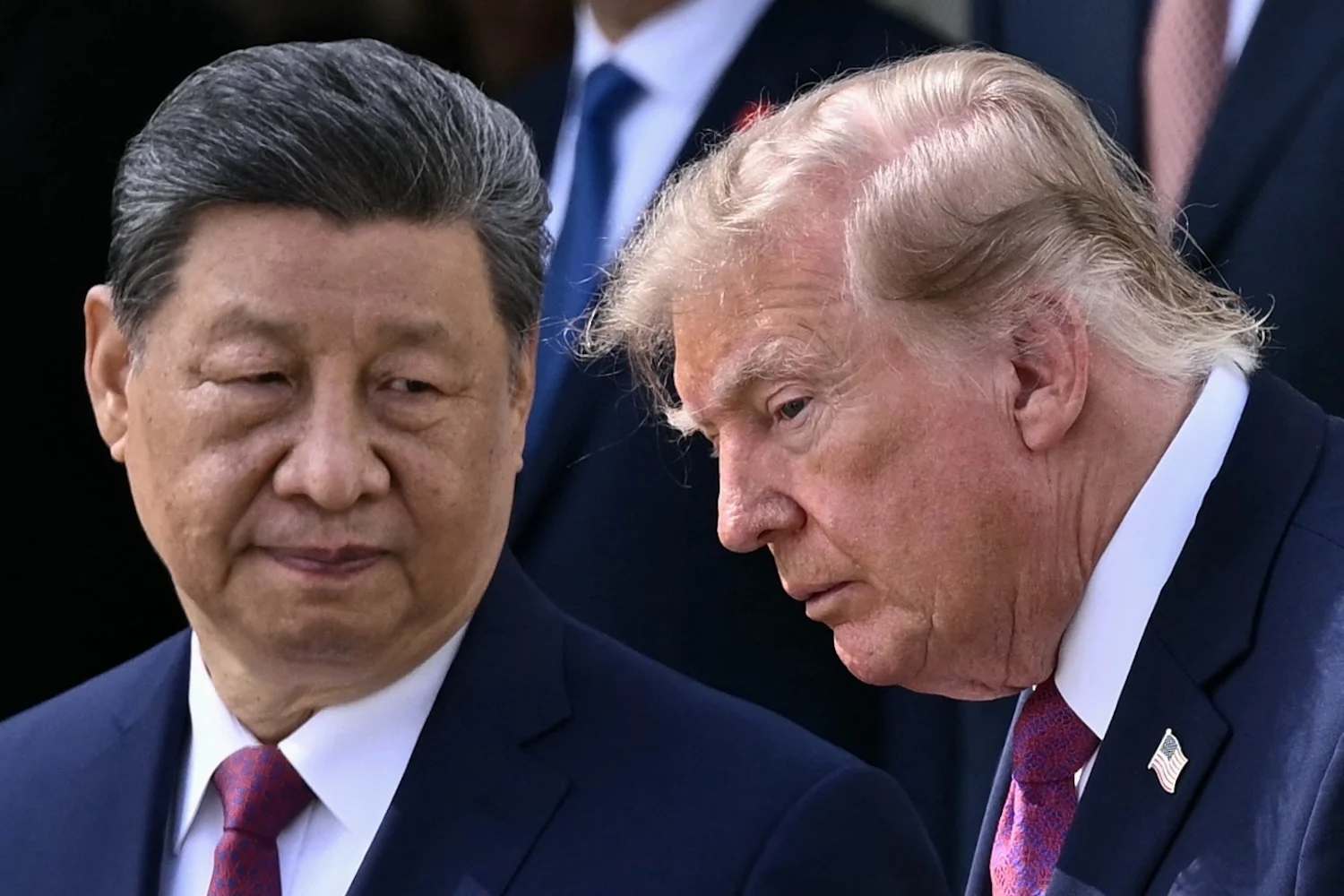
One of the most important outcomes of the recent summit in Washington between U.S. President Donald Trump and his Chinese counterpart, Xi Jinping, is something we are unlikely to learn soon, if ever.
This has nothing to do with the failure of the delegations to release a joint statement, or even the large discrepancies between each side’s readout of their meetings. Rather, it is about the private estimates that Xi must have made at the conclusion of his visit concerning two related questions: Who, deep down, is Trump, and what does his presidency say about the state of the United States as the world’s incumbent superpower?
One of the most important outcomes of the recent summit in Washington between U.S. President Donald Trump and his Chinese counterpart, Xi Jinping, is something we are unlikely to learn soon, if ever.
This has nothing to do with the failure of the delegations to release a joint statement, or even the large discrepancies between each side’s readout of their meetings. Rather, it is about the private estimates that Xi must have made at the conclusion of his visit concerning two related questions: Who, deep down, is Trump, and what does his presidency say about the state of the United States as the world’s incumbent superpower?
A column like this is necessarily speculative, so I am going to venture my best guesses. The first is by far the easiest: Trump’s extraordinary unctuousness in giving Xi the red-carpet treatment and flattering him at every turn stands no chance of turning the two men into genuine friends, as Trump often seems to believe.
Like any nation, China has made many errors and miscalculations over the decades, but in the post-Mao era, it generates policies through a disciplined process, whose goal is a sober and rational assessment of China’s—or at least the Chinese Communist Party’s (CCP’s)—interests. Friendship in the normal, personalized sense of the word has little to do with this. This is a rule that I would even extend to the theatrics of bonhomie played out between Xi and Russian President Vladimir Putin, whose Moscow serves as Beijing’s situational ally.
An admittedly more conjectural thought is that Xi may have found it highly amusing to watch Trump perform his interpretation of what authoritarian leadership consists of. It has become commonplace in U.S. political commentary to say that Trump fantasizes about having kingly powers. How else to interpret his lavish use of gold and his craze for monuments, especially ones that he hopes will bear his name down through the ages? But as Trump escorted Xi around the White House, extolling his helipad and the ballroom under construction, I am tempted to say that Xi must have taken him for a fool. For as much authority as Xi has concentrated in his own hands over the last 13-plus years, almost none of his energy has been consumed in the pursuit of personalized grandiosity.
Xi must also have thought poorly of his counterpart when Trump led him through a pavilion whose gilded walls featured portraits of U.S. presidents. They had been hung in ascending fashion, with Trump’s the highest of all. That is tacky enough by itself, but the Chinese leader stood by, looking as impassive as ever, as Trump paused before the frame devoted to his predecessor, Joe Biden. Instead of a portrait of Biden, it bore a photo of the autopen, the device that Biden often used to sign official acts (as other presidents have before him).
What Trump seemed oblivious to is that domestic politics and international relations at the highest level routinely warrant a careful distinction, as per the venerable U.S. saying about foreign policy that politics stops at the water’s edge. Xi caused waves in October 2022, when he had his predecessor, Hu Jintao, removed in front of a congress of the country’s top CCP officials, a rare sign of internal discord in a country where such things do not often surface in public. But it would be unimaginable for Xi to openly speak ill of any of his predecessors abroad. That is because he, like leaders of most nations with a well-developed sense of statecraft, understands that among his first duties while overseas is to promote a unified image of his country and its system.
At a minimum, Xi must have also felt that Trump was deeply confused when Trump dissed the U.S. media in his presence and expressed ill-concealed envy about the fact that the Chinese media reports what Beijing wants it to. Trump seems to believe that pro-government media coverage is a matter of banning news outlets whose criticism offends him. Xi knows better. The difference between the U.S. and Chinese press regimes is anchored in fundamental differences between democracy and dictatorship.
But there is something more in play: Press freedom in the United States, guaranteed by the Constitution, has long reflected not just legalism, but the deeper national self-assurance of a system that does not fear its own critics. Given this, I found myself wondering whether Xi concluded that he was witnessing not merely a president descending into cartoonishness, but the growing signs of a nation that has lost its way, including the self-confidence that Chinese leaders have long respected and even envied.
By way of comparison, examine how each man has operated atop his very different system. Xi’s rule should be seen as a strategic and highly determined conquest of near-absolute power. For some, this began even before he assumed leadership of China in late 2012, when he disappeared from view for roughly two weeks that September. Many accounts say that he used this stunt to exact commitments from older officials to grant him much more power than other newly installed leaders enjoyed in the post-Mao era.
Since then, Xi has methodically used sweeping anti-corruption drives not just to crack down on graft, but to eliminate party officials whose loyalty he felt was less than certain. He has done much the same with the high command of China’s military, imprisoning or retiring the virtual who’s who of its leading officers. This approach, among other moves, has given Xi the ability to rule indefinitely, bypassing the traditional two five-year mandates in place since Mao. Xi’s approach to power might be likened to the way a boa constrictor subdues its prey, through a gradual but relentless tightening of its grip.
None of this should be understood to mean that Xi is leading his country in the right direction, or that China’s continued rise is inevitable or lacking in deep internal contradictions. But neither can these things be said of Trump’s United States.
It is hard to conclude that what Trump has done, especially in his second term, will redound to the benefit of the United States, and much of my pessimism here is bound up in his style of leadership. Compared to Xi, Trump looks like a rank amateur: an incurious and ill-informed improviser who is guided by his own gut and whims; an impulsive man with little evident self-discipline who routinely takes pleasure in celebrating his own supposed greatness, wit, and wisdom.
For those who may think this harsh, consider the recent indictment of Trump’s leadership record by the billionaire Peter Thiel, one of the Republican Party’s largest recent donors. Thiel observed that Trump’s second administration has overcorrected from the internal conflicts of the first by imposing loyalty tests that have produced, in his words, “an administration staffed by not very smart but loyal people.” The strategic consequences of that choice are now playing out on the world stage, from Iran and the broader Middle East to Ukraine to East Asia.
As a result, Trump has made one of Xi’s most dangerous potential miscalculations significantly more likely. Now, Xi may be more inclined to overestimate his own ability and power, along with that of China—say, with regard to power plays involving Taiwan or Japan—and underestimate the United States’ chances of recovering from the self-damaging debacle of the Trump years, which under no circumstance will be easy.
