


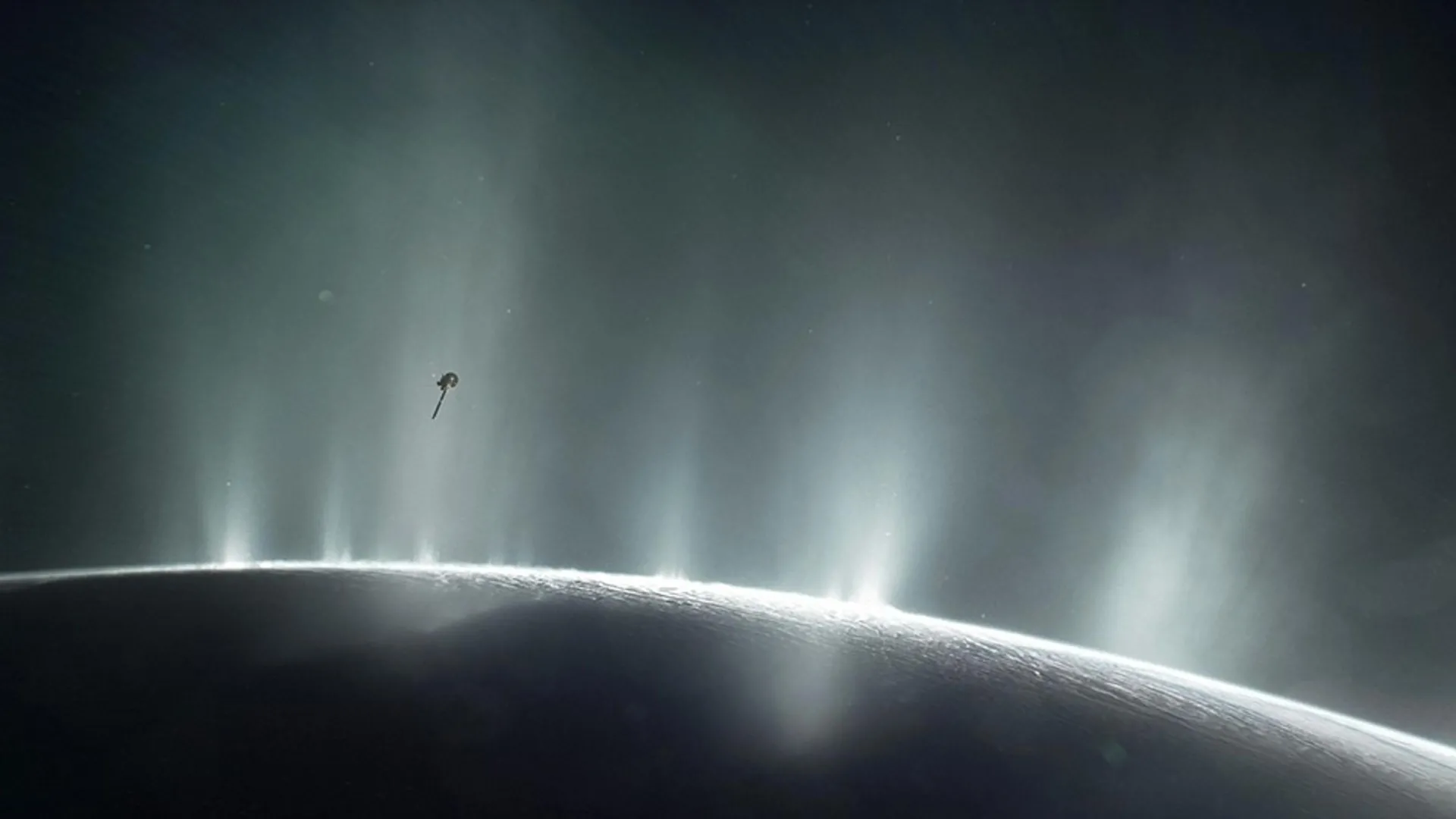
Saturn’s moon Enceladus is covered in ice, but beneath that frozen shell lies a global ocean. Near the moon’s south pole, fractures in the crust release water vapor and ice particles into space. Those particles give scientists an unusual way to study an alien ocean without having to drill through kilometers of ice.
An international team that includes researchers from the Earth-Life Science Institute (ELSI) at the Institute of Science Tokyo has now investigated what happens to that ocean water as it moves from beneath the surface and eventually becomes the tiny ice grains detected in space.
Cassini Found Surprisingly Diverse Ice Grains
Between 2004 and 2017, the Cosmic Dust Analyzer on NASA’s Cassini spacecraft measured the composition of individual ice particles in Saturn’s E-ring. That ring is continually supplied with material erupting from Enceladus.
A team led by Prof Frank Postberg at Freie Universität Berlin examined 961 mass spectra from salt-rich grains known as Type 3 particles. If the grains were simply small samples of the same ocean water, scientists might expect them to contain broadly similar mixtures of salts.
Instead, the grains varied dramatically.
Some were especially rich in sodium chloride, while others contained higher amounts of carbonates, phosphates or potassium chloride. One particularly striking pattern was that chloride and carbonate rarely appeared together in the same sodium-rich particle.
That raised a basic puzzle. If all of these grains came from the same ocean, why did their chemical compositions differ so much?
Recreating Enceladus’ Ocean Droplets in the Lab
To explore that question, Professor Yasuhito Sekine and colleagues at ELSI created laboratory droplets containing the major salts thought to be present in Enceladus’ ocean.
The researchers froze droplets of different sizes under different cooling conditions, then studied how the chemical elements were distributed once the droplets had solidified.
The results showed that the speed of freezing plays a major role.
In droplets about 200 micrometres across, salts became separated into different regions when freezing occurred relatively slowly, at approximately 10 K per minute or less. When the droplets froze more quickly, their chemical ingredients remained much more evenly mixed.
“What surprised us was that the diversity seen by Cassini could emerge from droplets originating from essentially the same ocean water,” said Sekine. “Our experiments show that when relatively large ocean droplets freeze slowly, different salts can separate within them. If those frozen droplets are later broken apart, they can produce much smaller ice grains, each with very different chemical compositions.”
A Slower Journey Through Enceladus’ Ice
The findings may also reveal something about what happens inside the moon’s icy crust.
Earlier studies generally assumed that seawater spray from Enceladus freezes quickly and moves rapidly toward space soon after leaving the ocean. The new experiments point to a different scenario.
The droplets may initially move much more slowly through the underground vent system, following complicated pathways through fractures in the ice before they approach the surface.
The researchers suggest that ocean spray first forms droplets ranging from tens to hundreds of micrometers in size. As those droplets move slowly through deeper sections of the vents, they gradually freeze, giving salts enough time to separate into different regions.
Closer to the surface, conditions change. Gas begins moving faster, and the frozen droplets can slam into the walls of narrower icy channels at high speed. Those collisions may break the droplets into much smaller pieces.
Each fragment can come from a different salt-rich region within the original frozen droplet, creating grains with very different chemical compositions. Those fragments can then escape into space and become part of Saturn’s E-ring.
“The Cassini data showed us that these salt-rich grains are far more chemically diverse than an average ocean composition would suggest,” said Postberg. “Combining those observations with the freezing experiments gives us a physical explanation: Cassini may have sampled fragments of larger frozen ocean droplets, each preserving different components that became separated during their journey towards the surface. The abundance of each individual component in the ocean is then reflected in the number of fragments in which a particular component is found.”
Enceladus May Naturally Concentrate Key Compounds
The discovery could be especially important for future missions to Enceladus.
As droplets freeze and break apart, individual compounds can become concentrated in particular grains. The process does not only separate different salts. Earlier work has also shown that organic substances can become separated from one another and appear at elevated concentrations in certain particles.
That could make future analysis considerably easier.
Compounds that are highly diluted in Enceladus’ ocean and mixed with many other substances may become much easier to detect when concentrated into individual ice grains.
On Earth, laboratories often spend considerable effort separating and concentrating chemicals before analyzing a sample. Enceladus appears to perform both of these “sample preparation” steps naturally: The chemical components become separated, and some end up concentrated within a fraction of the ice particles.
Possible Implications for Prebiotic Chemistry
Slow freezing could have another important consequence.
As ice crystals grow, small pockets of liquid brine may remain trapped between them. Salts and organic compounds can become highly concentrated inside those pockets.
That concentration could matter for prebiotic chemistry, which involves chemical processes that may precede the emergence of life. One major challenge in such chemistry is bringing molecules that are normally very dilute into close contact with one another.
Because much of the material erupted from Enceladus eventually falls back onto the moon, this freezing, concentration and recycling process could potentially happen again and again.
Understanding how Enceladus forms its ice grains therefore does more than explain Cassini’s unusual measurements. It offers new clues about the hidden environment beneath the moon’s surface and may help future spacecraft correctly interpret the particles they collect while searching for evidence of habitability and possible signs of life.
