


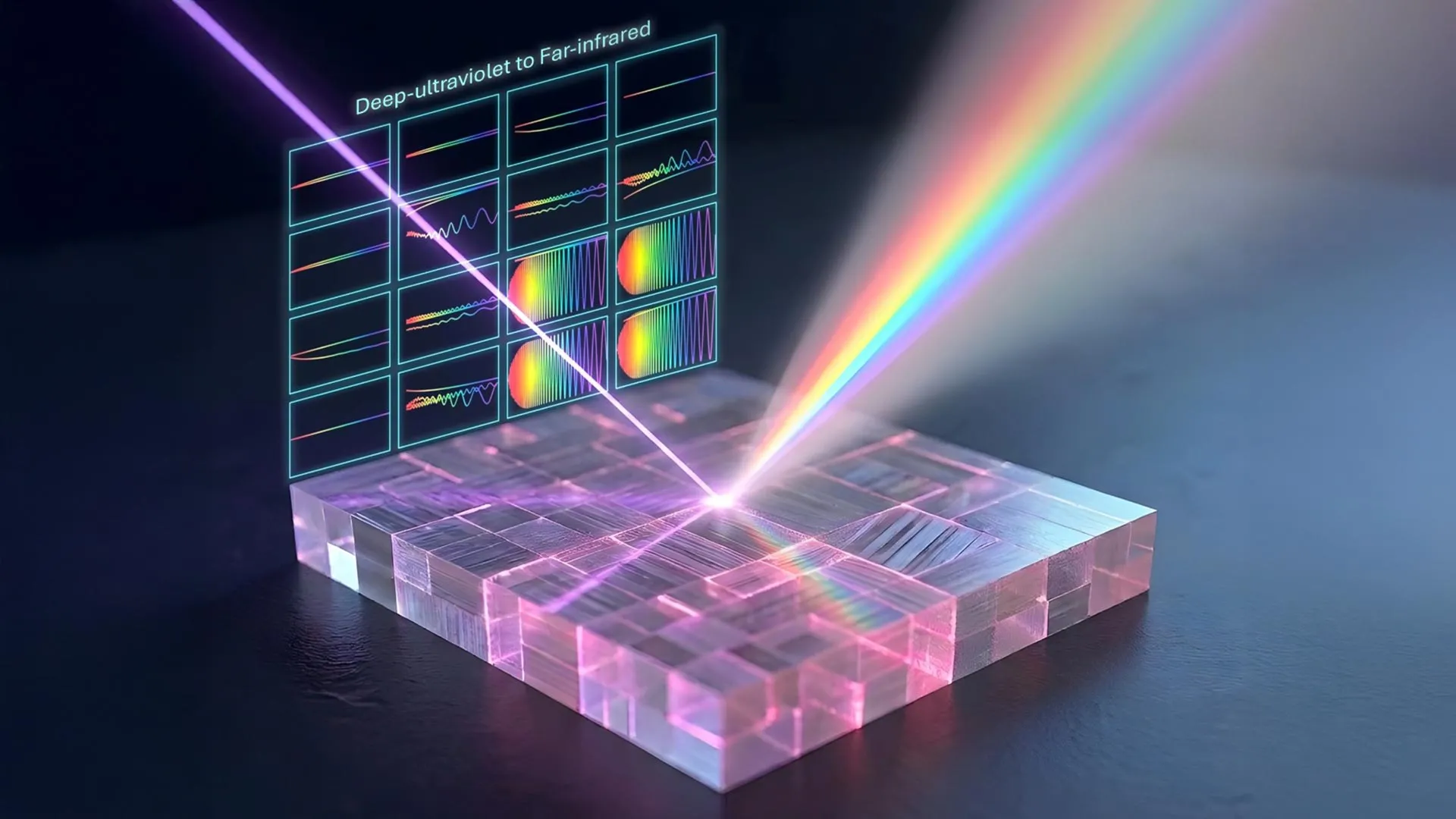
Light can carry vast amounts of information, but developing faster and more efficient optical communication systems requires precise control over how it travels. Scientists have now made an important advance in understanding barium titanate (BTO), a promising material that could help improve the performance of future devices that transmit information using light.
A research team led by KAIST has uncovered detailed information about how light moves through BTO and how much of it the material absorbs. These properties have been difficult to measure accurately for decades because of the crystal’s complicated internal structure. The new findings provide engineers with a more reliable foundation for designing optical devices that minimize signal loss and support faster data transmission.
KAIST (President Choongsik Bae) announced the results on November 8. The research was led by Professor Min Seok Jang of KAIST’s School of Electrical Engineering, working with Professor Harry A. Atwater’s group at the California Institute of Technology (Caltech), the Korea Research Institute of Standards and Science (KRISS), and U.S.-based J.A. Woollam Co. Together, the researchers examined how BTO interacts with light across wavelengths extending from the ultraviolet to the far-infrared.
Why Barium Titanate Could Transform Optical Communications
One of BTO’s most valuable characteristics is its ability to change how it affects light when electricity is applied. This behavior, called the Pockels effect, gives the material a strong electro-optic response and makes it especially attractive for optical modulators. These components convert electrical information into signals carried by light, making them important building blocks for advanced communication systems.
However, producing reliable devices requires a detailed understanding of two fundamental optical properties. The refractive index describes how light travels through a material, while the extinction coefficient indicates how strongly the material absorbs it. Engineers need both measurements to predict how light will behave inside a waveguide, a structure designed to direct light along a specific path, and how much of the optical signal may be lost.
Getting consistent measurements from BTO has been surprisingly challenging. The material can contain multiple microscopic regions, called domains, in which the crystal structure points in different directions. Because these regions interact with light differently, measurements of an entire sample can combine several distinct responses. This has contributed to widely conflicting reports of BTO’s optical properties over many decades.
Solving a Decades-Old Mystery About Light
To overcome this problem, the researchers used a sophisticated measurement method known as Mueller matrix spectroscopic ellipsometry. The technique examines how the polarization of light changes when light reflects from or passes through a material, allowing scientists to investigate its optical behavior in detail.
Rather than relying on crystals containing a complicated mixture of differently oriented regions, the team studied two types of single-crystal samples with relatively consistent domain orientations. This approach helped minimize overlapping optical responses and allowed the researchers to identify the material’s underlying properties more accurately.
Their measurements spanned wavelengths from 190 nanometers (nm) to 40 micrometers (μm), covering an exceptionally broad range of light from ultraviolet to far-infrared. Since a material’s optical behavior changes with wavelength, the scientists divided the spectrum into three regions and applied a different analytical approach to each. This revealed how BTO’s refractive index and light absorption depend on both wavelength and crystal orientation.
The researchers also investigated a particularly important range in which BTO allows nearly all incoming light to pass through. By combining ellipsometry with separate measurements of light transmission, they detected extremely low absorption, determining extinction coefficients of approximately 10-5 in the 2-10 μm wavelength range. These precise values will help engineers estimate how much light is lost as it travels through or remains confined within optical components.
In another advance, the team developed a way to predict the combined optical behavior of crystals containing multiple domains. Their method uses the orientations of those domains and the proportion of the crystal occupied by each to calculate the material’s overall response to light.
Opening the Door to Faster Data Transmission and Quantum Technology
The results could make the development of future optical devices more predictable and efficient. With accurate information about BTO’s behavior, engineers can model how light will travel through components of different shapes and dimensions before manufacturing them. They can also better estimate absorption losses, potentially reducing the need for repeated prototypes, costly redesigns, and extensive testing.
The potential benefits extend beyond conventional optical communications. BTO could also play an important role in devices that produce light at different wavelengths, as well as photonic circuits that use light to process quantum information. Such technologies depend on controlling light with exceptional precision.
“This study reveals the optical response of barium titanate, which had long remained unclear, and provides a reliable reference for how the material interacts with light,” said Professor Min Seok Jang.
Jang also emphasized that the findings could contribute to optical communication devices capable of transmitting data faster while reducing light loss. The improved understanding of BTO may also support the development of quantum photonic technologies, where precise manipulation of light is essential.
The study was published online on October 20, 2026, in ACS Photonics. Jiwon Kang, a Ph.D. candidate in KAIST’s School of Electrical Engineering, and Dr. Nina Hong of J.A. Woollam Co. served as co-first authors. Professors Min Seok Jang of KAIST and Harry A. Atwater of Caltech were the corresponding authors.
Funding was provided through the Culture, Sports and Tourism R&D Program administered by the Korea Creative Content Agency (KOCCA), with support from the Ministry of Culture, Sports and Tourism; the Basic Science Research Program administered by the National Research Foundation of Korea (NRF), with support from the Ministry of Education; the Ministry of Science and ICT; and the U.S. Air Force Office of Scientific Research (AFOSR).
