


- Research and reporting from across the Americas show that marine conservation outcomes depend heavily on how well protected areas are managed, fishing regulations are enforced, and local communities are involved in decision-making.
- Some of the most promising opportunities for smaller family foundations lie in improving the management of existing marine protected areas, strengthening community fishing rights, and addressing shortcomings in illegal fishing enforcement.
- The evidence for habitat restoration is more mixed, while research on migratory marine species points to opportunities to improve fisheries management beyond the boundaries of protected areas.
- Drawing on academic literature and Mongabay’s reporting in English, Spanish, and Portuguese, Founder Founder and CEO Rhett Ayers Butler examines where relatively modest philanthropic investments could help address persistent gaps in marine conservation.
COP17 ended in Armenia amid disappointment over the lack of concrete measures to reduce biodiversity loss by 2030. Finance was a sore point. Philanthropy is only a small part of that picture, but foundations can take risks that public agencies often cannot. I think there are some particularly good opportunities for smaller foundations in marine conservation.
My intended audience is family foundations that give away perhaps $2 million to $15 million a year and have a handful of staff.
Over the summer I went through the academic literature and Mongabay’s coverage in English, Spanish, and Portuguese to see what the evidence actually shows about marine conservation outcomes in the Americas. A first summary of that assessment – “From paper parks to lasting protection, here’s what works in marine conservation” – appeared last month. In some cases Mongabay’s reporting helped me understand why the results of a study were so disappointing. Our reporters had spoken to the people responsible for managing these areas, as well as people who lived or fished in them.
In reading about some of these places, I was struck by how long the laws protecting them had been on the books. Some of the agencies responsible for enforcing those laws lack adequate funding. Elsewhere, the designation of a protected area was done with little regard for the people who fished there.

Making existing protected areas work
I suspect it’s easier to raise money to establish a marine protected area (MPA) than to pay the salaries of the people who will patrol it. The same applies to restoration: there is often more interest in planting mangroves than in what happens to those mangroves three or four years later.
No-take reserves and other highly protected areas have a strong ecological track record. But even some of the better-known MPAs in the Americas have problems with illegal fishing. At Revillagigedo, the Mexican archipelago in the Pacific, Mongabay found that some complaints of illegal fishing had been archived or remained unresolved.
Some MPAs have been in existence for years without the ecological monitoring needed to determine whether they’re working. There are others where I think money would be better spent on enforcing fishing restrictions or working with local fishers.
If the agency responsible for an MPA lacks the legal authority to enforce its rules, better-equipped patrols may accomplish very little. And if a grant is going to pay for patrols, who will pay for them once the grant runs out?
Fishing rights and local governance
Some of the more interesting opportunities involve relatively small fishing communities. These communities don’t necessarily need an MPA to manage the waters they fish. Chile’s territorial use rights for fisheries (TURFs) and fisher-created refuges show how area-based rights and local organization can support stewardship. Costa Rica’s marine areas for responsible fishing may do more for conservation than standard protected-area figures suggest.
Getting legal recognition for an area that fishers already manage could be a good use of a foundation’s money. So could helping a fisher organization keep better records of what its members are catching.
I’d want to know who actually makes decisions about the fishery. Women and poorer fishers may have little say, even in places heralded for community-led conservation. And sometimes it’s an outside organization that has most of the authority.
Enforcing fishing regulations
Illegal fishing is much easier to detect than it used to be, but seeing a boat on a screen is a long way from boarding it or levying fines on its owner.
At Revillagigedo, patrolling a vast marine reserve more than 500 kilometers off Mexico’s Baja California is difficult and costly. Before funding more surveillance at Revillagigedo, I’d want to know why some of the cases mentioned in our reporting didn’t go anywhere. Was it a problem with the evidence or with what the authorities did with it?
It may be considerably cheaper to catch a vessel breaking the law when it comes into port than when it’s hundreds of kilometers out at sea.
I’d be particularly mindful of the risks of asking local people to document illegal fishing in areas where the boats belong to powerful commercial or political interests.

Restoring coastal habitats
I was less convinced by some of what I read about restoration. Restoration projects appeal to funders partly because planting is easy to count. But the number of seedlings or coral fragments says little about whether a damaged habitat will recover. In mangrove restoration, for example, reestablishing tidal flow may be more important than planting trees. On reefs, the conditions that contributed to the loss of corals, including pollution and overfishing, may need to be addressed before much is spent on outplanting.
In Florianópolis, in southern Brazil, one of the arguments for restoring mangroves is the protection they afford coastal communities as the climate changes. Some of the money for this work could potentially come from climate funders.
Beyond protected areas
I spent some time looking at conservation efforts in the Eastern Tropical Pacific, particularly in the waters around Galápagos, Cocos, Coiba, Malpelo and Gorgona (CMAR). These islands are important for some of the same populations of migratory marine animals.
Much has been made of the marine corridors in this part of the Pacific. Research on shark movements helped make the case for the creation of Ecuador’s Hermandad Marine Reserve in 2022. But a study published this year found that silky sharks tagged in Galápagos spent about half their time outside protected areas. Could seasonal fishing restrictions or changes in fishing gear reduce shark mortality there? That seems worth exploring.
Even where MPAs have benefited from decades of investment, fisheries management can remain a problem. Conservation groups have worked on the Mesoamerican Reef for decades, and Belize has long-term monitoring and ways of financing its MPAs. Overfishing is still widespread, and most commercial stocks still lack catch controls.

Sharks, rays, turtles, seabirds and forage fish die in fisheries operating well beyond the boundaries of protected areas. Studies of illuminated gillnets in Peru have shown that bycatch can be reduced while maintaining target catch and market value.
On the demand side, Mongabay has reported on government purchases of shark meat in Brazil and the mislabeling of shark meat in Ecuador. I wouldn’t know where to begin as a small funder interested in addressing either problem without the help of someone who knows the industry well.

One question I had while reading some of the studies was what happened after the researchers left. Was there still money to manage the protected area or maintain the restoration site five years later?
There may be some good opportunities to provide a few years of funding to MPAs that are in the process of securing government funding or setting up a trust fund.
At the risk of stating the obvious, if I were running a family foundation, I’d spend some time talking to people who have been managing these places for years. I’d ask them about the things they haven’t been able to get their existing donors or governments to pay for.
In going through Mongabay’s reporting from across the Americas, I was encouraged by how many people have devoted much of their working lives to looking after a particular stretch of coast. I suspect many of these people could put a modest grant to very good use.
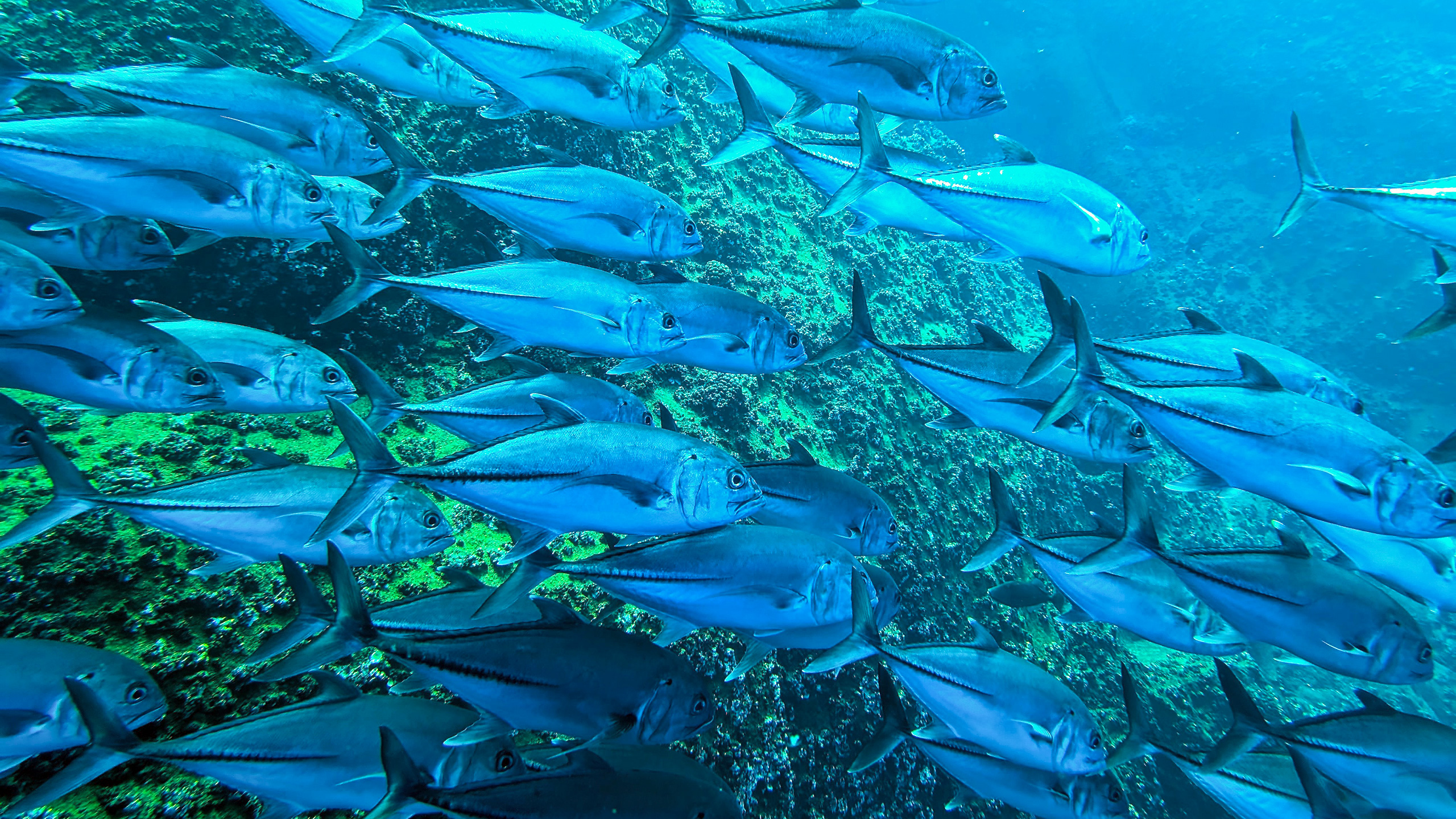
Banner image: Bigeye trevally (Caranx sexfasciatus) San Benedicto. Photo by Rhett Ayers Butler
