


- The Commission for the Conservation of Antarctic Marine Living Resources recently failed to reach an agreement that protects the Southern Ocean and species like whales, seals, penguins, and the crustaceans they all eat: krill.
- A new op-ed argues that as commercial krill-fishing vessels return to the Southern Ocean for the commencement of the new season on Dec. 1, the world will be watching to see if these ships’ owners’ promises to voluntarily distribute their efforts — and thereby protect krill populations — will hold.
- “This industry, which has intensified fishing effort in a biodiversity hotspot for whales, penguins and seals, and continues to catch and kill humpback whales in their nets, knows the consequences of its actions [and] the world will be watching,” the authors write.
- This article is a commentary. The views expressed are those of the authors, not necessarily of Mongabay.
Despite promising developments, the 27 member states of the Commission for the Conservation of Antarctic Marine Living Resources (CCAMLR) have again failed to reach an agreement that protects the Southern Ocean. Mired by consensus decision-making and shrouded from public view by confidentiality rules, Antarctica’s governance systems are no longer fulfilling their mandate. This leaves room for private industry to step up and put their money where their mouth is.
The Antarctic krill fishery is permitted to extract up to 620,000 metric tons of krill each season. Conservation Measure 51-07 previously split up that quota across smaller fishing subareas. The purpose was to reduce the risk that fishing would be concentrated too heavily in regions where predators depend on krill, as that can cause localized depletion of prey and therefore starvation.
Since 2024, due to the expiration of Conservation Measure 51-07 with no replacement, the 620,000-metric-ton krill-fishing catch limits in the northern Antarctic Peninsula have had no spatial distribution. The industry has been free to fish as much as it wants, wherever it wants, even in crucial wildlife breeding and foraging areas. A new report by one of this commentary’s co-author’s organizations — the Antarctic Wildlife Alliance — and Global Fishing Watch demonstrates the massive increase of fishing intensity in vulnerable, biodiversity-rich parts of the Antarctic Peninsula in the last two seasons.
The highly concentrated fishing in these areas can cause localized depletion of prey that penguins, seals, and whales need to survive. In fact, krill shortages are the main factor contributing to penguin and Antarctic fur seal colonies collapsing. Now, the Association of Responsible Krill Harvesters (ARK), which wants to be taken seriously as a credible conservation actor, has a chance to prove that its actions match its words. Conservation organizations and the public should watch what happens this season very closely.
Antarctic krill (Euphausia superba), the small shrimp-like crustaceans at the base of the Southern Ocean’s food web, are now caught on an industrial scale. Most of the catch is ground into feed for fish farms or pressed into expensive omega-3 health supplements. In 2025, a fleet of only 12 industrial fishing vessels took a record 625,000 metric tons, and in 2026, an 11-vessel fleet took another 620,000 metric tons, mostly from the waters around the northern Antarctic Peninsula.
If reports from this year’s CCAMLR meeting, in October, are correct, the krill-fishing industry is still pushing for further expansion and a doubling of the krill catch limit. Annual catches have already increased substantially, from approximately 100,000 metric tons in 2007 to almost 500,000 metric tons in 2023-2024. The 2024-2025 season represented a further step change in intensity. The report noted above found that krill-fishing operations are overlapping with important predator breeding grounds at almost all times. After spatial distribution measures expired in 2024, the duration of krill fishing within these critically important areas during winter increased by 138%.

The Marine Stewardship Council, inexplicably, certifies this as sustainable.
Five countries have fished Antarctic krill in recent years, and just two of them dominate: Norway landed more than half the 2025 catch, and China over a third. The biggest operators include Norway’s Aker BioMarine/Aker QRILL and the China National Fisheries Corporation. It is these leading companies and their partners in ARK (who claim to represent more than 95% of krill catches in CCAMLR waters) who could now voluntarily distribute the krill-fishing effort when governments fail to mandate. Aker BioMarine verbally promised to do just that if CCAMLR-45 in October was not successful during an event held at New York Climate Week in September.
Yet, despite CCAMLR’s continued failure to implement spatial distributions, Aker BioMarine’s CEO Matts Johansen again promised industry leadership in an article released this month after CCAMLR-45, but apparently now with another 12 month delay.

That company has consistently advocated for protection in Antarctica, playing a self-created and -occupied role of diplomat, claiming perhaps justifiably that in the CCAMLR forum where China and Russia have blocked consensus on protections for a decade, it can negotiate a winning compromise. The company has consistently spoken of its legitimacy as a stakeholder in this process, but success remains to be seen.
The report also reveals an alarming concentration of industrial krill-fishing activity in penguin and seal foraging areas around the Antarctic Peninsula, including a violation of ARK’s own “voluntary restricted zones” by a vessel operated by Aker BioMarine subsidiary Aker QRILL.
The industry has sought to position itself as a credible advocate for marine protection in exactly the areas where it has intensified its fishing efforts. But this new research suggests that the krill industry is operating with full awareness of its environmentally damaging impact. The actions don’t match the words.
But the industry does now have an opportunity. Aker BioMarine has suggested uniting the fishery to voluntarily distribute the krill-fishing effort. Clearly, if this dominant industry player makes this move voluntarily, it sends a powerful signal to the competition. However, other companies may see this as a competitive advantage and move to extract more krill from the smaller, more sensitive areas. Any voluntary management of an extractive industry, particularly one that operates so far from scrutiny, is by definition shaky.

The other major stakeholders in the conversation are Chinese companies. As China has bid to host the secretariat of the Biodiversity Beyond National Jurisdiction (BBNJ) Agreement (also called the U.N. High Seas Treaty), that nation may have additional incentive to act responsibly in the Southern Ocean this season, as countries are choosing where to place their vote.
This industry, which has intensified fishing effort in a biodiversity hotspot for whales, penguins and seals, and continues to catch and kill humpback whales in its nets, knows the consequences of its actions. Satellite technology can track and expose its activities to the world.
So, the industry has a very clear choice to make. Will it find its own consensus and voluntarily reimpose Conservation Measure 51-07, therefore proving its credibility as a good-faith actor? Or will it continue to plunder from a tiny area that’s critical to beloved wildlife already suffering in a warming Southern Ocean, while making empty promises?
As vessels return to the Southern Ocean for the commencement of the new krill-fishing season on Dec. 1, the world will be watching.
Dan Crockett is executive director of Blue Marine Foundation, leading its strategy, fundraising and global ocean conservation work, with a particular focus on 30×30 and large-scale marine protected areas. Ally Kristan is a marine biologist and leads efforts to protect Antarctic wildlife as executive director of Antarctic Wildlife Alliance.
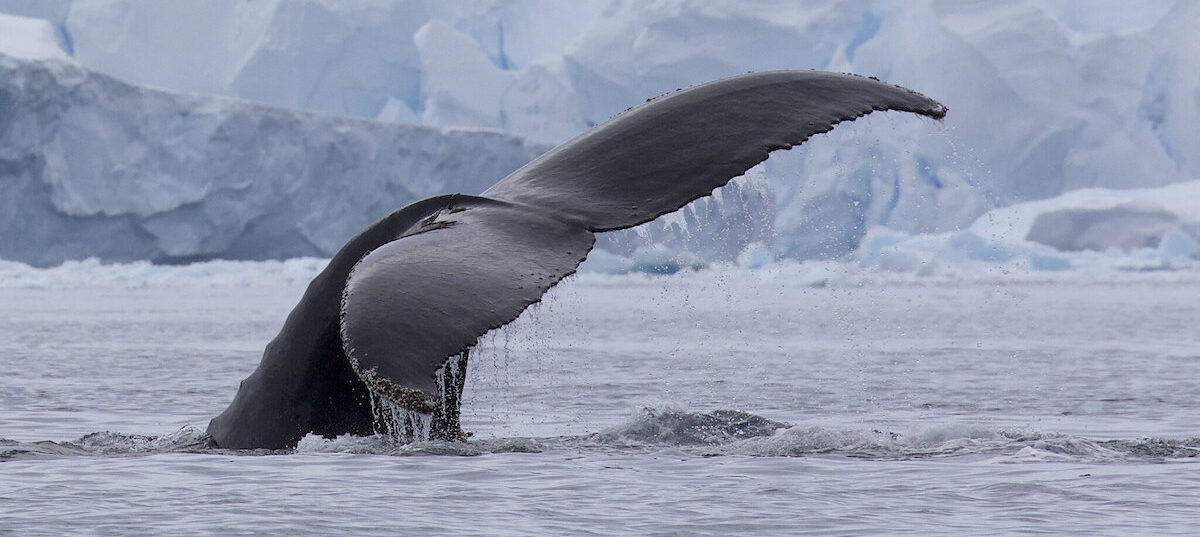
Banner image: A humpback whale in Antarctica, where the species feeds almost exclusively on krill. Image by Gregory “Slobirdr” Smith via Flickr (CC BY-SA 2.0).
See related coverage:
High expectations but no agreement on Antarctic marine protection, krill fishing
Cite this article
Ally Kristan, Dan Crockett (2026). As new season starts, Antarctic krill-fishing vessels face urgent conservation decision (commentary). Mongabay Conservation news. DOI: https://doi.org/10.66709/news-336869

