


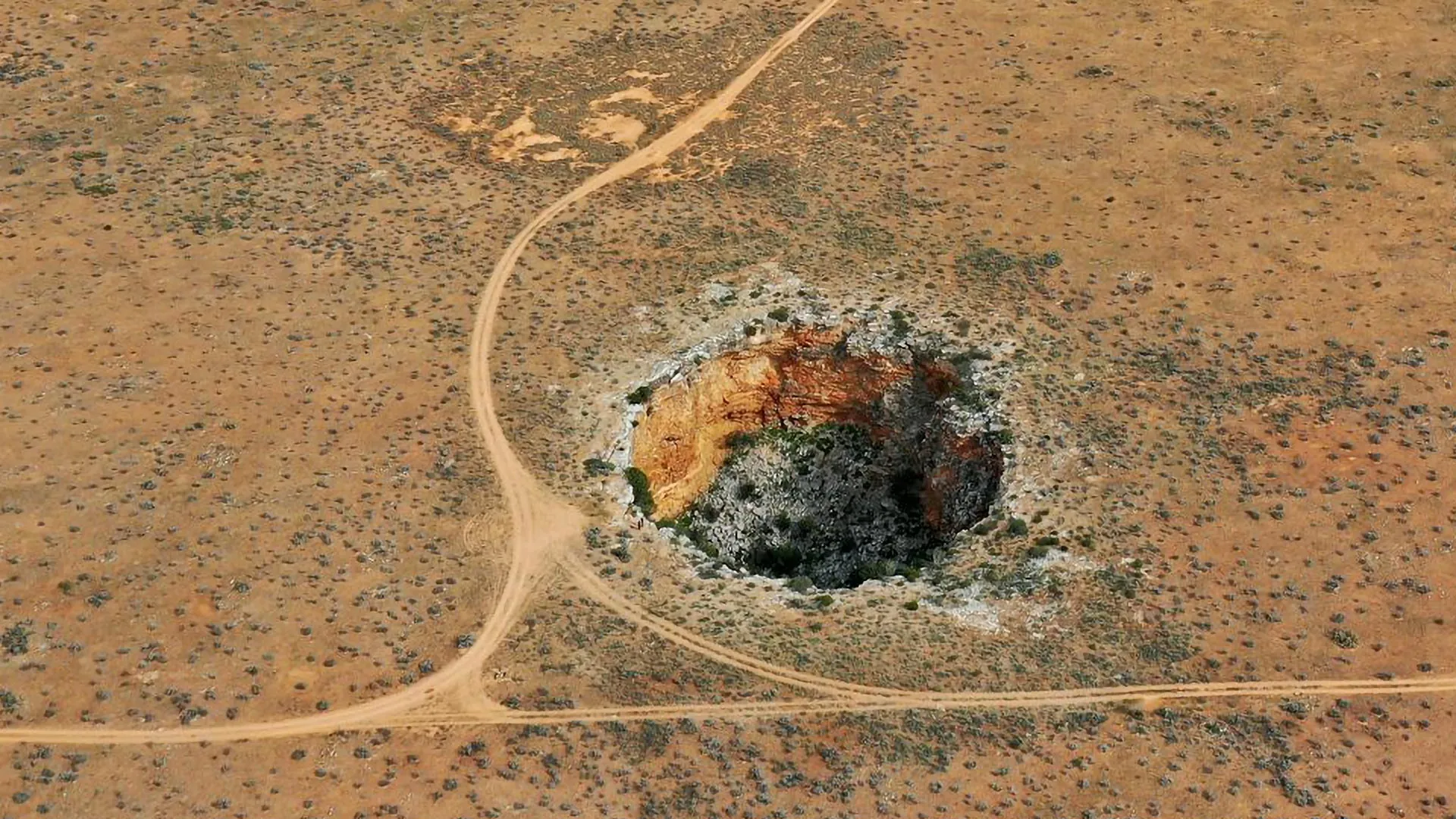
Stretching over 200,000 square kilometers across southern Australia, the vast, flat plains of the Nullarbor mark one of the world’s largest regions of limestone. It formed when an ancient shallow sea retreated some 14 million years ago.
Ultimately, this led to the familiar dry landscape of today, which has acted as a significant barrier for plants, animals, and poorly adapted colonial Victorian-era explorers who described it as “the sort of place one gets into in bad dreams”.
In contrast, the Mirning People of the Nullarbor and Great Australian Bight have lived for tens of thousands of years on this southern margin. They have watched the landscapes change and sea levels fall and rise with the build-up and collapse of the last ice age about 20,000 years ago.
To an untrained eye the Nullarbor Plain appears deceptively simple and featureless. However, beneath the immense plain lies a remarkable, largely hidden underground world.
Over millions of years, water has eaten away at the limestone and created complex cave networks that can extend for kilometers underground. Sadly, the caves remain poorly understood, partly because they’re only really known and accessible where they breach the surface.
Our new study, published in Communications Earth & Environment, reveals a new way to track these cave systems even when they are deeply buried. Our work helps explain the formation of previously mysterious, shallow trench features on the Nullarbor. It also provides a new way to identify hidden caves elsewhere – even beyond our own planet.
Valleys, but not from rivers
Scattered across the Nullarbor are tell-tale signs of its vulnerability to being dissolved – small cave openings and shallow depressions.
But there are also structures of previously unknown origin and significance: long (up to 20 km), shallow (a few meters) trenches that trend roughly north-south. They’re almost invisible from the ground, but we can clearly see them in modern digital landscape models.
These shallow trenches look somewhat like flat-bottomed valleys, but they were not carved by rivers. They begin and end abruptly and are not connected to existing rivers or drainage networks that extend into the upland areas around the Nullarbor.
They also lack typical river branching patterns and the sediments within them don’t show any evidence of being deposited from flowing water.
What we discovered
To understand how these strange structures formed, we combined several investigative techniques.
First, we mapped the trenches using drone and aerial photography, as well as detailed satellite-based digital landscape models. Then the layers of soil and rock were measured in boreholes and caves.
Finally, we used specialized geophysical techniques to “see” inside the Earth, somewhat similar to the way an X-ray enables us to see our internal body structures from the outside.
The work demonstrated that the shallow surface trenches sit above deep zones of broken rock, and in places line up with known cave systems and sinkholes.
This means the trenches are mere muted surface expressions of deeply buried cave systems. These systems are slowly, over millions of years, “collapsing upwards” through the overlying rock layers to reach the surface.
Caves are scientific archives
The results of this work will change how scientists interpret cave landscapes globally. It shows that to explain the surface structures we see, we must look deeper than we might think.
Understanding where voids may exist underground can be important for planning both surface (buildings, roads) and subsurface (tunnels, sewers) engineering works, mitigating geological hazards, and accessing and protecting groundwater resources.
Pockmarked karst landscapes (where rocks are dissolved by water, resulting in caves and sinkholes) represent 15% of the ice-free Earth’s surface and supply water to 10–25% of the global population.
More fundamentally, caves are important scientific archives. Because caves are sheltered from surface weathering and erosion processes, they can preserve snapshots of ancient environments and ecosystems that would otherwise be lost to time.
Furthermore, they may host an array of strange and vulnerable life-forms that have evolved and adapted in isolation. These are some of the least studied organisms on Earth.
To learn more, we must first locate the cave structures. And the results of our study could be very important in this regard.
Caves on other worlds
The implications of this new work even extend beyond our own planet. Because caves offer a stable environment and shelter from damaging space radiation, they provide promising exploration sites for life on other planets.
Mapping of planetary surfaces within our Solar System has identified numerous potential caves, including some thought to be related to karst on Mars.
The Nullarbor’s dry, stable surface is an excellent analogue to help locate the subtle surface fingerprints of hidden cave systems on planets that now lack a dynamic water-cycle – such as Mars. Even if the caves are barren of life, they could be attractive bases for future human explorers.
How many other apparently simple landscapes around the world or on other planets are concealing large cave systems underneath? We don’t yet know, but the trenches we studied are unlikely to be unique. Similar subtle landforms are likely to have been overlooked elsewhere, too.
Sometimes the most remarkable discoveries are waiting in understated but plain view, in landscapes we think we already understand.
The authors would like to acknowledge Matthias Leopold from The University of Western Australia; Rok Ciglič, Mateja Ferk, Jure Tičar, Matija Zorn and Matej Jelovčan from the Research Centre of the Slovenian Academy of Sciences and Arts (ZRC SAZU); John A. Webb from La Trobe University; Uroš Stepišnik, Matej Dolenec, Primož Miklavc, Tomislav Popit and Andrej Šmuc from the University of Ljubljana; and Jian-xin Zhao from The University of Queensland.
