


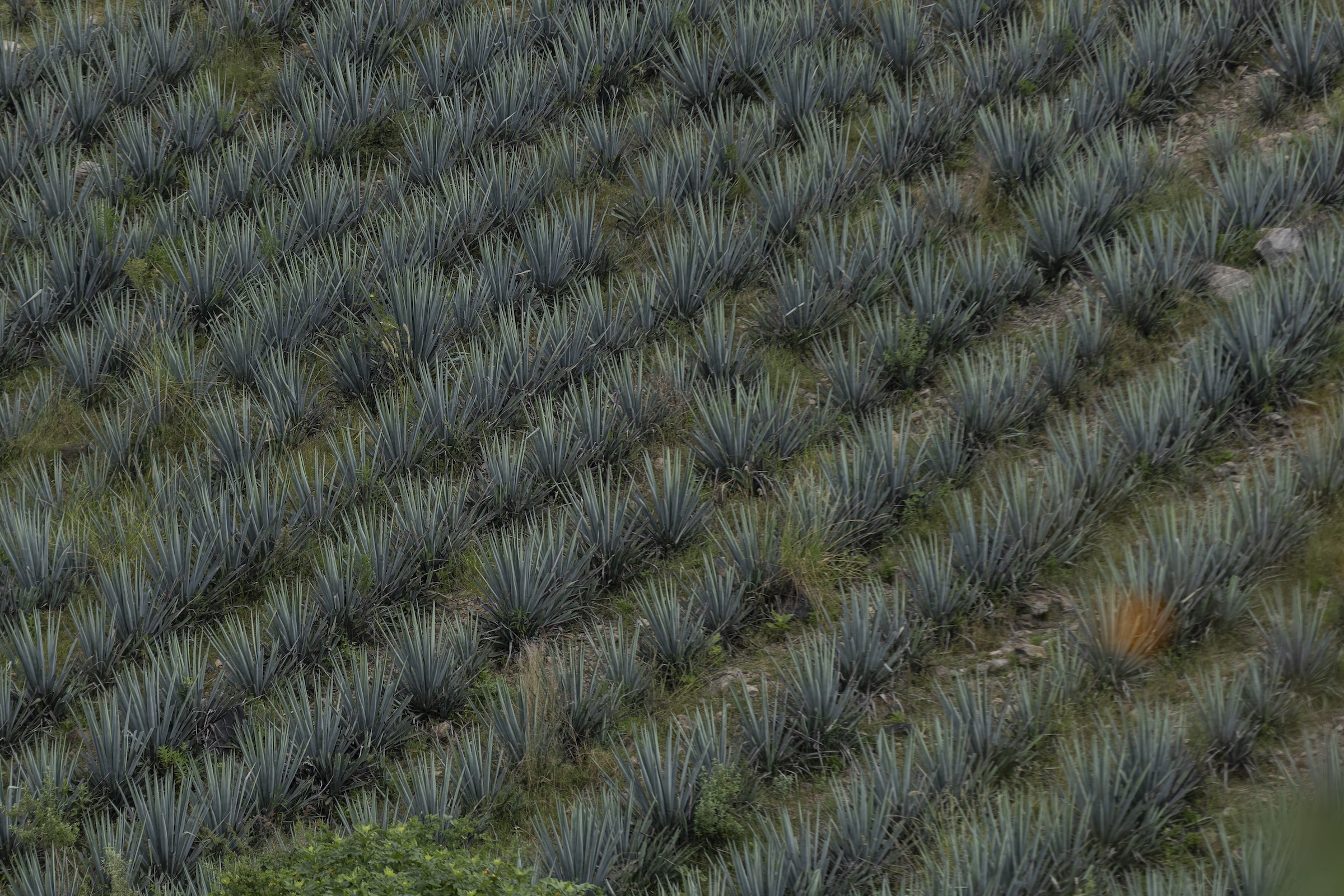
- Between 2017 and 2022, increased tequila production in Mexico drove greater demand for its raw material, blue agave, but also caused social and environmental damages.
- The tequila regulatory body and state authorities have failed to halt the expansion of agave into forest areas.
- Jalisco lost around 23,368 hectares (about 57,740 acres) of forest annually between 2019 and 2021, a period that coincided with the expansion of blue agave fields.
- Between 2017 and 2025, the area planted with tequila agave nationwide increased by 218%, reaching 276,043 hectares (about 682,110 acres).
For decades, Manuel García Castro has grown corn, squash and beans to feed his family and livestock. In 2019, he followed in the footsteps of prosperous local farmers and dedicated a portion of his land in the highlands of Jalisco, western Mexico, to planting blue agave, used to make tequila.
A friend persuaded him to plant 15,000 shoots on 3 hectares (7.41 acres) of his land and in other areas where his cattle grazed. García Castro would provide the labor; his friend, the capital. “We have to give it a shot to see if there’s some way to make money from something else,” was their thinking, he told Mongabay. Back then, raising livestock didn’t bring in much money and expenses were high.
They invested 500,000 Mexican pesos (around $25,300) in plants, pesticides and fertilizers, not including payment for García Castro’s own labor and that of the farm worker who helped him. Four years later, in 2023, hopes of selling the blue agave began to fade. Sale prices per kilogram plunged by as much as 92% compared with those between 2017 and 2019. The business was no longer profitable in the short term. Manuel García and his partner abandoned the fields two years ago.
The tequila boom
Tequila has a protected designation of origin in the states of Guanajuato, Nayarit, Tamaulipas, Michoacán and Jalisco. The drink is considered a national brand and a symbol of Mexican identity.
Over the past decade, the tequila industry has boosted its exports and developed premium and niche brands.
Between 2016 and 2025, the Tequila Regulatory Council (CRT) recorded an increase in production from 273.3 million liters (72.2 million gallons) to 583.5 million l (154 million gal). Production peaked at 651.4 million liters in 2022.
In 2020, Mexico exported 286.7 million l (75.7 million gal) of tequila, and 418.9 million l (110.6 million gal) two years later.
Between 2017 and 2018, the sale price of blue agave remained between 26 and 30 pesos per kilogram (just under $2), peaking in 2021 at 32 pesos per kilogram, according to industry website agaves.pro.
Those economic conditions attracted new producers, including Manuel García, who replaced corn on his plots with blue agave.
Agave replacing forests
In 2019, when blue agave prices boomed, Maximiano Bautista Andalón, a geospatial specialist and academic at the Western Institute of Technology and Higher Education (Iteso) in Mexico, began using satellite imagery to document the expansion of agave farms in Jalisco.
That year, he counted roughly 100,000 hectares (about 247,100 acres) planted with agave only in Jalisco. Six years later, the area had reached 200,000 hectares (494,210 acres). The researcher found that this expansion affected natural ecosystems and created monocultures, as many farmers stopped growing food while others took over forest and rainforest areas.
“Agave is a complex issue, especially because of how it was distributed: in areas with pine forest, oak forest, or right next to mid or high-altitude areas where other crops used to grow,” Bautista Andalón said. “It is a highly industrial model in which almost no other little plant survived among the agave fields.”

In 2023, a report by the University of Guadalajara and a coalition of 43 states and provinces from 11 countries, including Mexico, highlighted the expansion of agave production for tequila and mezcal as one of the drivers of forest loss.
“The increase in demand and prices for these distilled beverages, especially tequila, has triggered a cyclical expansion of agave cultivation into these ecosystems,” the report warns. Between 2019 and 2021, a period coinciding with the tequila boom, Jalisco recorded its highest deforestation levels losing 23,368 hectares (about 57,740 acres) annually.
Neither the National Forestry Commission (Conafor) nor the Jalisco Department of Environment and Territorial Development responded to Mongabay’s interview requests for this article.
The agave landscape around the town of Tequila, designated a UNESCO World Heritage Site in western central Mexico, has spread indiscriminately across the state.
By analyzing satellite imagery, researcher Bautista Andalón found that some of the newest agave plantations were preceded by fires, land clearing or tree cutting, or were established near water sources important to local communities.


Southern Jalisco is also experiencing the impacts of agave expansion. University of Guadalajara researcher Oscar Raúl Mancilla is part of a scientific group that has studied land-use change in the region for 20 years and found that blue agave cultivation increased by 60% in the Autlán region, in southwestern Jalisco, between 2015 and 2026.
“Thousands of hectares have shifted from tropical dry forest, livestock farming or other types of crops to agave cultivation,” Mancilla told Mongabay.
Crossing the boundary
The area planted with tequila agave nationwide increased 218% between 2017 and 2025, according to the Ministry of Agriculture and Rural Development
In 2021, the Tequila Regulatory Council (CRT) and the Jalisco government implemented the Environmentally Responsible Agave (ARA) certification to guarantee deforestation-free brands that comply with international sustainability standards.
Eduardo Ibarra Arellano, the CRT’s sustainability project manager, told Mongabay that they provided factories and farmers with a map outlining more than 2.67 million hectares (about 6.6 million acres) available for plantations across Jalisco’s 125 municipalities, as well as others in Guanajuato and Michoacán.
Farmers must confirm that their crops lie within the designated areas and register with the CRT under Official Mexican Standard NOM-006-SCFI-2012, which sets the specifications that define what can be produced, certified and sold as tequila.

“If that property was a forest or a protected area before 2016, they could not be granted authorization to plant agave there,” Ibarra Arellano said. However, producers know they can turn to coyotes, informal traders between producers and tequila manufacturers, to sell the plants illegally.
Ibarra Arellano said the map took watersheds into account when delimiting planting zones and that they follow a strict zero-deforestation policy. The Jalisco Department of Environment and Territorial Development has stated the ARA certification has prevented the deforestation of 17,000 hectares (about 42,000 acres) of forest.
However, the mechanism has fallen short. In November 2025, the Federal Attorney for Environmental Protection (Profepa) shut down an illegal property in the municipality of Valle de Guadalupe, Jalisco, where land-use change for agave cultivation affected 202 hectares (about 500 acres) of oak forest.
Agave fields in Jalisco extend into protected areas such as La Primavera Forest, where the ARA map identifies at least nine eligible crop areas that appear to contain rows of agave.
Gabriel Vázquez, director of La Primavera Forest, told Mongabay that these plots have existed within the forest since before it was declared a protected forest area and were previously milpas — traditional plots based mainly on the combined cultivation of corn, beans and squash. After seeing agave’s profitability, their owners decided to switch crops, even though the land is unsuitable for it.
“These soils are highly vulnerable, and agave is a plantation crop that demands a lot of nutrients,” Vázquez said. “It can affect soil quality and the forest’s ecosystem quality.”
Agave fields abandoned in 2026
Eight years ago, farmer Bernardino Correa Raygoza planted 10,000 agaves on his ejido — a type of community agroforestry system widely used in Mexico. He previously grew corn and beans. Like him, many farmers in the community of Ocotic, on the border between Jalisco and Nayarit, decided to invest in agave production for tequila. Some sold livestock and belongings, while others took out loans.
“There are the plots, just lying there like trash,” said Correa Raygoza, who is also a community leader in Ocotic. “They don’t yield anything anymore; you can’t get any benefit from them.”
Blue agave requires seven or eight years of work before it can be harvested.
During the 2017-2022 agave boom, 1 hectare (2.47 acres) generated profits of up to 3 million pesos (about $163,000), while corn brought in as much as 40,000 pesos annually (about $2,200). This prompted farmers to shift rapidly toward agave cultivation. However, things changed quickly in the following years.

The impact was not only environmental; the blue agave production boom also affected prices.
The number of producers registered with the CRT rose from 5,988 in 2017 to more than 43,000 in 2025. This sudden increase caused blue agave overproduction. As a result, prices collapsed.
By 2025, 1 kilogram was now sold for one or two pesos (between 5 and 11 cents), according to agaves.pro data
Concerned about their profits, many new and small-scale agave farmers have stopped producing it in the past three years. In July, the CRT acknowledged the problem, but the exact number of abandoned plantations remains unknown.
An uncertain future
According to specialists including Mancilla and Bautista Andalón, the expansion of agave monocultures is jeopardizing resources essential to life.
In southern Jalisco, it could affect plants such as the lead tree (Leucaena leucocephala), honey mesquite (Prosopis glandulosa), organ pipe cactus (Stenocereus thurberi), prickly pear cactuses (Opuntia ficus-indica) and Manila tamarinds (Pithecellobium dulce). According to Mancilla, local communities use these species for food or medicinal purposes.
People’s food sovereignty is at stake when the milpa that feeds families and farm animals is replaced, he added.
Herbicides and pesticides, on the other hand, threaten the survival of various insects, including the 20 native bee species found in Jalisco, Bautista Andalón said.
There is also a related problem: abandoned agave plots.

The CRT confirmed to Mongabay that it has been conducting field inspections to determine how many plantations have been abandoned. The agency warned of the danger posed by the spread of pests such as the agave weevil (Scyphophorus acupunctatus). This beetle burrows into the leaves and core of undernourished or older agave plants until they rot. Uncontrolled, the pest can spread to other wild cactus species or healthy agave plantations.
Nevertheless, producers would rather leave the agave than invest more. Some, like Manuel García, will try to sell whatever they can and, if they cannot, burn the plants before replanting corn. He said he does not rule out returning to agave later, when it becomes profitable again.
Others, such as Bernardino Correa, are confident they can return to their traditional crops despite the potential damage to the soil.
“Nothing ventured, nothing gained, and it turns out we lost,” he said. “Now we have to keep growing corn and beans and raising livestock, whatever makes money.
“The land is so generous that whatever we plant afterward, everything works. The agave ends, and whatever you plant next keeps growing. We have to plow again and work the land.”
This is an edited and translated version of the story originally published here.
Banner image: Agave fields in the Tequila Valley, Jalisco. Image by Fabricio Atilano.
Citations: Guevara-Gutierrez, R. D., Palomera-Garcia, C., Olguin-Lopez, J. L., Mancilla-Villa, O. R., Rosales-Almendra, M. P., & Barreto-Garcia, O. A. (2024). Effect of blue agave (Agave tequilana Weber) management on soil erosion. Air, Soil and Water Research, 17. doi:10.1177/11786221241236632
FEEDBACK: Use this form to send a message to the author of this post. If you want to post a public comment, you can do that at the bottom of the page.
Cite this article
Mariana González-Márquez (2026). Tequila’s hangover: How the drink’s success drove deforestation in Mexico. Mongabay Conservation news. DOI: https://doi.org/10.66709/news-337164

