


Homeowners in Hispanic and Black communities nationwide are paying a disproportionate share of skyrocketing home insurance costs, according to a recent report. The disparities leave communities of color at greater risk as climate change increases the frequency of billion-dollar disasters.
The report, released in July by the Consumer Federation of America, a nonprofit representing nearly 250 consumer groups, concluded that homeowners in predominantly Hispanic ZIP codes pay on average a 30 percent higher premium ($950 more annually) compared with homeowners in white communities. In predominantly Black ZIP codes, homeowners pay, on average, a 16 percent higher premium ($500 more annually).
The findings were based on an analysis of identical policies across communities, eliminating the possibility the inequities were related to differences among homeowners, their homes or what they chose to insure, the report said. Local risk factors could be responsible for some of the disparities, although even when such factors were accounted for the gap remained large.
“We’ve talked a lot about our insurance affordability crisis,” said Sharon Cornelissen, director of housing at the Consumer Federation of America and a co-author of the report. “What we haven’t really talked about is sort of the racially inequitable impacts of that, and that Black and Hispanic homeowners are particularly struggling.”
The inequities add up to at least $28,500 in additional insurance costs over the span of a 30-year mortgage for homeowners in Hispanic communities and $15,000 for homeowners in Black communities, according to the report. The situation points to a legacy of redlining in home insurance that continues to challenge communities of color when it comes to homeownership and exposure to risk, although the discrimination today may be inadvertent.
The historical practice of redlining involved the designation of certain neighborhoods as “hazardous” for mortgage lending, based largely on the race of residents. People in these neighborhoods were denied home loans, leading to lower home values and less homeownership. Although redlining ended in 1968 with the Fair Housing Act, the practice has left a legacy of segregation and disparities in these neighborhoods that endures today when it comes to health care, education, incarceration, access to nutritious food and public investment in infrastructure. The inequities also have left these communities more vulnerable to climate impacts such as heat.
Mark Friedlander, spokesman for the Insurance Information Institute, an industry group, said premiums are based on risk and not race or ethnicity and that the system used to establish premiums is actuarially grounded and heavily regulated.
“Using race, or any proxy for race, to set insurance rates is illegal in every U.S. jurisdiction, and state insurance regulators review and approve the rating factors insurers use precisely to guard against that,” he said in a statement provided to Inside Climate News. “Many of the communities cited in reports like this are located in areas with objectively higher catastrophe exposure or higher costs to rebuild and repair after a loss.”
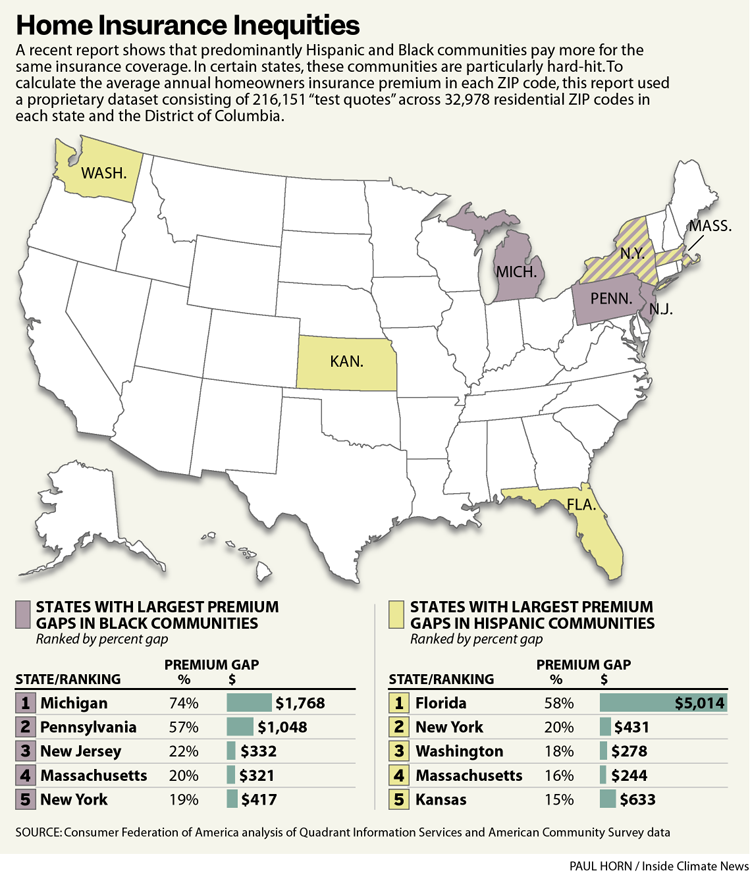
The report found the most acute home insurance disparity among homeowners in predominantly Hispanic ZIP codes in Florida, where they pay on average 58 percent more ($5,014 annually) for the same coverage as those in white communities. In the next four states, the gap was pronounced, but smaller: 20 percent ($431) in New York, 18 percent ($278) in Washington, 16 percent ($244) in Massachusetts and 15 percent ($633) in Kansas.
This story is funded by readers like you.
Our nonprofit newsroom provides award-winning climate coverage free of charge and advertising. We rely on donations from readers like you to keep going. Please donate now to support our work.
The inequities in Florida, where homeowners have been particularly hard-hit by insurance costs, represent “an enormous amount of money,” said Moira Birss, senior fellow at the Climate and Community Institute, a progressive think tank. “And so when we’re thinking about how we’re having an affordability crisis in this country … that’s unconscionable.”
When it comes to predominantly Black ZIP codes, the inequities are greatest in Michigan at 74 percent ($1,768 annually), followed by Pennsylvania at 57 percent ($1,048), New Jersey at 22 percent ($332), Massachusetts at 20 percent ($321) and New York at 19 percent ($417).
Meanwhile, the cost of insurance for the typical homeowner jumped by 24 percent between 2021 and 2024, according to the report, based on previous research by the Consumer Federation of America. Greenhouse gas emissions, primarily those associated with fossil fuels, are heating the global climate, shifting weather patterns and leading to more extreme disasters such as hurricanes and wildfires. That risk is moving insurance companies to raise rates.
Insurance companies have provided fewer and more expensive options in communities of color compared with white communities, the report said. It highlighted a $17.5 million settlement from the 1990s over a lawsuit alleging the insurance company Nationwide discouraged agents from selling coverage in Black neighborhoods, labeled Black ZIP codes as undesirable and used racial profiling to deny insurance to Black homeowners. American Family Mutual Insurance Company similarly agreed to pay more than $16 million in a settlement to Black homeowners who were provided inferior policies and, in some cases, denied coverage based on race.
More recently insurers have adopted new proprietary methods for determining premiums and claims payments, including some incorporating artificial intelligence, that raise concerns about possible discrimination, according to the report. For instance, previous research by the Consumer Federation of America found that homeowners with lower credit scores pay an average penalty of $1,996 annually, or 99 percent more, for insurance, a concern considering longstanding structural factors that have meant communities of color tend to have lower credit scores.
“I’m not saying that they have some secret race factor that they put into their model,” Cornelissen said. “A lot of this bias can kind of creep in if they’re not paying attention to potential unequal impacts. A lot of this could be through AI models or other factors that have a disproportionate impact on Black and Hispanic communities.”
Friedlander said the best way to make insurance more affordable and equitable is by reducing risk through resilience efforts such as strengthening building codes and increasing mitigation funding.
The report called on states to enforce fair housing laws and demand more transparency and accountability.
“Unless the insurance industry wants to give us more information about why this is happening,” Birss said, “it’s pretty hard not to interpret this as pretty serious racial discrimination.”
About This Story
Perhaps you noticed: This story, like all the news we publish, is free to read. That’s because Inside Climate News is a 501c3 nonprofit organization. We do not charge a subscription fee, lock our news behind a paywall, or clutter our website with ads. We make our news on climate and the environment freely available to you and anyone who wants it.
That’s not all. We also share our news for free with scores of other media organizations around the country. Many of them can’t afford to do environmental journalism of their own. We’ve built bureaus from coast to coast to report local stories, collaborate with local newsrooms and co-publish articles so that this vital work is shared as widely as possible.
Two of us launched ICN in 2007. Six years later we earned a Pulitzer Prize for National Reporting, and now we run the oldest and largest dedicated climate newsroom in the nation. We tell the story in all its complexity. We hold polluters accountable. We expose environmental injustice. We debunk misinformation. We scrutinize solutions and inspire action.
Donations from readers like you fund every aspect of what we do. If you don’t already, will you support our ongoing work, our reporting on the biggest crisis facing our planet, and help us reach even more readers in more places?
Please take a moment to make a tax-deductible donation. Every one of them makes a difference.
Thank you,

Reporter, Florida
Amy Green covers the environment and climate change from Orlando, Florida. She is a mid-career journalist and author whose extensive reporting on the Everglades is featured in the book MOVING WATER, published by Johns Hopkins University Press, and podcast DRAINED, available wherever you get your podcasts. Amy’s work has been recognized with many awards, including a prestigious Edward R. Murrow Award and Public Media Journalists Association award.
