


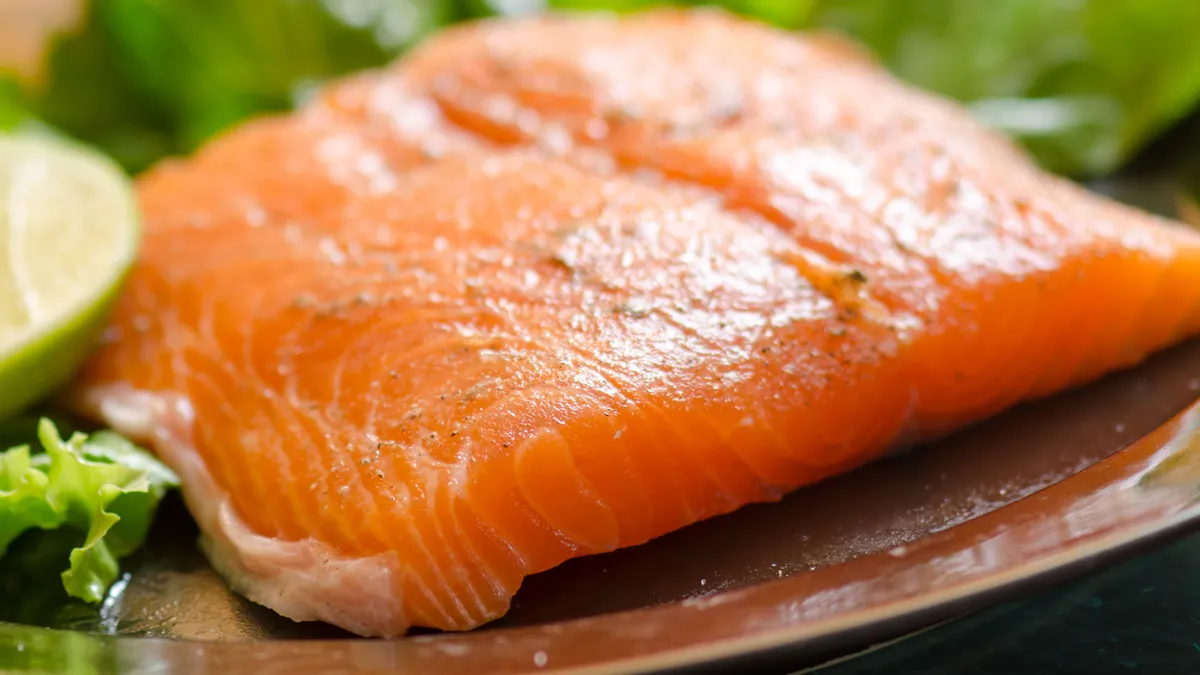
Some grocery stores in the U.S. are selling 3D-printed salmon meat manufactured by an Israeli company.
In early October, some social media posts spread the claim that an Israeli company manufactures 3D-printed salmon meat and sells it at U.S. grocery stores.
For example, a YouTube video (archived) claimed, “the first 3D-printed salmon just hit U.S. grocery shelves.” It then explained the salmon was manufactured by an Israeli company called Steakholder Foods and that the product is not required to have a label indicating it was 3D-printed on its packaging. It also noted that the salmon contained a chemical used in laxatives.
Users also shared the claim on Facebook (archived) and Instagram (archived). Snopes readers sent emails asking whether it was true.
In short, on Sept. 3, Israeli company Steakholder Foods, which specializes in making 3D-printing technology for plant-based meats, announced the launch of its 3D-printed, plant-based meat and fish products, including salmon, in Northeastern U.S. retail stores under the brand name Perfecta.
Therefore, we’re rating this claim true.
Snopes has already fact-checked a claim about Steakholder Foods’ 3D-printed meat hitting grocery-store shelves. That claim and the claim about salmon came from the same product announcement and thus share much of the same research.
It’s not clear which grocery stores or retailers have started selling or stocking the products. Snopes reached out to Steakholders Foods via a contact form on its website for more information. The company has not replied to Snopes’ prior requests for information.
According to Steakholder Foods, the company uses plant-based ingredients and cultivates cells to create what ultimately becomes the 3D-printed meat.
The U.S. Food and Drug Administration and the U.S. Department of Agriculture’s Food Safety and Inspection Service do regulate “lab-grown” meat and require a label for such products. However, this regulation is specifically for food made with cultured animal cells, not for food made with other kinds of cells, which is what Perfecta products consist of.
The FDA told Snopes in an email:
The product you are describing sounds like it is made from plant-based ingredients using a specific manufacturing process (3D printing). It does not appear to involve cultured cells of any type. The FDA generally does not approve finished foods or manufacturing processes. Although the FDA does not approve final food products, ingredients and additives must be demonstrated to be safe before they are used in food or in materials that contact food.
The FSIS told Snopes in an email that it regulates meat, poultry and egg products, and directed us to the FDA for more information.
Based on how the product boxes appear on the website, there doesn’t seem to be any text identifying the food as 3D-printed or made with cultured cells. The boxes do clearly identify the meat as “premium plant meat” and “plant-based.”
Manufacturers of plant-based meat products usually have to process their ingredient mixes in a way that allows them to mimic the texture of conventional meat. According to the Good Food Institute’s Asia-Pacific website, the most common processing method requires putting shear stress on the ingredients to align them into a meatlike texture. There are several other methods of processing plant-based meats, including 3D printing.
Methylcellulose, the chemical used in laxatives, is included on the 3D-printed salmon’s ingredient list. Methylcellulose is used in plant-based meats as a binder to keep the ingredients together and to replicate the texture of real meat.
The FDA has approved this kind of use of methylcellulose in food.
