


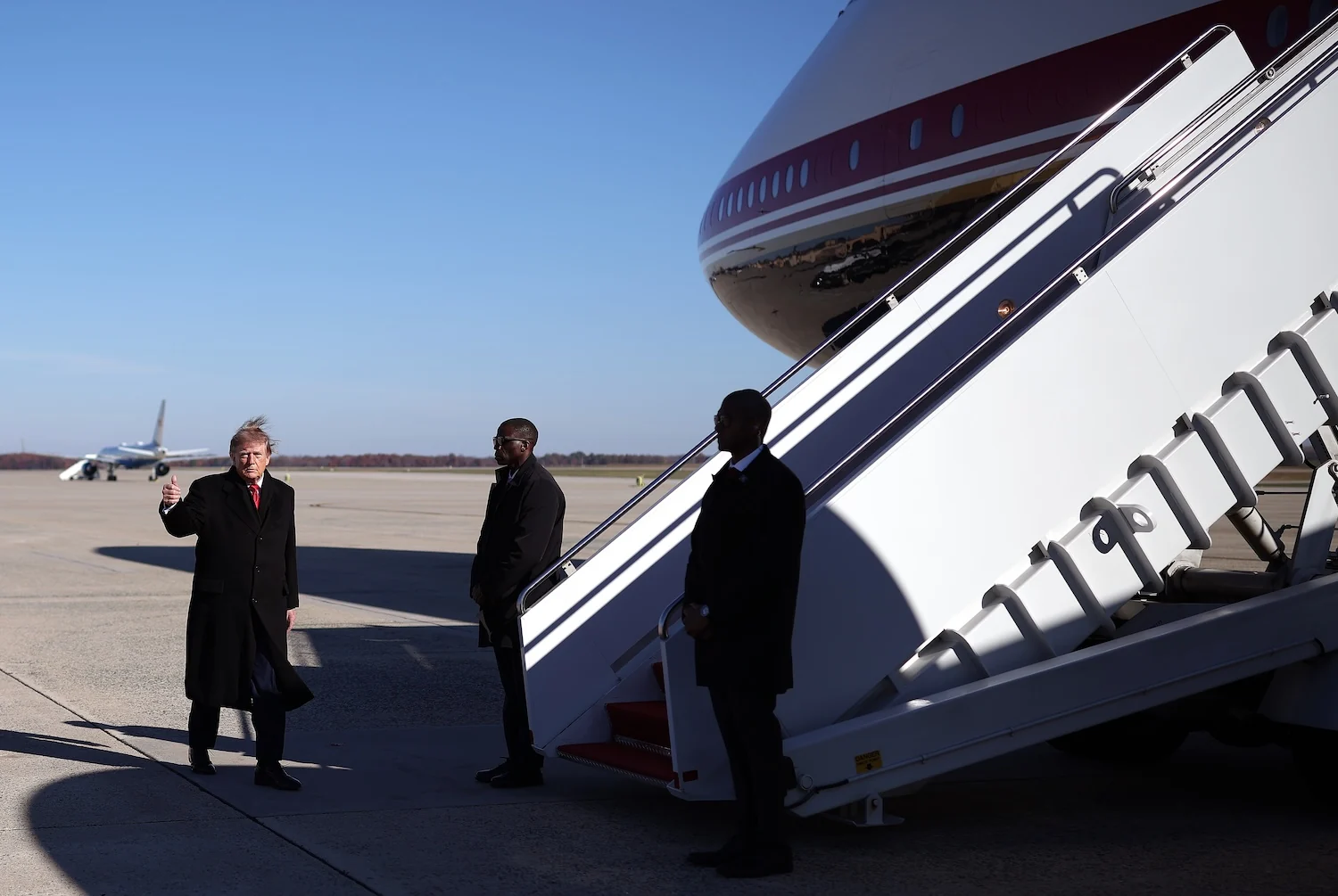
When U.S. President Donald Trump touches down in Shenzhen, China, this week for a three-way summit with Xi Jinping and Vladimir Putin, he will be embarking on the highest-level diplomacy he has ever undertaken at his weakest point in power.
The problem is not merely the devastating midterm election losses for his Republican Party, in which he urged supporters to turn out and cast their votes as if he were on the ballot. In recent weeks, Trump has displayed startling new levels of incoherence and evasion of responsibility for a sitting president. This seemed to reach a crescendo last week with two national crises for which Trump had no suitable answers.
The first of these crises brought news that Jensen Huang, the head of Nvidia, at once one of the world’s most valuable and strategically important companies, had had an affair with a suspected Chinese intelligence asset. Trump pleaded ignorance, denying well-sourced reports that he had been briefed about the matter as long ago as May, including by his national security advisor and secretary of state, Marco Rubio. The only thoughts the president seemed able to summon reflected credulity about Huang’s claim that he had never suspected the woman could have been a spy and personal sympathy for a man who had, until his sudden resignation from Nvidia last week, belonged to a club that means more to Trump than any other: the exclusive circle of the world’s richest and most powerful men. Perhaps for that reason, on Monday, Trump told reporters he “would not mind” if Huang was reinstated.
For all of Trump’s envy of powerful authoritarians, if the situations were reversed and Huang were a Chinese national leading a company as important as Nvidia, it is impossible to imagine Xi treating a man under such suspicions this way, including welcoming him on a flight to his country’s No. 1 competitor and adversary. But Trump’s need for this kind of validation is an ongoing matter and not something he has learned a lesson from. Witness his decision to invite the world’s richest man, Elon Musk, to join him on this trip, if not in the meetings with his fellow heads of state.
For a U.S. president heading off to a summit such as this, the week’s second crisis may have been even worse. The image the United States presented to the world in the wake of a breakdown in the nationwide air traffic control system on Friday was one of utter dishevelment and incompetence. It put the spotlight on two of arguably the least qualified members of a cabinet resolutely hostile to meritocracy: Transportation Secretary Sean Duffy, a former congressman and Fox News personality, and Homeland Security Secretary Markwayne Mullin, a former congressman whose formal education culminated with an associate’s degree in plumbing and construction.
With thousands of flights canceled and a country desperate for answers and reassurance, they bumbled their way through an almost incoherent news conference that offered no real explanations. Instead, they cast blame on others, including Congress and past administrations, while exalting Trump’s leadership as if they were members of a personality cult and the public should be too. During the first 36 hours of the crisis, Trump for his part chose to lie low, making no statements about the matter, apparently fearing that doing so would mean taking responsibility for something bad that happened on his watch, which he has always been deeply allergic to.
These displays of unaccountable behavior and cluelessness are bad enough for the United States in their own right, but Americans should be worried about their implications for the upcoming summit. Even in ordinary times, Trump’s narcissism and emotional neediness make diplomacy like this dangerous because he craves fellowship and approval from men such as Putin and Xi, whom he all but openly idolizes. But with last week’s crises and domestic scandals sprouting in many directions as Democrats prepare to take over Congress, Trump is liable to make large and unwise concessions to his imagined peers in order to secure political coups that he hopes can restore prestige and momentum to his badly weakened presidency. The cliché holds that weakened or trapped animals are liable to strike out to defend themselves. With Trump, the danger is the opposite—given his self-centered view of the world, where his own ego gratification is paramount, he could give away the store.
What could that mean? Here, one feels that Trump is so easily flattered that the sky is almost the limit. He has reportedly already forsworn raising the Nvidia crisis with Xi as well as Russia’s ongoing war of aggression against Ukraine. If true, such self-imposed restrictions themselves emphasize the weakness of the U.S. president’s hand and preemptively vitiate the utility of such an unusual gathering.
What does this leave on the table for discussion? The Trump administration has said it hopes to make progress on limiting nuclear weapons armament at a time when the United States and Russia still have enormous legacy arsenals whose maintenance and modernization are costly and China is belatedly racing to catch up. Trump officials have also said they hope to engage leaders of the world’s other two big powers on the United States’ stop-and-go war against Iran, which by now has turned into a quagmire.
But what could the latter possibly yield? That Trump has already displayed weakness and enormous gullibility on Iran in his dealings with both powers does not bode well. Russia has supplied intelligence and munitions support to Iran throughout the war, enabling that country to target U.S. military bases throughout the Middle East with devastating effect. Consistent with his general enthrallment to Putin, Trump has publicly downplayed the importance of this, making clear that maintaining warm relations with Moscow is his priority. China, if more cautious than Russia, has also hewed to a line that has enhanced the Iranian state’s position. It has done this by continuing to purchase as much Iranian oil as it can while also reportedly supplying electronic components essential to that country’s missile and drone production. Genuine progress toward administration goals on Iran would require concrete commitments from both powers to stop what they are currently doing. Trump appears unlikely to demand this, and even if he did, neither is likely to follow through.
Putin has already mesmerized Trump into treating Ukraine as if it were the faulty party in its defensive war against Russia. That conflict may not officially be on the agenda when the three leaders sit down together on Thursday, but the specific danger in Shenzhen is that Putin will offer Trump a vague, unverifiable promise to limit support for Iran—something that Trump can present as a win—in exchange for Trump’s deeper complicity in ending the Ukraine war on Russian terms. It would be a trade of something real and irreversible for something hollow and unenforceable. Because of Trump’s unique weakness for glad-handing and grandiosity, it may take little more than that. A more lucid and competent U.S. president would never allow such confusion between the two crises.
What might Xi seek, and how do Trump’s growing vulnerabilities play into this? Beijing’s biggest goal is progress toward exerting control over Taiwan, if not taking over the island altogether by the eventual end of Xi’s longtime hold on power. Toward this end, Trump has already gifted Xi in important ways without receiving anything in return. At the level of official rhetoric, Trump has weakened America’s traditional support for a peaceful resolution of the dispute between Beijing and Taipei over the island’s future. In fact, he has come close to saying the United States would have no business defending Taiwan in case a war broke out between the two sides.
This by itself is an immense gift, and it would be enhanced further if Trump delayed arms sales to Taiwan to ingratiate himself with Xi. Already, the U.S. military posture in East Asia has been dramatically weakened by the prolonged deployment of aircraft carrier battle groups near Iran and by heavy depletion of advanced weapons systems during the war with that country. Trump has also weakened U.S. alliances in Asia through tariff demands and unpredictable behavior. By nature, Xi seems much more cautious than Putin. But sensing Trump’s weakness and need for some kind of foreign-policy achievement, however illusory, he could try to induce concessions through displays of strongman camaraderie and vague pledges of cooperation in areas of U.S. need.
If we cannot know in advance what these meetings will produce, we should know one thing already. Trump will emerge from them making great claims about how well he gets along with the world’s two other most powerful heads of state. In fact, nothing more might publicly come out of the meetings beyond this. But the world should be wary even of any quiet understandings that Trump, at this moment of extreme weakness and vulnerability, believes he has reached. The likelihood is that he is being played due to his personal and political need, and if the details are unknowable, the costs could be great.
