


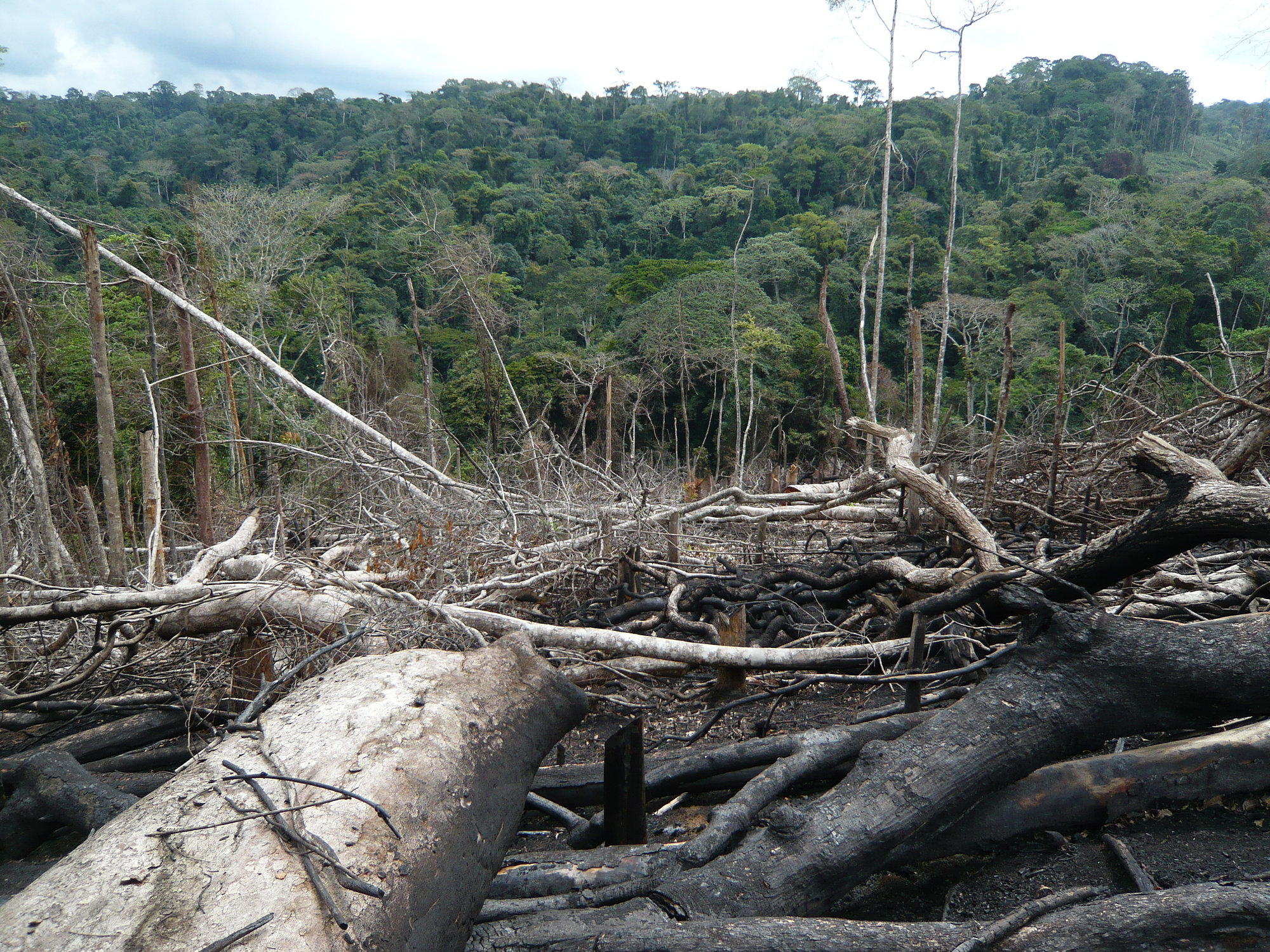
- The Angolan government has declared Serra do Pingano a protected area after the northern region lost 43% of its central forest over two decades.
- Ecosystem degradation threatens endemic plants, amphibians not yet described by science, and a potentially vulnerable population of African forest elephants.
- Forest destruction compromises carbon storage and water regulation in a region of southern Africa already affected by rising global temperatures.
The last large tracts of forest in Serra do Pingano, in northern Angola, are disappearing rapidly, leaving the landscape increasingly bare. Over the past two decades, central Serra do Pingano lost 43% of its original forest cover, while the wider Serra do Pingano Forest Ecosystem (SPFE) lost 21%, equivalent to 536 square kilometers (207 square miles) of forest. The findings appeared in Nature Ecology & Evolution earlier this year.
Two of the paper’s authors are Angolan. Signed by 11 researchers from multiple institutions, the study serves both as an urgent warning and as a call to action to protect what remains of the vanishing forest. After years of appeals, the Angolan government established the Serra do Pingano Conservation Area in April.
Located in Uíge province, the SPFE encompasses several densely forested mountain ranges of high biological value. Pingano forms an ecological transition zone between tropical rainforest and miombo savanna, bringing together elements of western Central African forests and species and evolutionary lineages associated with southern and eastern Africa. It also shelters some of Angola’s last remaining tropical forest south of the Congo River.
The Nature Ecology & Evolution study brings together evidence from years of research into the SPFE. One of its co-authors spoke with Mongabay. Thea Lautenschläger, a German ethnobotanist specializing in northern Angola and scientific director of the Botanical Garden of Hamburg, described the threats facing the forest and the species that depend on it.
“It is difficult to say to what extent our work directly influenced the final decision [to protect the mountain range],” Lautenschläger said. “What matters, however, is that scientific evidence and the urgency of the situation had been communicated for years. And, unfortunately, the time that elapsed came at a very high cost. To date, at least half of Serra do Pingano has already been deforested.”
Lautenschläger, who has conducted fieldwork in Angola several times, said scientists first proposed including Serra do Pingano in the country’s protected area strategy in 2010. Authorities responded favorably to recommendations to establish a national park in 2021. Implementation, however, had not moved forward.
In the law establishing the protected area, the government noted that the region protects “remnants of Afromontane Forest, rich in biodiversity and geology,” while serving as a strategically important site for observing rare and endemic species in their natural habitat.
Agricultural clearing and charcoal production are placing intense pressure on these ecosystems. Lautenschläger said species that depend on intact forest habitats are particularly vulnerable, including endemic plants, animals, amphibians and insects. She also noted that the area researchers originally proposed for protection was considerably larger than Serra do Pingano itself. It included relatively intact areas at the time, as well as zones now undergoing active clearing.
“As a result, the delay and the eventual limitation of the protected area to Serra do Pingano significantly reduced the scope of this designation. Some of the remaining areas of exceptional biodiversity are being cleared right now,” she said.
For Lautenschläger, forest destruction means more than losing trees. “Important ecosystem functions provided by intact forests are also lost, including carbon storage, water regulation, soil protection and the maintenance of ecological interactions,” she said. She added that “in the case of the Angolan Escarpment, forest destruction could ultimately result in the irreversible loss of species that occur nowhere else.”
Threatened species include the Pingano balsam (Impatiens pinganoensis), the Angolan dwarf galago (Galagoides kumbirensis), which is classified as near threatened, and the dragonflies Eleuthemis eogaster and Notogomphus kimpavita. Lautenschläger also cited several forest-dependent amphibians that science has yet to describe formally. “There is a risk that they will disappear before they are even properly known,” she said.
A recently discovered population of the African forest elephant (Loxodonta cyclotis), a critically endangered species, in Serra Vamba, part of the wider SPFE, may also be at risk, Lautenschläger said.
Angolan biologist Aguinaldo Cardoso Pereira shared that concern. He lamented the loss of species, “because each one of them represents a set of characteristics and information that contributes to biodiversity and future discoveries.”
For Pereira, a botany specialist, losing a species means losing information that should be studied. Some plants, he noted, are used in traditional medicine and may have properties with scientific potential that have not yet been proven. Once the plants disappear, however, “the possibilities of their potential being scientifically proven are eliminated,” he said. “It may be that Angola is losing extremely rare species for medicine.”
Forest loss in Serra do Pingano unfolds against a backdrop of rising temperatures and shifting rainfall patterns across southern Africa. A report by the Southern African Development Community (SADC) indicates that average temperatures in the region have increased between 1° Celsius (1.8° Fahrenheit) and 1.5° C (2.7° F) in recent decades, with greenhouse gas emissions projected to rise further. The report notes that warming is already contributing to longer and more intense heat waves, reduced soil moisture and changes in precipitation patterns, placing additional stress on ecosystems and natural resources.
Against this backdrop, Soki Kuedikuenda, a terrestrial ecologist and professor in the Faculty of Natural Sciences at Agostinho Neto University, said biomass removal compromises ecosystem functioning, accelerates soil degradation and can, under certain conditions, drive desertification and alter local climate conditions.
Species loss can destabilize how ecosystems work. “The elimination of a single species will cause modifications to the structure and even the functioning of the ecosystem in question, potentially leading even to alterations of the local climate,” Kuedikuenda said.

Environmental education and promoting local research
The law published by the Angolan government in April also establishes, among the goals of the Serra do Pingano Conservation Area, the “promotion of environmental education, ecotourism and sustainable use of natural resources.”
For students like Luís Ramos Luango, a biology student in Luanda, Pingano’s flora and fauna hold immense scientific value, but access to information about the ecosystem remains limited. “What worries me most is the irreversible loss of species in our biodiversity, important for Uíge and for the entire country, whose potential remains unknown,” Luango said.
“Many young people have little awareness of the ecological, environmental and medicinal, or even cultural, importance of Serra do Pingano and other areas of the Angolan escarpment,” he said. “Those who have some idea are generally students of biology and related fields.”
For Lautenschläger, however, Angola does not strictly lack studies or scientific evidence. “We already know enough to identify many of these areas as having high value and urgently needing protection,” she said. What is missing, she noted, is the political action and timely implementation needed to turn this knowledge into effective conservation.
At the same time, expanding research capacity in Angola remains a critical need. “There are many native species and habitats that remain understudied, and there are simply not enough local experts to document and monitor them at the scale needed. Therefore, training Angolan researchers, strengthening universities and research institutions, and supporting long-term field research are fundamental,” she said.
Local expertise is particularly important, Lautenschläger added, because researchers based in Angola can identify valuable habitats early on, monitor changes continuously and contribute directly to conservation decisions.
“International researchers and collaborations can offer valuable knowledge and resources, but they cannot replace a strong and sustainable scientific community within Angola,” she said. “In the long term, Angola needs both: Continued international collaboration and a much more robust national capacity to study, document and protect its extraordinary biodiversity.”
Banner image: Deforested area in Serra do Pingano, Angola. Image by Raffael Ernst – Senckenberg Gesellschaft für Naturforschung via Green Heart of Africa.
This story was reported by Mongabay’s Brasil team and first published here on our Portuguese site on Oct. 9, 2026.
Citations:
Ernst, R., Cheek, M., Dijkstra, K.-D. B., Finckh, M., Gomes, A., Huntley, B. J., … Lautenschläger, T. (2026). Angola’s northern escarpment forest is disappearing before our eyes. Nature Ecology & Evolution, 10(5), 827–828. doi:10.1038/s41559-026-02979-6
Academy of Science of South Africa. (2026). Climate change and extreme heat: Strengthening resilience and adaptive capacity in the Southern African Development Community (SADC). doi:10.17159/assaf.2026/125

