


- Nearly 20 years after a landmark court ruling in their favor, Indigenous San communities in Botswana may finally secure broader rights to their ancestral lands in the Central Kalahari Game Reserve, following decades of evictions and legal disputes.
- President Duma Boko’s government has approved a roadmap for land restitution that could allow San communities to return to the reserve, obtain legally recognized land rights and participate in its conservation and management.
- In an interview with Mongabay, Botswana’s Justice Minister Nelson Ramaotwana said the government intends to establish legal protections before the 2029 elections, but questions remain over land ownership, community participation and the sharing of tourism revenues.
Nearly two decades after winning a landmark court case against their forced removal from ancestral lands in Botswana’s Central Kalahari Game Reserve, Indigenous San communities may finally be closer to securing broader, legally protected rights to the land they have called home for generations.
The Central Kalahari Game Reserve was established in 1961 both to protect wildlife and to provide a sanctuary where San communities could continue their traditional way of life. But beginning in the 1990s, the government relocated residents to settlements outside the reserve. The United Nations documented how the authorities justified these policies on conservation grounds and the costs of providing public services. Some residents moved under government resettlement programs, while others resisted. Following the withdrawal of basic services in 2002, further forced relocations led to a prolonged legal battle.
In December 2006, Botswana’s High Court ruled in favor of Roy Sesana and other San applicants, finding that they had been unlawfully deprived of possession of their land. But the ruling did not resolve the wider question of Indigenous land rights in that area.
A change of government in November 2024 opened the possibility of a different approach. Botswana’s new president, Duma Boko, a former human rights lawyer involved in the San people’s legal struggle, had firsthand knowledge of their grievances. In March 2025, his administration announced an interministerial committee to examine the situation of San communities, including their relocation, land claims, cultural rights and possible return to the reserve. The committee subsequently began consultations with affected communities, many of whom described the economic and social hardships they had experienced since relocation.
The process has since produced what could become a significant change in Botswana’s approach to Indigenous land rights. According to Michael Taylor, executive director of Anthropos Africa, a non-governmental organization working with communities and the government, the administration approved a land restitution roadmap in September 2026. Under the proposed arrangement, the reserve would retain its protected status while Indigenous communities would gain legally recognized land rights and participate in its conservation and management. Anthropos has outlined a four-phase restitution process involving community representation, negotiations over land rights, legal reform and conservation co-management.
But restitution has not yet been completed. Important questions remain about whether Indigenous land rights will be held individually or collectively, which laws will need to change, how communities will participate in managing the reserve and whether they will receive a meaningful share of tourism and conservation revenues. The United Nations and Indigenous rights organizations have also highlighted the importance of constitutional recognition, secure land tenure and meaningful participation in decision-making.
Botswana’s Minister of Justice and Correctional Services, Nelson Ramaotwana, who is helping lead the government’s response, says the administration has accepted the principle of restitution and intends to establish legal protections for Indigenous communities before the next national election in 2029. In March 2026, he had already outlined the government’s commitment to recognizing the right of return and strengthening San participation in national development.
For San communities whose struggle for ancestral land has lasted decades, the government’s new direction offers the prospect of a historic change. Whether that promise becomes a lasting solution will depend on the laws adopted, the rights recognized and the role communities are given in shaping their future.
Mongabay spoke with Ramaotwana about the restitution process, the government’s plans to address historical injustices, the relationship between Indigenous land rights and biodiversity conservation, and what success would mean for the San.
The following interview has been edited for length and clarity.

Mongabay: The recent recognition of San Indigenous leader Roy Sesana by the University of Botswana has brought renewed attention to the decades-long struggle of San communities for their ancestral lands in the Central Kalahari Game Reserve. We understand that since coming to power nearly two years ago, your government has taken steps to address this longstanding issue, including developing a roadmap for land restitution. To begin, could you explain what land restitution would mean in concrete terms for the San people of Botswana?
Nelson Ramaotwana: To understand what restitution means, we must first understand the history of the Indigenous people of Botswana. For generations, Indigenous communities lived in areas that later became national parks and game reserves. Many were hunter-gatherers, agro-pastoralists or nomadic communities who depended on these lands for food, medicine, shelter and their livelihoods.
The Central Kalahari Game Reserve was established in 1961, but Indigenous communities had lived there for generations before that. Following independence in 1966, and particularly with the introduction of government policies in 1986 and wildlife legislation in 1992, restrictions were imposed on their movements, hunting and occupation of these areas.
This eventually led to the forced relocation of communities from the Central Kalahari Game Reserve, beginning in 1997. The affected communities challenged the government in court and won. However, the judgment did not benefit everyone. It applied to the litigants, leaving out hundreds of other people, including family members and descendants who were not parties to the proceedings.
When the new government came into office in November 2024, President Duma Boko established an interministerial committee to consult Indigenous communities across the country about their grievances.
Those consultations identified several demands, particularly recognition as Indigenous Peoples and the restitution of their ancestral lands. Restitution means that these communities should be allowed to return to their ancestral lands, reside there and hold legally recognized rights over those lands.
The government has accepted the principle of restitution. What we must now determine, through consultations with the communities, is the appropriate form of landholding. Should the land be held individually, or should communities have collective, communal rights over it?
These are the modalities we are now discussing with them. Whatever arrangement is adopted must be agreed upon through meaningful consultation and free, prior and informed consent. We also recognize that restitution must go beyond land occupation. Indigenous People should participate in decision-making structures, including Parliament, the House of Chiefs, land boards and local development committees.
We must also ensure that their rights are protected through appropriate laws and policies, while making it possible for them to coexist with wildlife and participate in conservation.
Mongabay: President Boko’s current term ends in 2029. The restitution roadmap envisages legal reforms before then. How will you ensure these rights are protected by law so they cannot simply be reversed by a future government?
Nelson Ramaotwana: The roadmap has four pathways, and these are structured and time-bound. We have specific activities that must be completed within six months, others within 18 months, and others over the three-year implementation period.
Our intention is that, before the next election, there should be a legal framework protecting the rights of Indigenous communities. The four pathways address issues such as data collection, land restitution, biodiversity conservation, institutional development, and the formulation of policies and laws.
We will be developing the necessary legislation, policies and co-management arrangements during this period. The objective is to ensure that Indigenous land rights are legally safeguarded and cannot easily be reversed by future administrations.

Mongabay: What specific legislation needs to be amended or introduced? Will there be a bill before Parliament, and what needs to happen before 2028?
Nelson Ramaotwana: At this stage, I cannot say definitively which particular law will be introduced or amended. What we have agreed is that there must be a legal instrument protecting Indigenous land rights in a way that future administrations cannot simply reverse.
One possibility is constitutional recognition. Botswana is preparing for a constitutional review, and that process could provide an opportunity to include provisions specifically protecting Indigenous communities. Another possibility is legislation dealing with land rights. We are already looking at amendments to the Tribal Land Act, and there could be provisions recognizing communal landholding.
We may also consider a specific law dealing with land rights claims. These are options that must be discussed with Indigenous representatives. We need to agree on the kind of legal protection required and where it should be placed, whether in the Constitution or in specific legislation.
Mongabay: President Boko personally represented San communities as a human rights lawyer. What instructions has he given your ministry, and how far is he prepared to go to ensure restitution happens?
Nelson Ramaotwana: President Boko has a long history as a human rights lawyer representing marginalized communities, including the San. When he assumed office, he was already familiar with the challenges these communities faced, including their exclusion from economic opportunities and decision-making. He, therefore, instructed the interministerial committee to examine several issues.
These included recognition of Indigenous peoples, land restitution, economic participation and inclusion in decision-making. Those instructions formed the terms of reference for the committee’s work. The committee consulted communities, prepared its findings and developed the four pathways that will guide implementation. The president has been clear that these historical injustices must be addressed.
Mongabay: Does the president support legally protected land rights, an acknowledgment of historical injustices and changes to how the Central Kalahari Game Reserve is governed?
Nelson Ramaotwana: Yes, indeed. The president is clear that there should be land restitution. We recognize that previous laws and policies resulted in the forced removal of these communities from their ancestral lands. The question now is how we correct those historical injustices. We must put in place appropriate policies and laws that protect Indigenous communities while also ensuring the conservation of biodiversity. That is why we are discussing a co-management plan, where land restitution and conservation can coexist.
We recognize that these communities have strong cultural and spiritual connections to their ancestral lands. They need access to places where they can practice their traditions, conduct spiritual and traditional healing, and maintain their cultural identity. At the same time, we must develop arrangements that allow them to coexist with wildlife and contribute to the management of protected areas.
Mongabay: The Central Kalahari Game Reserve is currently managed by the Department of Wildlife and National Parks. Could Indigenous communities eventually exercise some of the management authority currently held by the department?
Nelson Ramaotwana: Yes. Indigenous communities are already discussing how to strengthen their own representative institutions. There are efforts to transform an existing regional Indigenous council into a national body that can represent their interests and engage with the government.
Such a body could also help establish local structures, including community-based natural resource management committees or boards. These structures would allow communities to participate directly in managing natural resources and in the local economy. We want Indigenous communities to become genuine participants in decisions affecting their ancestral lands.

Mongabay: So, the intention is that San communities could live in the reserve and become genuine partners in its management and conservation?
Nelson Ramaotwana: That is correct. That is the intention. There is no need to relocate people hundreds of kilometers away from their ancestral lands simply because the government wants to provide development or public services. We believe Indigenous communities can coexist with wildlife and biodiversity while participating in the local economy. They should also receive training in wildlife management and conservation. These communities already possess considerable traditional knowledge about conserving nature, wildlife, plants and other natural resources.
The question is how we ensure that they benefit from conservation. In the past, people were removed from their lands, while others established safari and tourism businesses without meaningful participation by the communities themselves. That is what we want to change.
Mongabay: The Central Kalahari Game Reserve generates revenue through tourism and other wildlife-related activities. How much revenue has been generated in recent years, and how much has reached San communities?
Nelson Ramaotwana: We have been in government for almost two years, since November 2024. Personally, I have not yet engaged the Minister of Environment and Tourism or obtained a detailed report from the department responsible for those activities. That is one of the issues we are looking into. We know that the reserve generates some revenue because people visit to see wildlife and nature. However, I cannot quantify how much revenue has been generated.
What I can say is that the communities have not been benefiting from those activities because they were previously treated as illegal occupants of the reserve. As a result, they were excluded from meaningful participation in the local economy.
Mongabay: Will the government establish a legally enforceable benefit-sharing mechanism, with published accounts and a guaranteed share of tourism revenue for Indigenous communities?
Nelson Ramaotwana: Indigenous communities must participate in the economic activities taking place on their ancestral lands. That is why we are discussing the establishment of community-based natural resource management institutions. The communities themselves must participate in these institutions, and they must receive training on how to manage them. We want them to take part in conserving the reserve while also benefiting from the economic opportunities it generates.
This includes developing their capacity to manage income, operate institutions and participate in local businesses. The intention is to correct the injustices of the past, when communities were excluded from the benefits generated by their ancestral lands.
Mongabay: Previous governments justified relocating San communities partly on the grounds that it would improve their living conditions and make public services easier to deliver. Looking back over nearly three decades, do you believe those policies failed the San people?
Nelson Ramaotwana: They have failed thus far. The San people themselves have explained that, when they lived in the Central Kalahari Game Reserve, they depended on nature for their livelihoods.
They obtained food and other necessities from their environment. But after relocation, many found themselves in settlements where they no longer had access to those traditional means of survival.
They have told us that the modern way of life they were promised has instead brought hunger and misery. We need to rethink that approach. Development should not mean removing people from their ancestral lands and forcing them to abandon their culture and way of life. We can support their development while allowing them to remain on their ancestral lands.
They can maintain their traditions while gaining access to education, economic opportunities and new skills. We can also prepare them to participate in modern leadership and governance structures, whether as councilors, public officials, employees or leaders of institutions. But this must be done without belittling their traditional systems of leadership and decision-making.

Mongabay: The U.N. Special Rapporteur on the rights of Indigenous peoples has raised concerns about their inadequate representation in Parliament, traditional governance structures and community institutions. What is the government doing to address this? Can restitution be meaningful without their participation?
Nelson Ramaotwana: We are aware of the Special Rapporteur’s findings. The government welcomed the report and acknowledged the concerns he raised. We agree that Indigenous communities have historically been marginalized and excluded from decision-making. That is why we have committed ourselves not only to land restitution but also to their participation in governance.
We want Indigenous representatives to participate in Parliament, the House of Chiefs, district councils, municipalities, ward and village development committees, land boards and other public institutions. We recognize that they have been excluded from many of these structures. Our intention is to change that.
Mongabay: The removal of Section 14(3)(c) of Botswana’s Constitution weakened protections associated with the San people’s rights of movement and residence. Do you have sufficient parliamentary support to introduce new constitutional protections for Indigenous rights?
Nelson Ramaotwana: We agree that the removal of Section 14(3)(c) made Indigenous communities more vulnerable. That provision had provided protections relating to their movement and residence. Its removal weakened those protections and increased their vulnerability to government actions affecting their ancestral lands. As for parliamentary support, I believe we have the necessary majority. There is no doubt in my mind that we have the parliamentary support needed to pursue reforms protecting Indigenous communities.
Mongabay: What would success look like three years from now, particularly regarding restitution for the San people?
Nelson Ramaotwana: Success would mean that Indigenous communities have been allowed to return to their ancestral lands and reside there. It would mean that they are participating in local economic development activities on those lands. It would also mean that we have introduced policies and laws protecting their rights to occupy and hold their ancestral lands. We must establish progressive legal protections to ensure that these communities are not subjected to future harassment or forced removal. That is what success would mean.
Mongabay: President Boko recently attended the University of Botswana ceremony honoring Roy Sesana, who led the legal struggle against the evictions. What was the significance of his presence at that ceremony?
Nelson Ramaotwana: The president is also the chancellor of the University of Botswana, and in that capacity, he may attend university graduation ceremonies. But Roy Sesana’s recognition was particularly significant. President Boko had represented the San communities during their long struggle for justice. He had witnessed their suffering and their efforts to secure recognition of their rights. To see Roy Sesana being honored by the university after all those years was an important moment. I believe it was a moment of relief for both the president and the country.
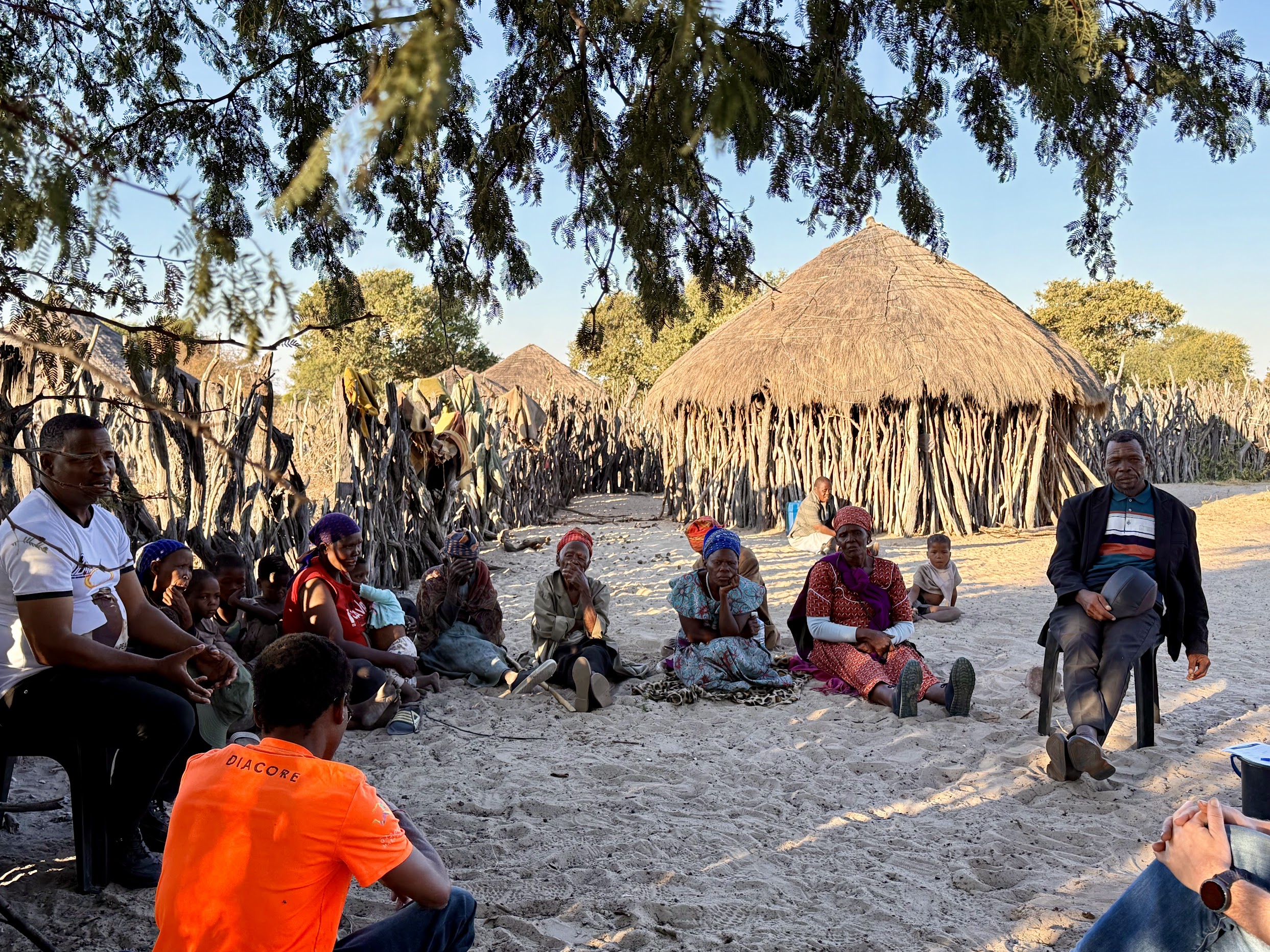
Banner image: Botswana’s previous governments said relocating the San would improve living conditions and ease the delivery of public services. Justice Minister Nelson Ramaotwana says those policies “have failed thus far.” Image courtesy Michael Taylor/Anthropos Africa.
Botswana honors 97-year-old who fought eviction of Indigenous people in Kalahari
Feedback: Use this form to send a message to the author of this post. If you want to post a public comment, you can do that at the bottom of the page.

