


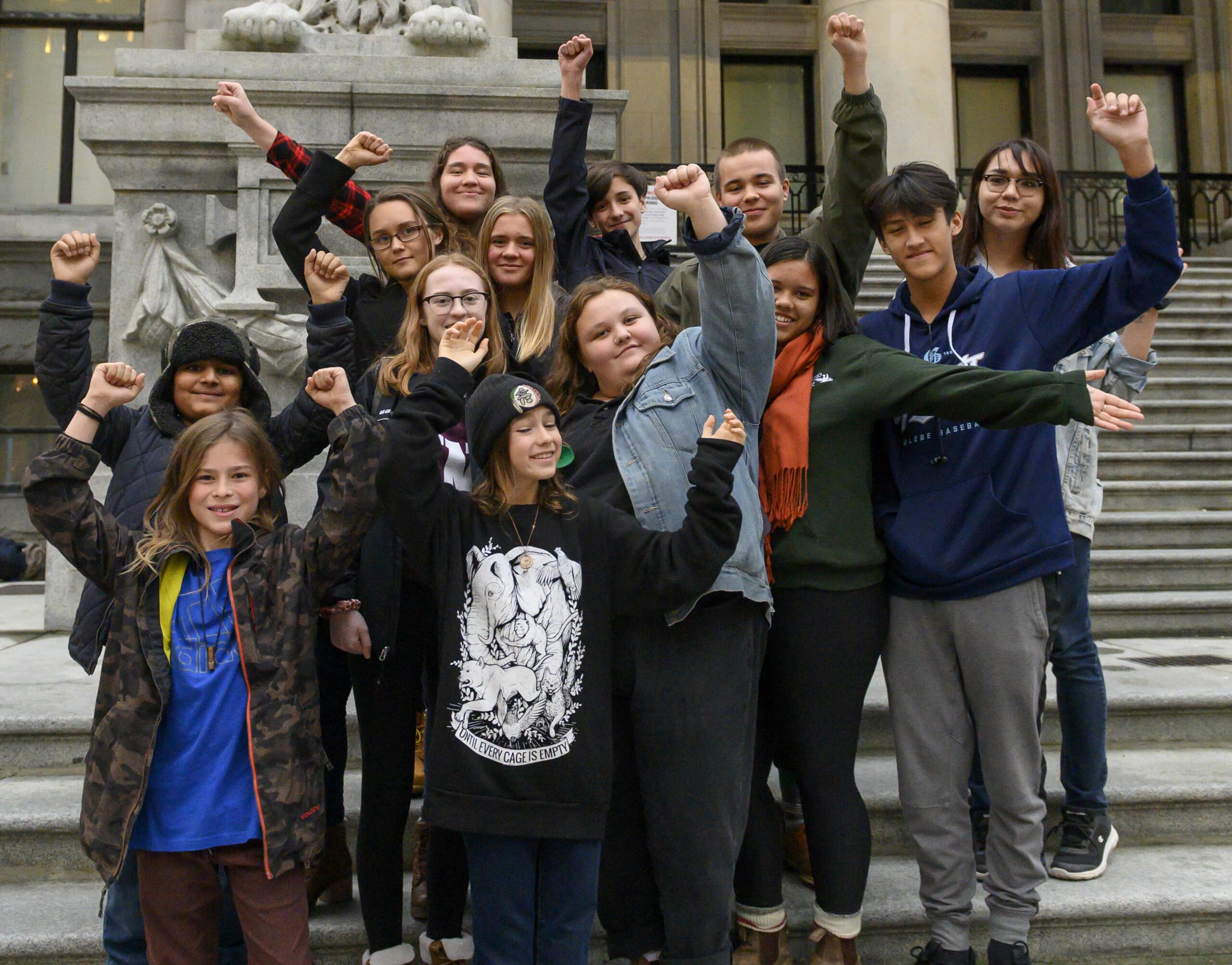
- On Oct. 26, 2026, 15 youth will begin a landmark trial against Canada and its attorney general over the country’s net-zero emissions plan they say contributes to the climate crisis and is undermining their Charter rights to life, liberty and security.
- At the trial, young indigenous plaintiff Leandrea Taylor Reeves of the Yukon, in the North, will offer her lived experience of how climate change disrupts her cultural practices and endangers her community.
- Canada’s North, especially the Yukon, is warming faster than the rest of the country and most of the world.
- Reeves details reductions in available groundberries, declining snow, unpredictable seasons and impacts on hunting, accessibility and culture.
Earlier this year, one of Leandrea Taylor Reeves’s best friends fell ill with a cold. “Maybe you need to go gather some Labrador,” said Reeves’ grandmother, observing the friend. For as long as Reeves could remember, her community, part of the Taku River Tlingit First Nation in Yukon, Canada, gathered and steeped the leaves and flowers from the evergreen shrub in hot water to make a medicinal tea that treats coughs and colds.
Reeves, 22, told Mongabay she had plenty of experience harvesting Labrador (Rhododendron groenlandicum) and knew what to look for and where. But as she searched along the edge of the boreal forest, she couldn’t find much. After coming across a short Labrador bush and plucking a tiny harvest, she handed her grandmother a huge Ziplock bag with only the very bottom filled.
“Nana,” Reeves said. “There are none there.”
The decline in Labrador near her community is one of a myriad of climate change impacts Reeves worries is affecting Canada’s North. Reeves is part of a group of plaintiffs comprising 14 other youth across the country. They are suing Canada and the attorney general of Canada for its continued support of fossil fuels, a net-zero emissions plan that allows an increase in emissions, and actions on climate change that infringes on their rights to life, liberty and security under Section 7 of the Canadian Charter of Rights and Freedoms.
The five-week trial of La Rose v. His Majesty the King beginning on Oct. 26, 2026, in Vancouver, B.C., is the first federal youth-led climate trial in Canadian history. First filed in 2019, the lawsuit went through a strike, an appeal and an amendment for further precision before being set back on track to plead in front of the courts.
The youth are also asking the court to acknowledge their right to a stable climate and to supervise and enforce a plan to keep the country on a science-based greenhouse gas emissions trajectory. If they win, it would be the first time Canada has acknowledged a climate right and the first time a charter rights case has gone beyond blocking government infringement to requiring government action.
Mongabay caught up with Reeves as she was preparing for trial. Being based in Yukon, she’s particularly concerned about changes in Canada’s North, she said.
“I’m scared,” Reeves said. “I am. I’m disappointed that it has ever gotten to this place. It shouldn’t have gotten to this place. Now that it is, adults need to take very considerable steps moving forward.”
While the country has warmed by 2° Celsius (3.6° Fahrenheit) over the last 75 years, the North has warmed by 2.6° C (4.68° F), according to Canada’s 2026 Changing Climate Report. Average annual temperatures in the Yukon are projected to increase by another 2-4° C (3.6-7.2° F) in the next 30 years, according to the Yukon State of the Environment Report 2023. Arctic Sea ice in the region has also dropped by half since 1980, affecting polar bears, walruses and seals, as well as Indigenous people who depend on the ice for hunting and travel. More frequent and severe fires are also plaguing the Yukon, the report states.
“The North is changing faster than anywhere else,” Deborah McGregor, a researcher on climate and Indigenous environmental justice at the University of Calgary, told Mongabay. “And there is a weakness in terms of understanding the exact impacts on people. A lot of the research has focused on things of concern to the government like what permafrost is doing to transportation and the airports. But there is a gap on the lived reality of people, including youth.”
Climate-stoked wildfires, floods and droughts grab headlines, but more subtle and insidious changes, such as shifting seasons and ecological degradation, are also threatening cultural survival of Indigenous people all across the country, McGregor said.
A spokesperson for Environment and Climate Change Canada told Mongabay in an email that the government shared the concerns of people across the country.
“Young people are among those leading the charge toward a cleaner future,” they said. “Our commitment to net-zero by 2050 has not wavered, and we are implementing an ambitious climate agenda built on doubling our grid, electrifying our economy, and investing in low-carbon fuels and technologies.
“The Government of Canada respects the role of the courts.”

On the stand
Reeves heard about the La Rose case through her work with the Yukon First Nation Education Directorate.
“I thought it was a really amazing opportunity to listen and learn things but also be a representative for our community,” she said.
But the prospect of testifying at a federal trial is intimidating, she told Mongabay. Her only experience with the legal system was watching the American reality TV show Judge Judy. “I don’t know what to expect,” Reeves said. “I wonder if the courtroom will be full. Or is it going to be empty? I’m curious about the reactions I’m going to get.”
Experiences Reeves may share with the court include how harvests, from Haskap berries, raspberries and soapberries as well as sage and Labrador, are shrinking due to climate change. She’s also noticed that the seasons have been disrupted. Historically, it snows up North before Halloween, she explained. Two years ago, it didn’t.
“We’re like, ‘Why is there no snow?’” Reeves said. Seasons, she explained guide annual cultural practices. “With seasons so unpredictable, we don’t know the right time to go hunting,” Reeves said.
“People are wondering: Should they hold off on hunting?”
She may also describe for the court how wildfires have made connecting with others in her community difficult. Reeves travels around the province as a junior education advocate, bringing cultural activities to youth. She has driven through burning forests thick with smoke and been stuck when wildfires closed highways.

“There was just so much smoke, it was crazy and scary,” she said.
Her community has also had to cancel ceremonies, culture camps, and fish camps because of smoke. “It’s not safe for our youth,” Reeves said. “It’s not safe for our elders. It’s not safe for any of us.”
Other Indigenous youth who are plaintiffs in the case — Montay Jesse Beaubien-Day of Wet’suwet’en and Tahltan descent; Haana Edenshaw, a member of the Tsitts Gitanee clan of Haida Nation; Sáj Milan Gray Starcevich of Carry the Kettle Nakoda Nation (Cega’Kin); and Madeline Laurendeau, a Red River Métis and member of the Manitoba Métis Federation — also raise similar concerns.
Plaintiff Sophia Sidarous, of Mi’kmaq descent and a member of the Metepenagiag First Nation who grew up in Quebec, said she has seen declines in culturally essential plants and animals such as lobster, moose, chaga, sweetgrass, cedar, black ash, birch bark and red ochre. Salmon populations have dropped so severely that her family has been unable to teach her to fish, she told Mongabay. Smoke and extreme heat have restricted sweat lodge ceremonies, fasts, feasts, Powwows — and her “beloved jingle dances.”
Next steps
McGregor said she sees the La Rose trial as an important moment for Indigenous communities, especially youth.
“To me the test is: Do we mean it when we say our future is young people? They’re going to tell their story and are we going to listen and try to change our trajectory?”

Prime Minister Mark Carney’s government has supported fossil fuel expansion to maintain “energy sovereignty” and economic security, driven in part by tariffs and geopolitical tensions with the United States. The administration has partnered with Alberta on the Pacific Link pipeline, fast-tracked major liquefied natural gas (LNG) projects such as Kitimat, and expanded tax credits for carbon capture as part of oil extraction. Plans to expand transit corridors and mine critical minerals in the North have garnered both support and opposition from Indigenous leaders.
The Canadian Net-Zero Emissions Accountability Act, which is featured in the lawsuit,
establishes target greenhouse gas reductions of 40 to 45% below 2005 levels by 2030. But Carney has conceded that the country will miss those targets.
The Canadian court recognizes the significance of the case. Presiding Justice Simon Fothergill wrote recently that La Rose is “a matter of considerable public importance, not only because of the factual context but also because of its constitutional implications” and that if the youth plaintiffs succeed, “the impact of this case may be profound.”
According to data in 2024, Canada was the eleventh largest emitter of carbon dioxide emissions from fossil fuels and industry, with 685 megatonnes of carbon dioxide equivalent in total GHG emissions.
“Once the dust settles, a win by the youth would force the government to re-evaluate the short-term economic thinking that had caused it to prioritize oil and gas over the health and safety of Canadians,” staff attorney Andrew Gage of West Coast Environmental Law, a nonprofit that supports the plaintiffs, wrote recently.

“As a result, the federal government would be required to strengthen its climate laws, perhaps shifting subsidies that currently go to fossil fuel companies towards public investments in a national electricity grid, in electric buses and trains, and solar, hydro, tidal, wind, and geothermal energy.”
No matter the final outcome of the La Rose case, it could become a catalyst for change, according to McGregor. “I hope it’s taken seriously,” she said. “Not just by governments, but literally by everyone. There’s no reason why the rest of us can’t care.”
Reeves said she’ll be really disappointed if they lose the case. “I just can’t imagine that being the answer,” she said. If they win, she hopes the rest of the world gets inspired. La Rose is part of a global trend of youth suing their governments over climate impacts. Reeves hopes other countries will take their youth’s concerns, especially Indigenous youth, seriously.
“Climate change affects the way that we live, heal, and connect,” Reeves said. “Our relationship with the land is part of how our culture continues. So much of our knowledge is passed down by being taught these things. With the climate crisis, it’s like, I need to learn this, and I want to learn this, and are we going to lose this?”
Banner image: Photo from the day La Rose was filed in 2019. Image courtesy of Our Children’s Trust.
Citation:
Krebs, C. J., Boonstra, R., Kenney, A. J., Hofer, E., Jung, T. S., & O’Donoghue, M. (2023). Trends in groundberry cover under climate change in the southern and central Yukon, 1997–2022. Botany, 102(1), 1–9. doi:10.1139/cjb-2023-0068

