


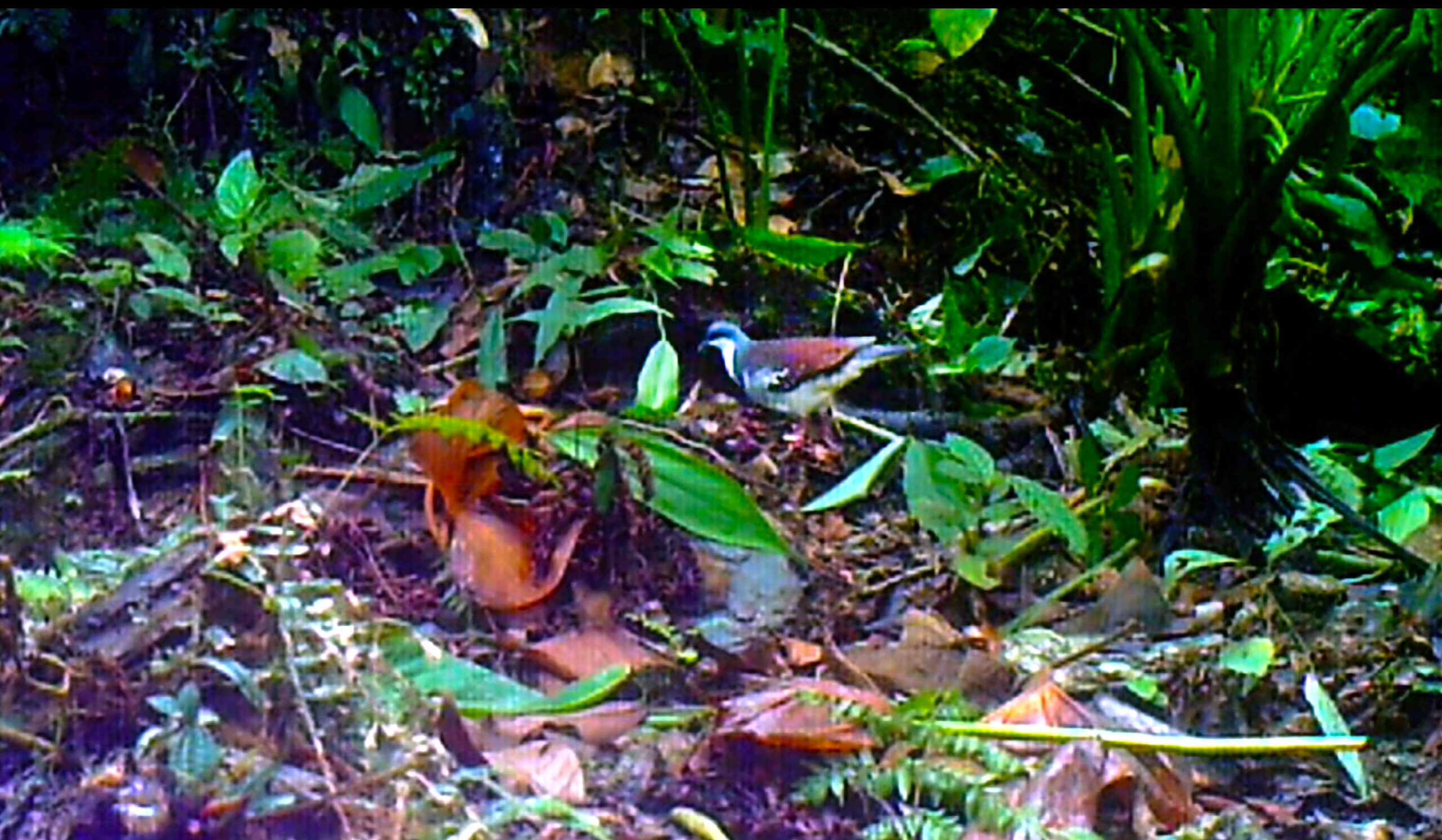
- Philippine conservation nonprofit CCIPH and Indigenous Iraya Mangyan forest patrollers documented a Mindoro bleeding-heart pigeon, providing the first confirmed image of the critically endangered species in two decades.
- Two independent ornithologists confirmed the identification based on the bird’s orange-red breast marking, iridescent green plumage, and other distinctive features.
- The image was recorded at an elevation above 900 meters (about 3,000 feet), higher than the species’ typical lowland range of 400-88 m (1,300-2,600 ft).
- Experts called for expanded camera-trap surveys, a comprehensive population. assessment, stronger habitat protection, and measures to address logging, poaching and accidental trapping.
A camera trap on the Philippine island of Mindoro has photographed one of the country’s rarest birds, confirming that the critically endangered Mindoro bleeding-heart pigeon still survives in the wild.
Captured in August in the Puerto Galera rainforest, the image is the first confirmed photograph of the species Gallicolumba platenae in two decades, according to the nonprofit organization Center for Conservation Innovation Ph Inc. (CCIPH).
“For an extremely rare and secretive species, a single image can carry enormous weight,” CCIPH researchers wrote in a Sept. 3 announcement. “It confirms that the bird continues to survive within the landscape.”
Juan Carlos Gonzalez, an ornithologist and director of the Museum of Natural History at the University of the Philippines Los Baños, independently confirmed that the image shows a Mindoro bleeding-heart.
“This record not only proves that this very rare species continues to persist in these steep rainforests, but solidifies the importance of Puerto Galera as a UNESCO biosphere reserve and an important sanctuary for this critically endangered species,” Gonzalez told Mongabay by email.
Alex Berryman, who oversees species conservation assessments for Asia at the NGO BirdLife International, also separately confirmed the identification.
“There is no doubt that this refers to a Mindoro bleeding-heart,” Berryman told Mongabay by email.
Berryman said the orange-red spot on the bird’s otherwise white chest, together with the iridescent green plumage on its head and neck, make it readily identifiable. Gonzalez also pointed to its blue-green and brown upper parts, brown wings, and single whitish wing bar, which distinguish it from other Philippine bleeding-hearts.
Decades of few confirmed encounters
The Mindoro bleeding-heart is a ground-dwelling pigeon endemic to Mindoro. Historical accounts described it as common inside the island’s forests, but confirmed encounters became increasingly rare during the second half of the 20th century.
The last confirmed record came in 2005, when an individual was caught in a snare intended for red junglefowl near a fruiting fig tree. Other encounters were subsequently reported, but not all could be verified, CCIPH said.
During later field surveys, CCIPH researchers didn’t detect the species. Many villagers and local guides were unfamiliar with it, while some hunters said they hadn’t encountered it in years.
The prolonged absence led the Search for Lost Birds program to list the pigeon as a “lost” species, a designation covering birds not documented by science for at least 10 years. Berryman noted that the bird is also listed as critically endangered on the IUCN Red List, meaning it faces an extremely high risk of extinction.
“Birds that find themselves on both these lists are of particular concern,” he said.

New record above 900 meters
The species has generally been described as a lowland forest specialist, typically occurring at elevations of around 400 meters (1,300 feet), and occasionally up to 800 m (2,600 ft). The camera trap photographed it above 900 m (nearly 3,000 ft).
“A lowland specialist appearing in high-elevation forest is not necessarily a species expanding its horizons,” CCIPH researchers wrote. “It may be a species running out of lowland to live in.”
Moist lowland and transitional mid-mountain rainforest can still occur at around 900 m in the steep range, Gonzalez said. Much of the lower slopes of Puerto Galera have been degraded as tourism grows, potentially pushing the birds toward less-accessible upper forests.
Berryman said the high-elevation record “raises hope that there might be more out there.”
Still, the image doesn’t provide an estimate of the population or its trend, or evidence of breeding.
“It is a data point, and a fragile one: a single confirmed occurrence of a single bird in a landscape where suitable forest has become increasingly fragmented,” the CCIPH researchers wrote.

Protection and further surveys
The photograph resulted from an Indigenous-led initiative inside the Iraya Mangyan ancestral domain. CCIPH attributed it to Iraya patrollers Alex, Melenciano, Cristito, Jay, and Sonnyboy, citing their landscape knowledge, sustained forest presence, and stewardship of their ancestral domain.
Working with them, CCIPH researchers John Bibar and Joshua Manila deployed the camera traps under the Mindoro Forest and Biodiversity Conservation Programme.
Berryman said the next priorities should be to safeguard as much suitable habitat as possible and conduct a comprehensive assessment of the species’ population.
“Clearly camera trapping is a great way to detect this species, as it is for other terrestrial pigeons, and so expanding this initiative should be considered a priority,” he said.
Gonzalez called for establishing a legislated protected area covering the Mount Halcon-Mount Malasimbo Range, which he said currently has no government-designated protected area covering its entirety.
He also called for stopping illegal logging and poaching, strengthening conservation education, and preventing traps intended for red junglefowl from catching bleeding-hearts. He proposed safer trap designs and using Indigenous wildlife-tracking expertise to support regulated ecotourism.
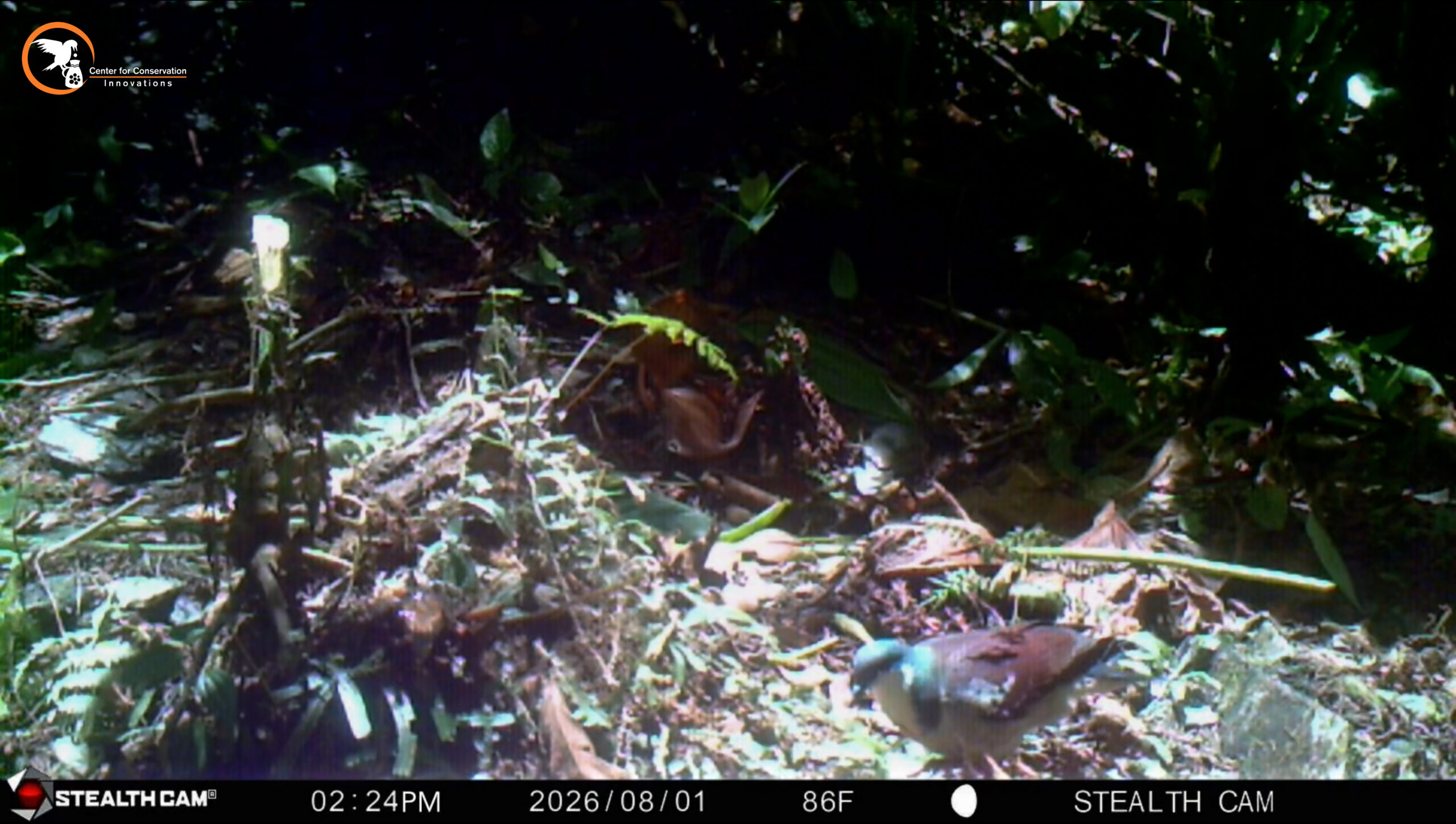
CCIPH broadly called for more focused research and protection for the Mindoro bleeding-heart.
“Whether it continues to beat for another twenty years or another hundred will depend on whether we treat this image merely as an extraordinary record or allow the evidence it carries to change what we do next,” the CCIPH researchers wrote.
Banner image: Mindoro bleeding-heart pigeon captured by camera trap. Image courtesy of CCIPH.
Once lost, now found: Five “missing” bird species rediscovered in 2025, offering hope
Cite this article
Keith Anthony Fabro (2026). A ‘lost’ Philippine pigeon reappears after 20 years — but its forest is disappearing. Mongabay Conservation news. DOI: https://doi.org/10.66709/news-328564

