


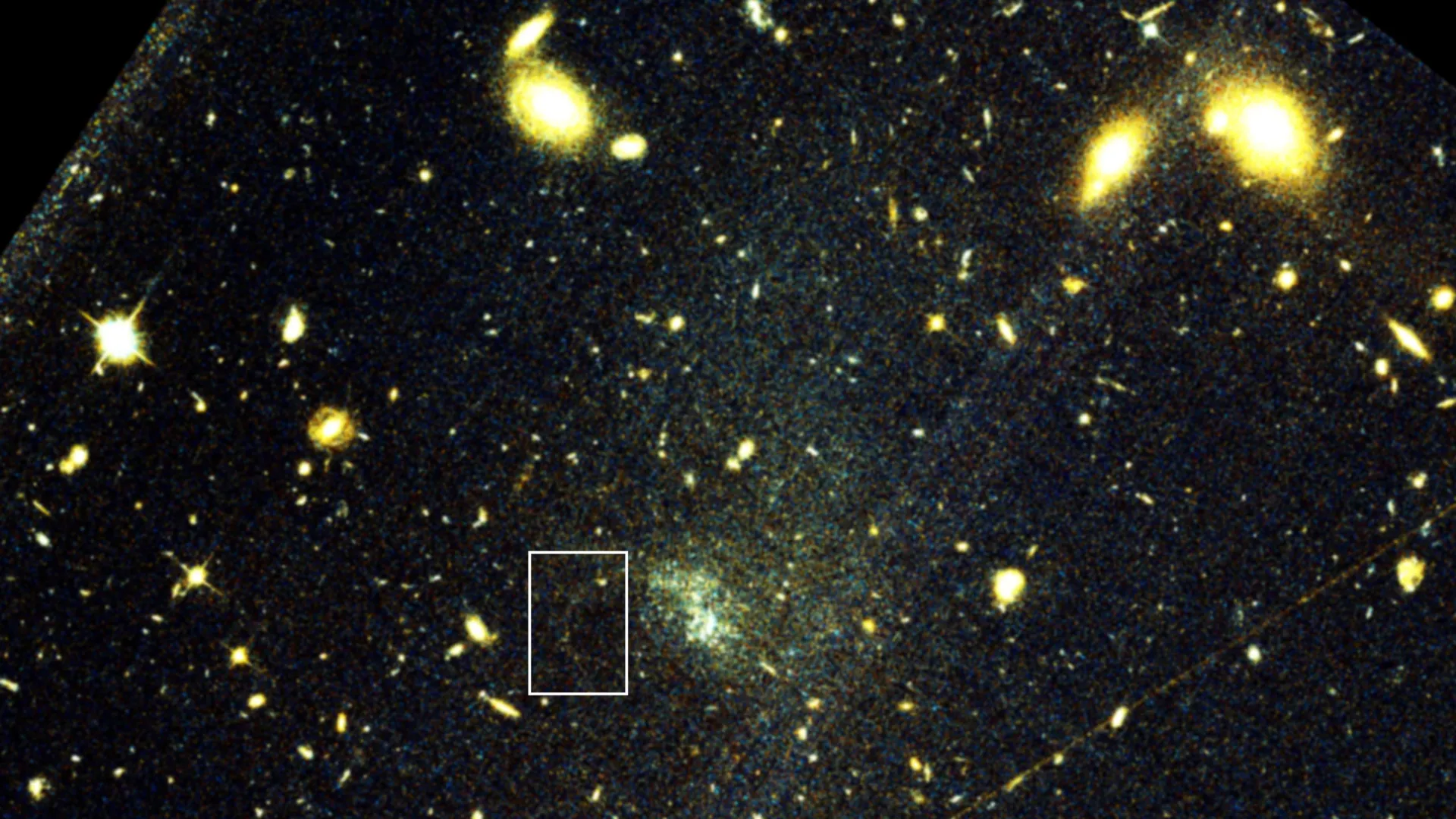
For billions of years, an ancient cluster of stars has been gradually coming apart, shedding stars that now form a faint, narrow ribbon across space. That delicate structure is offering astronomers a new way to investigate one of the universe’s biggest mysteries.
An international research team, including an astrophysicist from Northwestern University, has identified the first stellar stream of this type ever observed outside the Milky Way. Astronomers have long predicted that such streams should exist around other galaxies, but their extreme faintness has made them difficult to detect.
The newly discovered stream also offers scientists an unusual tool for studying dark matter, which remains one of the major unanswered questions in astrophysics. By analyzing the stream’s shape, researchers reconstructed the gravitational field of its host galaxy and used that information to determine how unseen dark matter influenced the stars’ paths.
The findings could eventually help scientists investigate how dark matter is distributed across many different galaxies and throughout the universe.
The study was published Aug. 12 in the journal Nature.
“The stars in a stellar stream all travel along nearly the same orbit, and that orbit is shaped by the galaxy’s gravity,” said Northwestern’s Tjitske Starkenburg, who coauthored the study. “By modeling that gravity, we can estimate the galaxy’s total mass. We already know roughly how much of that mass comes from visible matter like stars, so the rest must be dark matter.”
Starkenburg, an expert in extragalactic astronomy, is a research assistant professor at Northwestern’s Center for Interdisciplinary Exploration and Research in Astrophysics. The study was co-led by Julie Kiel Holm of the University of Copenhagen and Sarah Pearson of the Technical University of Denmark.
First Stellar Stream Found Beyond the Milky Way
Globular clusters are densely packed groups of stars held together by gravity. As one of these clusters travels around its host galaxy, the galaxy’s gravitational pull can slowly strip stars away from it.
Those stars do not simply scatter in every direction. Instead, they tend to continue along nearly the same orbital path, creating long, thin stellar streams that retain information about the gravitational forces they have experienced.
Astronomers have identified dozens of streams produced by globular clusters inside the Milky Way. Until now, however, no comparable stream had been detected in another galaxy. Such structures are generally so faint that they disappear against the light of their host galaxies.
The breakthrough came through archival observations from NASA’s Hubble Space Telescope presented by study coauthors David Sand and Catherine Fielder, both astronomers at the University of Arizona. While study coauthor David Hendel was examining images of the ultra-diffuse galaxy UGC 9050-Dw1 for their publication, he noticed a faint, narrow arc that looked like a stellar stream.
UGC 9050-Dw1 lies roughly 115 million light-years from Earth. Because the galaxy contains relatively few stars, it provided an unusually dark background that made the dim stream easier to distinguish.
A New Way to Measure Dark Matter
The importance of the discovery extends beyond finding the stream itself. Researchers have now shown for the first time that a globular cluster stellar stream can be used to investigate dark matter in a galaxy beyond the Milky Way.
Dark matter accounts for roughly 85% of all matter in the universe. Because it does not emit or reflect light, astronomers cannot see it directly. Instead, they detect its effects through the gravitational influence it exerts on stars, galaxies, and other visible objects.
Once the stream was identified, the team ran thousands of computer simulations. The researchers tested different combinations of globular cluster characteristics and possible dark matter distributions to determine which scenarios could reproduce the stream’s observed appearance.
The models that most closely matched the observations provided new estimates of UGC 9050-Dw1’s total mass and showed how that mass is distributed throughout the galaxy. The results indicated that UGC 9050-Dw1 contains a large amount of dark matter, as astronomers had expected for an ultra-diffuse galaxy.
“Our results are consistent with previous studies and what they have shown about dark matter in this ultra-diffuse galaxy,” Kiel Holm said. “We are measuring it with a completely new tool for this type of galaxy, demonstrating that this method also works beyond our own galaxy.”
Stellar Streams Could Expose Dark Matter Structure
Although the current analysis centers on just one galaxy, the finding could lead to searches for similar stellar streams around many different types of galaxies. With a larger sample, astronomers may be able to learn much more about how dark matter behaves and how it is distributed.
Thin stellar streams may be especially valuable because small concentrations of dark matter can potentially disturb them, producing visible gaps or clumps.
“Thin stellar streams can develop gaps or clumps when small concentrations of dark matter pass through them,” Starkenburg said. “Astronomers have long debated whether we’ve seen this happen in streams within the Milky Way. If we can confirm that’s what’s causing these features, that will give us an entirely new way to test how dark matter is distributed — and ultimately learn more about its fundamental nature.”
New Telescopes Could Find Many More Streams
Future observatories could make these elusive structures much easier to find. The European Space Agency’s Euclid mission and NASA’s Nancy Grace Roman Space Telescope are designed to survey far larger regions of the sky than Hubble, increasing the likelihood that astronomers will detect stellar streams around additional galaxies.
“It’s exciting that we discovered a thin stellar stream around a galaxy other than our own with already-existing Hubble Space Telescope data and confirmed it with ground-based telescope data,” Starkenburg said. “That makes it very promising for the new telescopes becoming available, including the Roman Space Telescope, which can see an area 100-times larger than that of the Hubble.”
The study, “Evidence for the First Globular Cluster Stellar Stream beyond the Milky Way,” was supported by VILLUM FONDEN (award number VIL53081) and the European Union (BeyondSTREAMS award number 101115754). Starkenburg also gratefully acknowledges support from the NSF (grant number AST-2510183) and NASA (grant numbers 22-ROMAN22-0055 and 22-ROMAN22-0013).
