


Focusing only on emergency planning, disaster response, and recovery after each climate catastrophe is no longer enough in Europe. Policymakers urgently need to start mapping Europe’s long-term future, which will require a fundamental overhaul of its infrastructure, energy system, and major economic sectors.
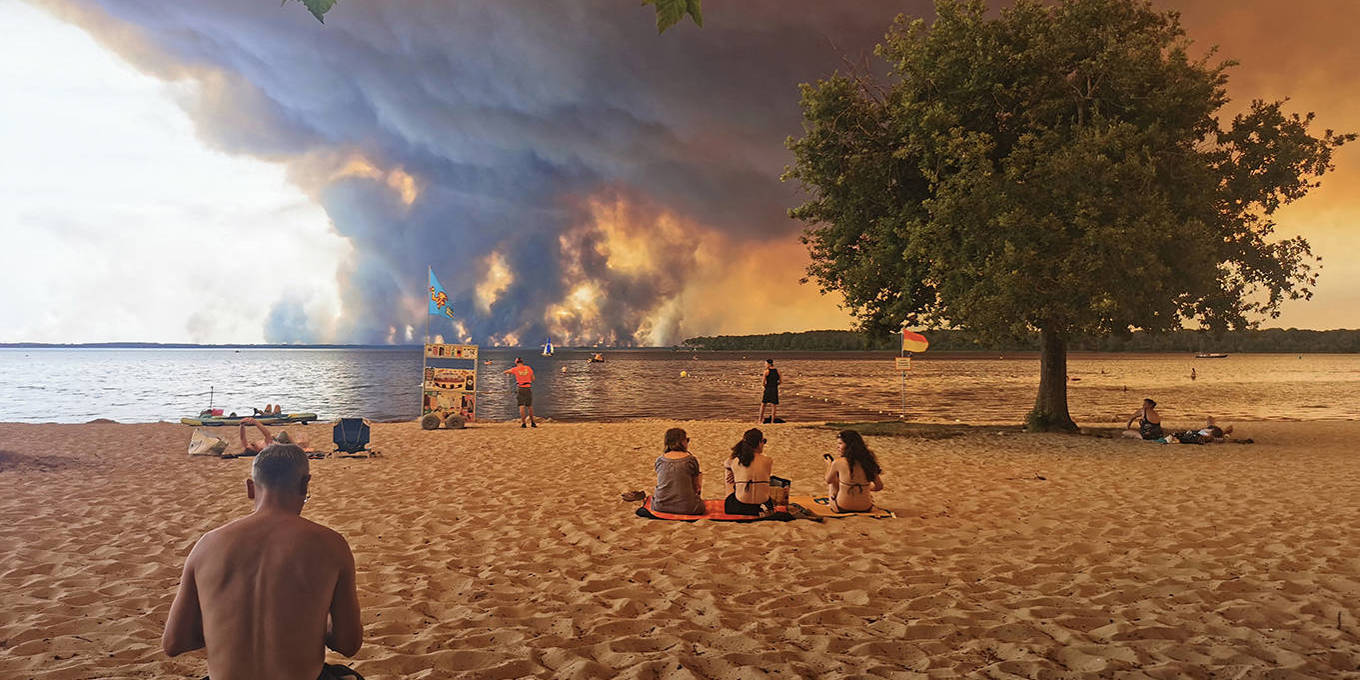
LONDON—Between June 20 and 28, a powerful heat wave hit Europe, creating the conditions that have fueled the wildfires now raging across large swathes of France and Spain. Soon after the June heat wave, city officials in Rome announced a new, scientifically informed operational strategy to prepare for a hotter world. As with other such efforts in Europe, the heat plan includes emergency responses for the vulnerable, green public spaces, more water fountains, climate shelters, investments in grid resilience, and so forth.
This is not the Eternal City’s first heat initiative. Rome previously rolled out a heat health warning system in 2002, in time for the 2003 heat wave that killed 70,000 people across Europe (including more than 1,000 in Rome). After that, Rome and many other cities enacted emergency plans to provide early warning systems, register vulnerable people, and prepare hospitals. But when a massive heat wave struck in 2022, those two decades of emergency planning proved inadequate. Another 60,000 people died.
Once again, governments announced structural responses such as school closures, event cancellations, and outdoor labor regulations. But while they had some positive effect, this year’s heat wave showed that Europe is still far behind the curve.
The problem is that we are chasing a moving target. Heat waves are becoming more frequent, prolonged, and intense, and this trend has exacerbated other risks. For example, heat waves create ideal conditions for forest fires, which have now hit several countries in southern Europe. They also lead us to overlook increasingly common extreme precipitation, with frequent destructive floods becoming a fact of life, often in the very same places suffering heat waves. Since anthropogenic climate change is the cause of all this, zeroing out greenhouse-gas emissions is the route to stabilization. But until then, current conditions will worsen.
Following major floods in 2023, I argued that a new frontier was coming into view. Europe would need to orchestrate a constitutional response to its shifting material conditions, with a state-led program to transform its economy. Three years and many floods and heat waves later, the frontier is upon us, yet we are still behaving as if nothing has changed. Focusing only on emergency planning, disaster response, and recovery after each catastrophe may fit the Intergovernmental Panel on Climate Change’s definition of building “resilience”; but resilience is no longer enough.
That is why I have long focused on the broader, evolving relationship between economic development and the environment. Over the years, country after country has written the story of its future by transforming its landscape. Consider the hydro-infrastructural transformation of the American West during the Progressive Era; Sun Yat-sen’s blueprint for Chinese modernization on the Yangtze; Italy’s extensive land reclamation and hydropower development to support industrialization; Jawaharlal Nehru’s dams, “modern temples of India” that served as symbols of economic emancipation; and Park Chung-hee’s spatial reorganization of the South Korean economy in service of export-led growth.
In The Environmental Republic, I argue that, despite all their mistakes and distortionary effects, these efforts hold a crucial lesson. In changing material conditions, resilience cannot just be about “weathering the storm.” It must be a property of how we grow. The transformation that climate change makes necessary will be of comparable scale and scope to those pursued over the last century.
Consider the energy system. During the June 2026 heat wave, air-conditioner use pushed Rome toward its daily peak electricity capacity of 2.1 GW, and localized blackouts followed. The grid proved inadequate, even though Italy has been investing in it. There is still too little spare capacity; natural gas dominates production; the hydropower share of production is itself vulnerable to climate change; and a significant share of distribution is underground, where thermal stresses from accumulated heat damage cables.
The solution is not simply to fix each of these individual problems. It requires mapping Italy’s long-term energy future. Like many European economies, Italy is suffering declining competitiveness. It needs to find space for innovation and comparative advantage in a global economy that is adopting the tools of 21st-century industrialization: electrification, renewables, automation, and AI. The spatial distribution of that transformation will define the future economy’s network needs, which will both drive grid modernization and pay for it.
Europe faces challenges like this around every corner. Its median age is now 45, with a pensioner for every three workers. By the end of the century, one-third of Europeans will be over 65, the age cohort most vulnerable to heat-induced mortality. But a shrinking workforce with declining productivity obviously cannot support welfare services on the scale that people are used to. The solution must be vastly higher productivity, a larger working-age population, or a combination of the two.
As it happens, the median age in Africa, just across the Mediterranean, is under 20, and the continent’s total population will swell to 2.5 billion by 2050. Politics aside, the conditions for an extraordinarily beneficial partnership are in place. But accommodating migration on any significant scale and sustaining the increase in related trade will have profound territorial consequences. New social housing, transportation infrastructure, and services will add to challenges already facing cities like Rome, Vienna, and Paris. Now open-air museums to Europe’s cultural legacy, these metropolitan centers were modernized with infrastructure designed for a different society, economy, and material conditions.
When asked what made Singapore—transformed from a resource-poor local port into a global hub in the space of a generation—so successful, its founding leader, Lee Kuan Yew, famously answered: “Air conditioning.” He understood that modernity’s most consequential gift has been the control of material conditions.
Europe can no longer afford to treat climate change as a background trend that is unfolding while we are making other plans. Shifting material conditions are the new normal. History tells us that such challenges can be overcome only through transformations on a societal scale. Europe must think much bigger, aiming not for mere resilience but for resilient growth.
