


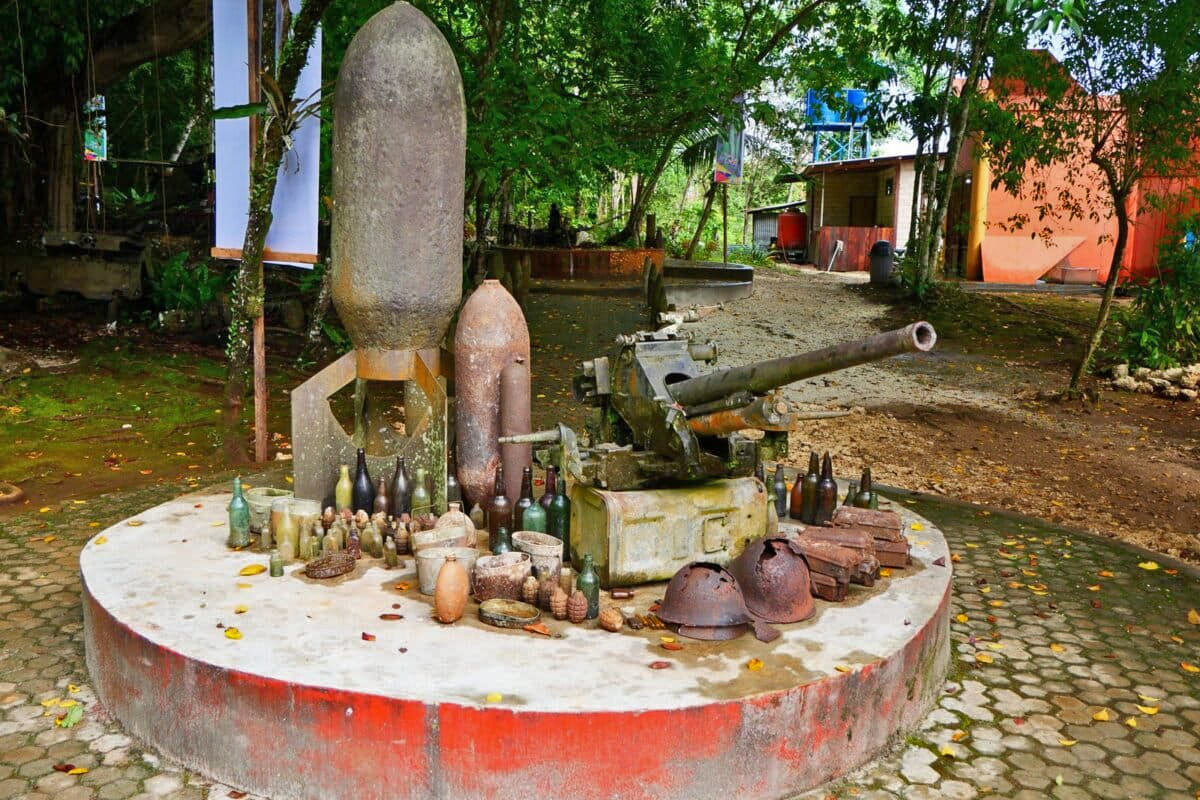
- At least seven people were killed on May 31 when a World War II bomb exploded in Fandoi village on Indonesia’s Biak Island.
- Interviews with officials indicate the explosion occurred while an unexploded wartime ordnance was being dismantled to recover explosives for illegal blast fishing.
- The HALO Trust estimates that unexploded bombs and ammunition have killed or injured around 25,000 people in neighboring Papua New Guinea since the end of the World War II, reflecting the region’s enduring wartime legacy.
- A casualty estimate for the Indonesian territory of the New Guinea archipelago is unclear.
BIAK, Indonesia — The munition here had outlasted one of the Pacific’s fiercest World War II battles. Eight decades later, investigators in Indonesia said it exploded by the timber-framed houses in the coastal village of Fandoi on Indonesia’s Biak Island.
Investigators and officials later concluded a group of local fishers were dismantling an unexploded munition recovered from coastal waters off Papua, where some of the Pacific’s most intense fighting took place in 1944.
“They take them and dismantle them on the island,” said Cliff Marlessy, who as director of the Indonesia Locally Managed Marine Area (ILMMA) works with communities to manage marine resources in Biak.
Their deaths are the latest in a long legacy of unexploded wartime ordnance, which has killed or injured at least 25,000 people across neighboring Papua New Guinea since 1945, according to The HALO Trust, the world’s largest humanitarian mine-clearance organization. No concrete estimate exists for the death toll across Indonesia.
Authorities have known about repurposing of unexploded bombs for decades, yet some fishers continue to recover wartime explosives for use in blast fishing despite the extreme danger.
Legacy of war
New Guinea and its surrounding islands were among the Pacific’s most violent World War II theatres, while Allied forces advanced westward through Japanese-held territory.
During this period, months of heavy bombing and naval combat left countless unexploded bombs and artillery shells buried on land and offshore.
Biak Island, off the north shore of New Guinea, became a heavily fortified military base following its occupation by Imperial Japanese forces in 1942.
Japan had established a command center inside the karst chambers of Biak’s Binsari Cave, creating a fortified barracks and hospital. This cave later became one of the region’s largest mass graves when thousands of Japanese soldiers died inside after Allied bombardment collapsed sections and sealed some exits in June 1944.
The site remains a place of remembrance for the families of Japan’s war dead.
After weeks of fierce fighting through mid-1944, Allied forces secured Biak in August, capturing airfields that helped support the campaign to liberate the Philippines to the northwest of Papua.
More than 80 years later, unexploded munitions deployed in the fighting continue to be uncovered today during construction, farming and fishing, posing a persistent risk of death or serious injury.

Ordnance survey
Despite the extreme risk, World War II bombs are deliberately sought out by a small number of audacious Biak Island fishers, who have become specialists in salvaging wartime explosives for use in blast fishing.
“They take them and dismantle them on the island,” said Cliff Marlessy, who as director of the Indonesia Locally Managed Marine Area (ILMMA) works with communities to manage marine resources in Biak.
Cliff added that local evidence appeared to show explosives were being traded.
“Apparently, it has grown into a market,” Cliff said.
A report for the U.S. government published in 2004 cited several studies published since 1950 that conclude that people in Indonesia, Papua New Guinea and the Philippines have “fished with explosives since World War II when ordnance and explosives left behind provided the basis for a new and effective method of harvesting reef fish.”
The Papua Archaeological Center, a state archaeological research body, compiles a map of World War II artifacts across Indonesia’s Papua provinces. When archaeologists encounter explosives, they alert the local military garrison.
“They’re the ones who’ll come in to resolve the situation, because we’re limited to assessing the leftover bombs—what type they are, their function, and whether they came from Japan or the Allies,” archaeologist Sonya Martha Kawer said.
Sonya said these islands remained littered with presumably viable explosives. To the east on Wakde Island, location of a strategic World War II airfield, bombs often emerge at low tide, and explode sporadically in the forest during heatwaves.
The Biak explosion was not an isolated incident. On April 27, 2025, fisherman Agus Drunyi died while assembling a homemade fish bomb at his home in the coastal village of Enggros, near Papua’s provincial capital, Jayapura.

Frits Rumbino, who oversees conservation work for Indonesia’s Ministry of Marine Affairs and Fisheries in Papua, said authorities had spent years warning communities about the dangers of salvaging World War II explosives, yet some fishers continue to take the risk.
“There’s still actively using explosives,” Frits said.
Lieutenant Colonel Tri Purwanto, commander of the XVII Cenderawasih military command, urged residents not to handle suspected wartime munitions.
“It is not impossible that remnants of war materials such as ammunition, bombs, or unexploded artillery are still scattered in many places, both on land and under the sea or in the surrounding waters,” Tri said.
The wartime legacy is measured not only in lives lost but often life-changing injuries. Across parts of the region, the same explosives have also fueled one of the world’s most destructive forms of fishing.
A 2021 review of 221 studies by scientists at the University of New England in Australia noted a “broad range of ecological, socio-political and economic considerations” resulting from blast fishing.
“Blasting reefs with explosives provides fish for commercial and consumption purposes across the globe, but the practice has also led to large-scale destruction of coral reefs in much of Southeast Asia, Tanzania, the Red Sea, and other areas in Asia, Africa, Europe and South America,” the review, which was published in the journal Biological Conservation, concluded.
Affected farmers in this region even demonstrate reticence when seeking to clear new land for agriculture, she said.
“People there can’t just burn the forests indiscriminately,” Sonya said. “They do burn them, but usually with caution, because the fires often trigger bullets or bombs to explode.”
This story was first published here in Indonesian on June 11, 2026.
New treaty promises safer conditions for Indonesia’s fishing crews
Indonesian fishers mount a community-led fight against destructive fishing
Citation:
Hampton-Smith, M., Bower, D. S., & Mika, S. (2021). A review of the current global status of blast fishing: Causes, implications and solutions. Biological Conservation, 262, 109307. doi: 10.1016/j.biocon.2021.109307

