


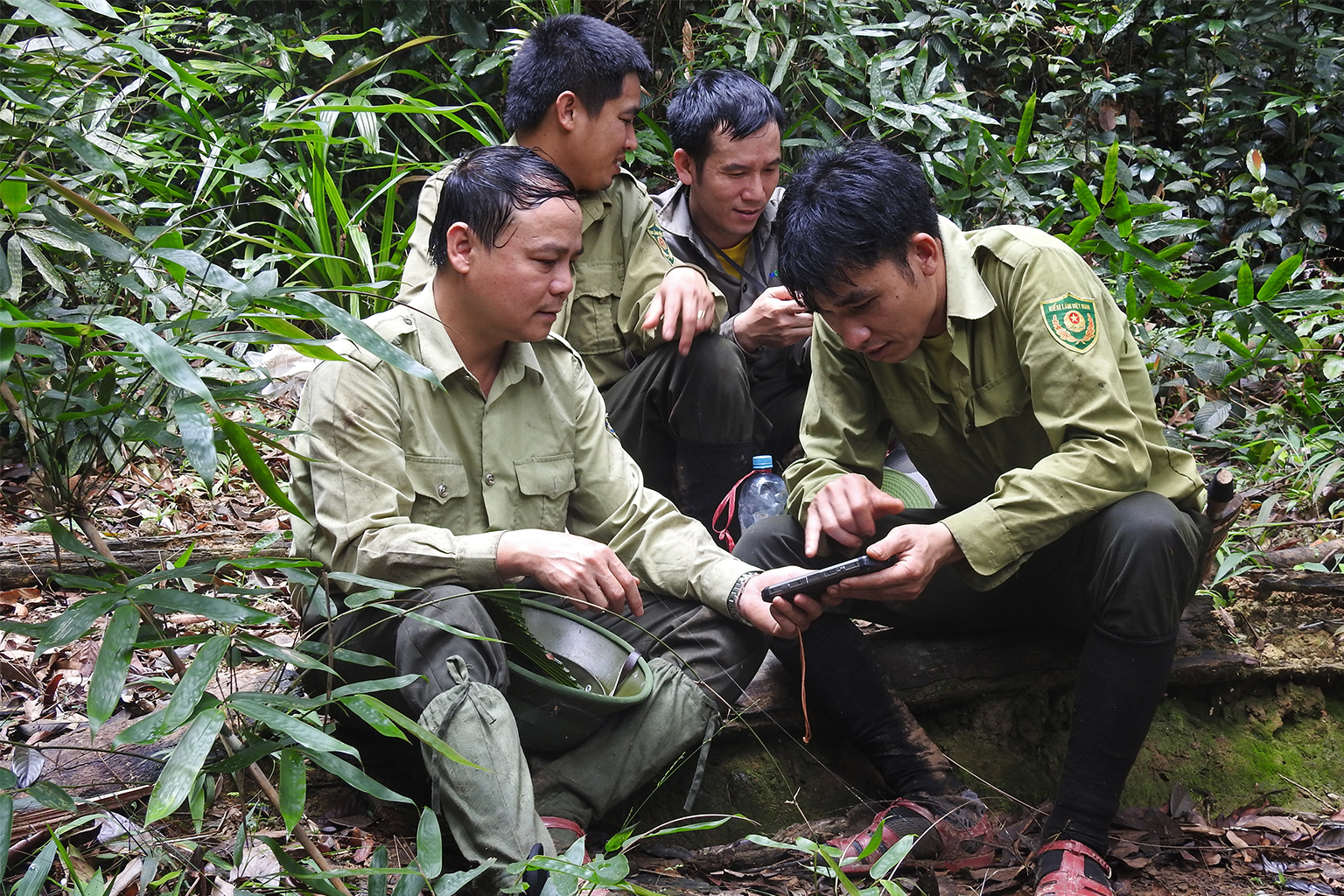
In Vietnam’s Pu Mat National Park, which borders Laos, an antipoaching unit is integrating high-tech tools with on-the-ground patrols to help turn the tide on illegal wildlife poaching.
The antipoaching unit (APU) was formed through a partnership in 2018 between the NGO Save Vietnam’s Wildlife (SVW) and the park, to address the widespread use of wire snares and the limited capacity of forest rangers, APU coordinator Huu Trung Nguyen told contributor Campbell Rusden in an interview for Mongabay.
Nguyen said that about 70 forest rangers previously monitored more than 1,300 hectares (3,200 acres) of rugged terrain each on average.
Patrol information was also recorded in written notes and patrol routes, and locations of illegal activities were described in narrative form, said Trung Hau Luong, the unit’s deputy head, in the interview.
Now, the APU team uses SMART (Spatial Monitoring and Reporting Tool) software and remotely monitored “PoacherCams.”
Luong said that SMART allows patrol teams to record routes, wildlife observations, and snare locations via GPS-enabled smartphones, creating structured data to identify trafficking hotspots and guide strategic planning.
Meanwhile, PoacherCams, which are cameras installed at certain locations such as forest entry points, ridge crossings, or trails frequently used by hunters, help the unit better understand people’s movements through the forest and identify potential illegal activities. In one instance, a camera captured footage of a man entering the forest with a gun. After the authorities spoke with the individual and explained the legal consequences of hunting, he voluntarily surrendered his hunting gun, Luong said.
Van Nam Luong, head of the APU, said they’re already seeing changes. They’re encountering fewer snares in the park, for example, and have observed encouraging signs of wildlife recovery, such as wild pig nests, otters, and pangolin activity in areas that were once heavily hunted. Independent camera-trap surveys have further documented the presence of rare species in the landscape, including clouded leopards (Neofelis nebulosa) and Owston’s civets (Chrotogale owstoni).
Still, the team said the technologies have limits. Nguyen pointed out that the park’s rugged terrain, high humidity, and limited connectivity often challenge electronic equipment. Furthermore, while artificial intelligence holds promise for automating analysis of images and sounds to detect threats more quickly, Nguyen said “AI should be seen as a tool that supports human decision-making rather than its replacement.”
The APU aims to expand its influence through community outreach and a mobile nature center to reduce the demand for illegally sourced wildlife. For the officers, many of whom grew up near the park, the mission is deeply personal.
“For those of us working in the forest, the most encouraging moments are when we begin to see signs of wildlife returning to places that were once heavily hunted,” Van Nam Luong said.
Read the full interview by Campbell Rusden here.
Banner image: Antipoaching officers and forest rangers in Pu Mat use the SMART application in their forest patrols and protection work. Image courtesy of Save Vietnam’s Wildlife.
