


- Bangladesh’s shipbreaking industry faces a pivotal treaty dispute. The country’s interim government last year decided that both Basel Convention and the Hong Kong Convention (HKC) will apply simultaneously to the local shipbreaking operations.
- However, shipbreakers say that applying Basel rules would make ship imports more expensive and legally complex, potentially forcing many shipbreaking yards to close due to their inability to meet Basel standards.
- Basel strictly controls transboundary movement of toxic waste, and requires dismantling ships on impermeable surfaces that contain hazardous waste, effectively ruling out the conventional method used in Bangladesh, of grounding a ship onto a beach.
- The Hong Kong Convention permits the beaching method, but environmental activists say it doesn’t provide sufficient environmental protection and reflects shipping industry interests.
DHAKA — Ships sail oceans all over the world, yet as they reach the end of their lives, they mostly go to die on the beaches of Bangladesh, India and Pakistan.
Around 85% of the world’s end-of-life ships are dismantled and recycled in these three South Asian countries, an industry that has long relied on low-cost manual labor but has also been criticized for its high disregard for worker safety and severe environmental pollution.
Shipbreaking is so hazardous that the industry was shut down in industrialized countries in the 1960s, displaced to less-industrialized countries, particularly in South Asia.
Data from the NGO Shipbreaking Platform, which campaigns for improved ship-recycling standards, show that since 2009, 8,221 ships have ended up on South Asian beaches, 480 workers have died on the job, and 520 have been injured. The numbers don’t account for pollution so severe that fish stocks have declined in these areas, putting local fishers out of work.
The future of Bangladesh’s ship recycling industry now hinges on a dispute over two international treaties: the Basel Convention, which regulates the transboundary movement of hazardous waste, and the Hong Kong International Convention for the Safe and Environmentally Sound Recycling of Ships (HKC), a sector-specific treaty adopted under the International Maritime Organization (IMO).
Bangladesh ratified both conventions: Basel in 1993, and HKC in 2023. The latter came into force in 2025, while the former entered into force in 1992.
Government position sparks industry concern
In November 2025, Bangladesh’s interim government reportedly submitted a policy position to the Basel Convention Secretariat, arguing that the Hong Kong Convention cannot replace the Basel Convention procedures governing the transboundary movement of end-of-life ships. The submission proposed that both conventions should continue to apply simultaneously to the shipbreaking industry.
This upset Bangladeshi shipbreakers, who said the move could make ship recycling more costly and complicated, and that it might lead to the closure of the industry in the country. The Bangladesh Ship Breakers and Recyclers Association (BSBRA) has urged the new government, which took office in February, to withdraw that position.
In 2004, it was the countries that had signed up to Basel who invited the IMO to develop mandatory international rules specifically for ship recycling, eventually leading to the adoption of the Hong Kong Convention in 2009. However, they never agreed that the HKC provides an equivalent level of environmental protection.
Beaching remains the biggest divide
The most contentious difference between the two conventions concerns “beaching,” the method in which ships are deliberately grounded on tidal beaches before being dismantled.
Basel’s “Technical Guidelines for the Environmentally Sound Management of the Full and Partial Dismantling of Ships” require dismantling activities to take place on impermeable surfaces capable of containing hazardous materials, effectively ruling out traditional beaching. The HKC, however, permits beaching, provided that shipbreaking yards meet specified safety and environmental standards.

For Bangladeshi recyclers, this distinction is crucial.
Mohammad Mohsin Chowdhury, president of the BSBRA, told Mongabay that the Hong Kong Convention is better suited to South Asia’s economic realities, calling it “customized for the subcontinent’s reality: its [work] culture, community and environment.”
“Following any convention is difficult for us given the human resources we have; we still want our future generation to have a safe environment, and we are working on bringing shipbreaking under regulation,” he added.
“Since we are following HKC regulations, improving the industry and enjoying the benefits, we don’t see why include Basel into shipbreaking affair. It will be an extended burden for shipbreakers.”
Asked whether Basel’s opposition to beaching is why shipbreakers oppose it, Chowdhury said: “This is one of the main reasons, but I think Basel is not concerned about protecting our industry. Following Basel regulations may lead to the closure of the shipbreaking industry.”
“HKC is more suitable for us,” he reiterated. “Basel thinks about the environment, but nothing can be changed overnight.”
Commercial shipbreaking in Bangladesh began in the early 1970s, and the sector boomed in the 1980s, turning the country into a major global hub for ship recycling. But dire working conditions, high rates of fatalities, exploitation of underaged workers, and severe pollution of the marine environment by hazardous waste continued unabated for around five decades. The industry only started to pay heed when many industrialized countries began to ban the beaching method for the dismantling of ships registered in their jurisdictions, and started pushing for a safer environment for workers.

Europe’s standards remain out of reach
The EU Ship Recycling Regulation, adopted in 2013, strictly prohibits the beaching method used in South Asia, and requires all European-flagged vessels to be dismantled at certified “green” yards, predominantly located in Europe, Turkey, and North America. European ship owners account for around 30% of the world’s fleet in tonnage.
According to the BSBRA, 23 shipbreaking yards in Bangladesh’s Chattogram region received green certification under the Hong Kong Convention. However, none of them are listed on the official EU list of approved ship-recycling facilities.
“This is definitely a great loss for us, but ship dismantling on dry docks is very expensive,” Chowdhury said. “We’ll need to spend a whole year’s budget to build just one dry dock.
“I think Basel Convention is partial [to developed countries], maybe it wants to protect their interests,” he added. “Perhaps they want ships to be recycled in an expensive way, and we end up buying more expensive products made with the salvaged metal.”
Environmentalists call for stricter standards
Environmental activists have rejected the industry’s argument.
Syeda Rizwana Hasan, chief executive of the Bangladesh Environmental Lawyers Association (BELA), led the country’s environment ministry in 2025 as an adviser to the interim government at the time. She questioned why the ministry should permit shipbreaking on beaches if the Basel Convention prohibits it.
She also said the Hong Kong Convention primarily reflects the interests of the shipping industry, given that it’s administered by the IMO.

“HKC is monitored by IMO. IMO is a clubhouse of shipowners. It is protecting their interests,” Rizwana Hasan said.
“Nobody wants their waste-laden ships nowadays. Pakistan used to scrap them, now they don’t do that much; shipbreakers in Kolkata, Madras in India don’t take them … only Gujarat and Bangladesh do,” she said. “South Korea stopped it, while China has banned beaching through legal processes.”
She also accused local shipbreakers of not wanting to be regulated — “That’s why they don’t want to comply with Basel Convention” — and alleged that Bangladesh continues to import hazardous ships through inaccurate declarations — something that Basel is specifically designed to prevent.
Rejecting claims that stronger environmental rules would destroy the industry, Rizwana Hasan cited the example of Bangladesh’s garment sector after the 2013 Rana Plaza factory collapse, which killed more than 1,100 people and prompted sweeping reforms to improve workplace safety.
“Everyone thought the garment industry would collapse,” she said. “Instead, compliance improved and the industry became stronger.”
Noting that Bangladesh had ratified the Basel Convention decades ago, Rizwana Hasan said that “no new position has been taken; what we did is a reiteration of what is existing.”
Many environmental organizations argue that the Hong Kong Convention still falls short of guaranteeing environmentally sound ship recycling. Ingvild Jenssen, founder and executive director of the NGO Shipbreaking Platform, said the convention requires significant strengthening.
“Clearly, the Hong Kong Convention does not set a standard that ensures safe and environmentally sound practices,” she said in a statement on the organization’s website. “Now under review at the IMO, it will be key to bolster its requirements, including ways to phase out the fatally flawed beaching method. At the same time, better enforcement of the Basel Convention’s restrictions on hazardous waste trade needs to be ensured through measures that effectively hold the shipping industry accountable. This entails shifting responsibility to the states that actually have control over the owners of assets intended for disposal.”
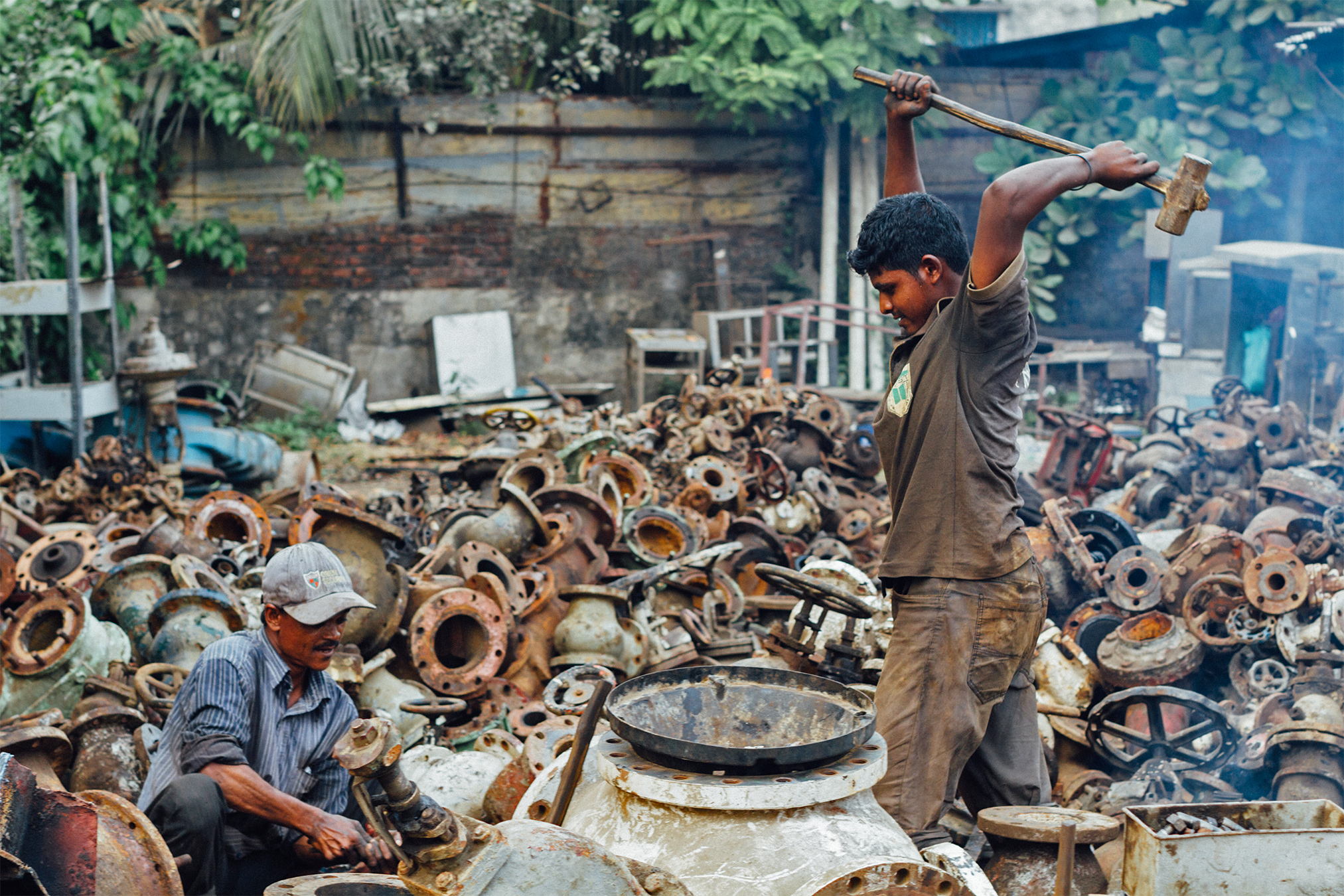
Banner image: A shipbreaker with a sledgehammer amidst ship parts, Chittagong. Image by Adam Cohn via Flickr (CC BY-NC-ND 2.0).
Bangladesh struggles to enforce ‘polluter pays’ principle amid legal delays
Feedback: Use this form to send a message to the author of this post. If you want to post a public comment, you can do that at the bottom of the page.

