


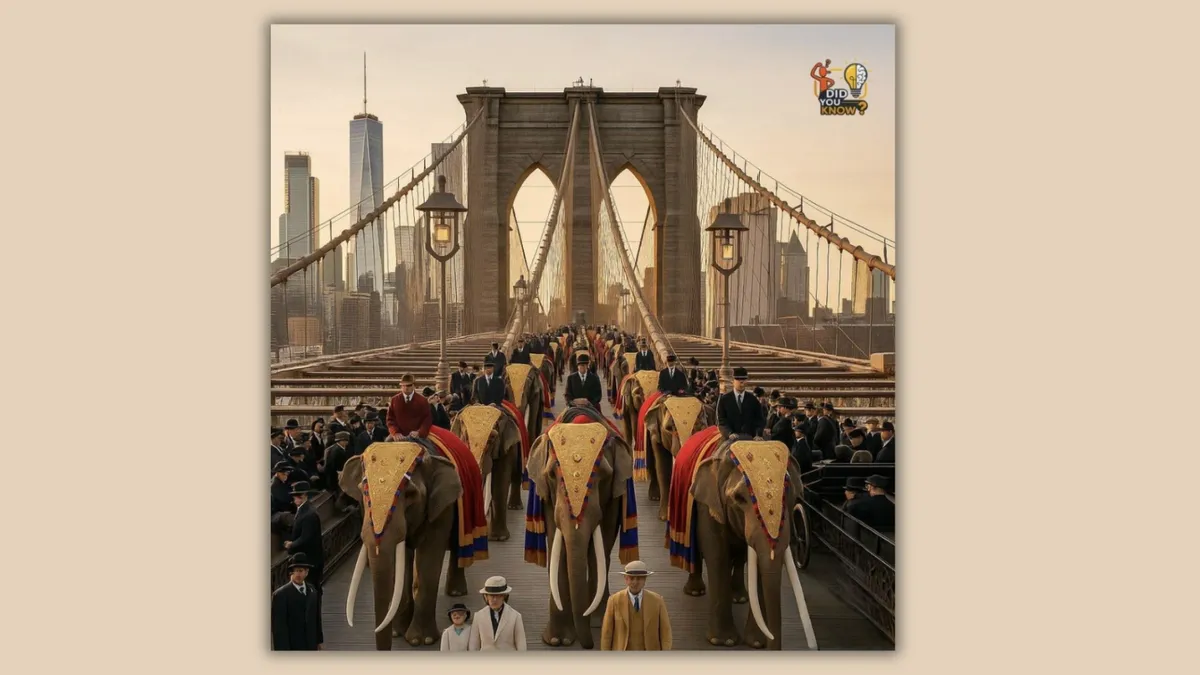
For years, social media users have shared the story that P.T. Barnum, the 19th-century showman and circus operator, once marched 21 elephants across the Brooklyn Bridge to prove the newly built structure would not collapse. Some versions say Jumbo, Barnum’s most famous elephant, led the procession as thousands watched.
One Facebook post (archived) with the story read:
When the Brooklyn Bridge first opened in 1883, it was hailed as an engineering marvel, yet many New Yorkers doubted its safety.
Rumors spread that the suspension bridge might collapse under heavy weight, creating fear among the public. The following year, famed circus showman P.T. Barnum seized the chance to silence the doubts with a grand spectacle.
On May 17, 1884, he marched 21 elephants, including his legendary star Jumbo, across the span from Manhattan to Brooklyn. Thousands watched in awe as the massive animals crossed without incident, proving the bridge’s incredible strength.
The event reassured the city, boosted public confidence, and became one of the most memorable and iconic moments in the bridge’s rich history.
Versions of the story have circulated on platforms including Reddit, YouTube, Facebook, Threads, X, LinkedIn and Instagram. Posts have often paired the claim with historic-looking illustrations of elephants crossing the bridge, including images that appeared to have been generated using artificial intelligence.
In short, the crossing itself was real and well documented. A New York Times report published the following day said 21 elephants, seven camels and 10 dromedaries crossed the bridge from Manhattan to Brooklyn on the night of May 17, 1884. Jumbo was among the elephants, although the newspaper said he brought up the rear rather than leading the procession.
A separate report in The Sun estimated that 2,000 people greeted the animals near Cortlandt Street and said many followed them across the bridge, where no trouble occurred.
There is also some near-contemporaneous support for the explanation that the crossing was intended to demonstrate the bridge’s strength. In an autobiography published in 1885, Jumbo’s keeper, Matthew Scott, wrote that he had been invited to take the elephant across the bridge “so as to test its strength.” However, Scott did not identify who invited him, and neither the Times nor The Sun independently documented such an invitation or identified testing the bridge as Barnum’s stated or principal motive.
Scott also acknowledged that Barnum had a “business object in view,” while the Times described the animals continuing to the circus’s Brooklyn showgrounds before a parade and performances. The evidence therefore points to overlapping purposes: The procession displayed the bridge’s apparent strength, moved the animals as part of the circus’s Brooklyn engagement and generated publicity. It does not establish who proposed the purported test, which objective mattered most to Barnum or whether the event measurably restored public confidence in the bridge.
As such, we rated the claim a mixture of true and unconfirmed information.
What crossed the bridge in May 1884?
According to the May 18, 1884, Times report, the procession began at 9:30 p.m., when 21 elephants, seven camels and 10 dromedaries emerged from the ferry landing at the foot of Cortlandt Street in lower Manhattan. They then continued through lower Manhattan and crossed the bridge toward Brooklyn.
The Sun separately reported that a group of animals from Barnum’s circus arrived by ferry at Broadway and Cortlandt Street. The newspaper said about 2,000 people met the procession and escorted it through Park Row to the entrance of the bridge’s south driveway.
Contrary to some modern versions of the story, Jumbo did not lead the elephants. The Times said the famous animal “brought up the rear” and waved his ears in acknowledgment of spectators after reaching Brooklyn. The article also did not state that Barnum personally walked at the head of the animals. Therefore, saying Barnum arranged the procession, rather than physically led it, is more precise.
After reaching Brooklyn, the procession continued through what the Times described as a “tremendous crowd” to the showgrounds at Tompkins and Fulton avenues. The newspaper said a large parade was planned for Monday morning, followed by the circus’s first performance that afternoon.
The destination and performance schedule show that the crossing was part of the circus’s Brooklyn engagement. It moved at least part of the animal troupe to the showgrounds while also generating considerable publicity.
