



- A new study estimates the Sumatran orangutan population declined by nearly 20% between 2011 and 2023.
- The researchers found that habitat loss alone cannot explain the declines, pointing to additional threats such as killing, conflict and habitat fragmentation.
- The study is the first comprehensive reassessment of Sumatran and Tapanuli orangutans since a landmark 2016 survey.
- The Forestry Ministry co-authored the study and says it will use the findings to guide conservation policy, marking a contrast with the previous administration’s public claims that orangutan populations were increasing.
JAKARTA — The number of Sumatran orangutans has declined by nearly 20% in the past decade and the critically endangered Tapanuli orangutan remains perilously close to extinction despite years of conservation efforts, according to a new study.
The study, published in Global Ecology and Conservation, also suggests that habitat loss alone cannot explain the species’ decline. While deforestation remains the primary driver, several orangutan populations in Indonesia’s island of Sumatra shrank by a far greater degree than the rate of forest loss might explain, pointing to additional threats such as killing, conflict with humans and habitat fragmentation.
The findings come from the first comprehensive reassessment of both Sumatran (Pongo abelii) and Tapanuli (Pongo tapanuliensis) orangutans since the landmark 2016 range-wide survey led by primatologist Serge Wich.
The study also signals a notable shift in the Indonesian government’s public approach to orangutan conservation.
Between 2018 and 2022, then environment and forestry minister Siti Nurbaya Bakar repeatedly said “ground-based evidence” showed orangutan populations were growing and dismissed projections of continued decline.
Those claims were challenged at the time by prominent primatologists, who argued that peer-reviewed research consistently showed that the populations of all three orangutan species, Sumatran, Tapanuli and Bornean (Pongo pygmaeus), were declining and urged the ministry to release the data underpinning its assertions.
The dispute escalated when the ministry temporarily barred several of the scientists from conducting research with Indonesia’s national parks and conservation agencies.
The latest assessment of the animals presents a picture that’s markedly different from the previous administration’s declarations, and more in-line with figures put forward by scientists.
Based on surveys carried out in 2021-2023 by researchers from Indonesia’s Ministry of Forestry alongside Indonesian and international scientists, the study estimates there are 11,694 Sumatran orangutans across the species’ current range, representing a drop of 19.5% from 2011 to 2023, or about 1.8% annually.
This decline has occurred even though the rate of annual forest loss across the orangutans’ range during 2017 to 2023 was about 32% lower than in 2011 to 2016. In the study, the researchers say this suggests habitat destruction, while still the dominant threat, is no longer sufficient to explain the continuing population decline on its own.
Other drivers of decline
Forest loss explained about three-quarters of the variation in population declines across the 11 orangutan meta-populations surveyed, making it the strongest predictor of population change.
But several populations declined much faster than habitat loss alone might explain, indicating that additional pressures, including killing, illegal capture and conflict with people, may also be contributing factors.
The discrepancy was most pronounced in the meta-populations of Batu Ardan, Siranggas and Sikulaping, all relatively small and fragmented forests within an ecosystem area south of the Leuser Ecosystem. Batu Ardan lost an estimated 40.2% of its orangutans during the study period, compared with 28.2% in Siranggas and 14.5% in Sikulaping.
The researchers say regional government records support this interpretation.
“Regional government records corroborate this directly: 15 individuals recorded across Aceh and North Sumatra between 2012–2024 bore confirmed air rifle pellet wounds, consistent with deliberate persecution rather than incidental injury,” they write.
Hunting and wildlife trafficking remain active threats, said Annisa Rahmawati, senior wildlife campaigner at Indonesian NGO Geopix, pointing to Indonesia’s repatriation of several illegally removed Sumatran orangutans from Thailand in December 2025.

Tapanuli orangutans
Tapanuli orangutans, the world’s rarest great ape, remain in an especially precarious position.
The researchers behind the study estimate that 716 Tapanuli orangutans remain in the wild, compared with an earlier estimate of 767 individuals.
The two figures should not, however, be interpreted as evidence of population decline, they say. The difference between these estimates could partly reflect improved survey coverage rather than a true reduction in numbers: Unlike the new assessment, the earlier estimate did not systematically survey the Batang Toru landscape, where Tapanuli orangutans occur.
Instead, the study establishes the first systematic, range-wide baseline against which future changes in the Tapanuli population can be measured.
Even so, the animal’s conservation outlook remains grim, experts say.
The population is split across three increasingly fragmented meta-populations, leaving the species with little demographic margin for additional losses.
“At such a critically small population size, the loss of even a few individuals each year could have severe consequences for the species’ long-term survival,” Annisa said in a press release.
While Batang Toru remains the Tapanuli orangutans’ primary stronghold, a separate team of researchers recently documented another cluster of the apes in a peat swamp forest roughly 32 kilometers (20 miles) away from the ecosystem, after the surveys were carried out.

Leuser remains the global stronghold
According to the study, the Leuser Ecosystem, which covers 2.6 million hectares (6.4 million acres) of Aceh and North Sumatra provinces, remains the stronghold of the Sumatran orangutan, supporting an estimated 10,519 individuals, about 94% of the species’ comparable study population.
The future of the Sumatran orangutan will largely depend on what happens in Leuser.
Yet, the research also finds that Leuser accounted for the largest overall population losses during the study period, with more than 2,400 orangutans disappearing since 2011.
Within Leuser, one landscape stood out.
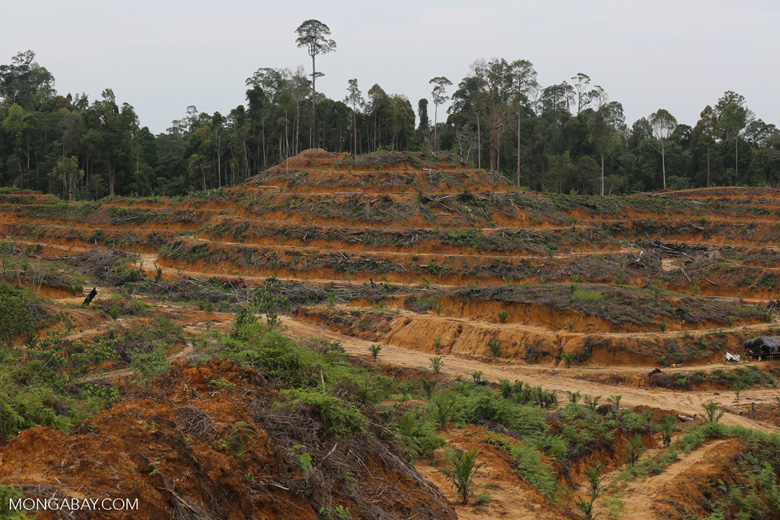
The researchers estimate that the Rawa Tripa peat swamp lost roughly 51% of its forest cover between 2011 and 2023, largely through conversion to oil palm plantations. In the same period, the area’s orangutan population is estimated to have fallen by about 75%, from 212 to 52 individuals.
The authors describe Tripa as a stark example of how quickly orangutan populations can collapse when high-quality habitat is not effectively protected.
Peat-swamp forests are especially important because they support some of the highest orangutan densities in Sumatra.
The researchers suggest this is likely because peat swamps provide a more stable year-round food supply than many upland forests, where fruit production fluctuates dramatically during mast-fruiting cycles. They also note that peat swamps have historically experienced less human settlement and hunting, although they have not directly tested this hypothesis.
The continued conversion of peat-swamp forests to oil palm plantations is a particularly serious conservation concern, the authors say.

Protection alone isn’t enough
The study finds that 82% of all orangutans occur within protected forests or conservation areas.
But the remaining 18%, about 2,200 Sumatran orangutans, live in production forests, typically used for growing timber or pulpwood; or areas designated for other uses, known locally as Areal Penggunaan Lain or APL, where forests can legally be converted to other land uses.
Those unprotected landscapes accounted for a disproportionate share of habitat loss, according to the study.
In Rawa Tripa, for example, the entire estimated orangutan population occurs within areas designated as APL. The study finds that all forest loss in Tripa occurred within these unprotected landscapes.
Across Sumatra, APL accounted for all forest loss in Tripa, 64% of habitat loss in Trumon-Singkil and 48% in East Leuser, the study says.
“The fact that nearly one-fifth of Sumatra’s orangutan population lives outside protected forests demonstrates that conservation efforts can no longer focus solely on existing protected areas,” said Annisa of Geopix.
The researchers argue that these landscapes should become a much higher conservation priority, particularly in parts of East Leuser and Batang Toru where significant orangutan populations persist outside of formal protection.

Batang Toru
The Tapanuli orangutan’s range in Batang Toru remains under growing pressure.
The Batang Toru landscape is divided into three increasingly isolated subpopulations by rivers, roads and human settlements. The western block contains the largest population, with an estimated 514 orangutans, while the eastern block supports only about 159.
Although most of the western area is classified as protected forest, the landscape continues to face pressure from a hydroelectric project, gold mining and agricultural expansion.
The authors argue that maintaining connectivity between the western and eastern blocks is essential because such a small total population has little capacity to withstand further fragmentation or mortality.
The researchers’ warning has become even more urgent in light of what occurred in late 2025.
After fieldwork for the study concluded, Cyclone Senyar triggered widespread landslides across Batang Toru in November 2025.
A separate satellite-based analysis estimates the storm destroyed more than 8,300 hectares (20,500 acres) of intact forest, an area roughly half the size of Washington D.C. in the U.S., and may have killed around 58 Tapanuli orangutans — a single event that exceeds the mortality level considered sufficient to place the species on a trajectory toward extinction.
As such, the new population estimate provided by the study may represent a baseline that has already been overtaken by events.
“This is another powerful reminder of the urgent need to strengthen protection for this critical habitat,” Annisa said.

Beyond protecting forests
The study argues that conserving orangutans will require a strategy broader than simply preventing deforestation.
As habitat loss alone cannot explain the declines observed in several populations, the authors say future conservation efforts must also focus on reducing human-caused mortality by tackling killings, illegal capture and conflict with people.
Rather than spreading limited conservation resources evenly across Sumatra, they recommend prioritizing areas where orangutan populations are declining much faster than the rate of habitat loss would indicate, including Batu Ardan, Siranggas and Sikulaping.
Improving the way authorities respond to human-orangutan conflict should be another priority, they say.
Government records cited in the study document 169 direct releases of orangutans into the wild in Aceh and North Sumatra between 2012 and 2024, none of which included post-release monitoring.
Previous research suggests that releasing conflict-affected orangutans directly into the wild without adequate monitoring can increase mortality and disrupt resident populations. Citing this work, the researchers recommend adopting routine post-release monitoring for wild-to-wild translocations.

Protecting the right places
The researchers also argue that conservation planning should be more strategic and focus on where orangutans are most abundant.
In Batang Toru, maintaining habitat connectivity between the western and eastern blocks of the three small Tapanuli subpopulations is essential to prevent the population from becoming even more isolated.
“Hydropower development and associated infrastructure in the Batang Toru landscape pose immediate risks to connectivity; maintaining functional linkage between West and East Batang Toru is therefore essential for long-term viability,” the study’s authors write.
Beyond Batang Toru, they recommend strengthening protection for orangutan habitat in APL landscapes, particularly in parts of East Leuser and Batang Toru, where important populations remain outside protected forests.
The new density maps produced by the study should also be incorporated into processes used to evaluate development and protect forests, such as High Conservation Value and High Carbon Stock assessments, concession management plans and government licensing decisions, the authors say, allowing high-density orangutan habitat to be identified and retained before development takes place.

Measuring what works
The next decade should not simply end with another population survey, the authors argue.
Instead, future assessments should be designed to measure whether conservation interventions are actually working.
Rather than treating population estimates as an end point, they say the new baseline should be used to evaluate which policies reduce orangutan declines, identify where conservation gaps remain and guide future management.
“This should be treated as an urgent priority,” the researchers write.
Despite the study’s sobering findings, co-author Wich, a primatologist at Liverpool John Moores University, said he remains optimistic.
“I’m optimistic that both the Sumatran and the Tapanuli orangutans can be saved,” he told Mongabay. “All parties have to be committed to the efforts, including the government, companies, local communities, conservation organizations, scientists and international community.”
Annisa agreed that success will depend on coordinated action.
“Without these measures, orangutan populations in Sumatra will continue to decline even if protected forests remain intact.”
From dispute to policy
Experts are also hopeful that this survey is, itself, a sign that the government is shifting to more evidence-based policy after years of suppressing population data.
Rather than contesting evidence of population decline, the Ministry of Forestry co-authored the study documenting these declines and says its findings will help shape future conservation policy.
Deputy Forestry Minister Rohmat Marzuki has publicly said research would serve as an important scientific foundation for strengthening orangutan conservation.
Establishing preservation areas is one measure under consideration.
A conservation designation introduced in 2024 gives the government a new legal mechanism to identify ecologically important areas outside Indonesia’s existing network of protected -area networks and impose conservation obligations on landowners and businesses operating there.[whom? To do exactly what] to
But its implementation still depends on regulations allowing this to be implemented that have yet to be finalized.
The ministry is also preparing an updated Population and Habitat Viability Assessment (PHVA) for orangutans that would replace the previous assessment published in 2016.
Rohmat has said the updated assessment would support implementation of Indonesia’s Biodiversity Strategy and Action Plan (IBSAP) 2025-2045, which identifies species conservation as a national priority.
“Therefore, all stakeholders must continue working together to ensure the systematic, adaptive and sustainable conservation of Sumatran and Tapanuli orangutans,” he was quoted by state news agency Antara as saying.
Whether those policies succeed may depend on the study’s central conclusion: Protecting forests remains essential, but preventing the continued loss of orangutans from killing, conflict and fragmentation will be equally important if Indonesia is to halt the decline of its two endemic great ape species.
Citations:
Hadi, A. N., Siregar, J. P., Anugrah, N., Kuswanda, W., Boang Manalu, J. H., Nasution, N., … Buckley, B. J. (2026). Population status of sumatran and Tapanuli orangutans: A comprehensive assessment 2021–2023. Global Ecology and Conservation, 69, e04302. doi:10.1016/j.gecco.2026.e04302
Sherman, J., Voigt, M., Ancrenaz, M., Meijaard, E., Oram, F., Williamson, E. A., … Wich, S. A. (2025). Outcomes of orangutan wild-to-wild translocations reveal conservation and welfare risks. PLOS ONE, 20(3), e0317862. doi:10.1371/journal.pone.0317862
Banner image: The Ulu Masen-Leuser Tiger Conservation Landscape houses many other species, including Sumatran orangutans. Image by Rhett A. Butler / Mongabay. Image by Rhett A. Butler / Mongabay.
FEEDBACK: Use this form to send a message to the author of this post. If you want to post a public comment, you can do that at the bottom of the page.

