


Those picking up a copy of the Economist this week might have been struck with an unpleasant sense of nostalgia. Readers were greeted with a front cover emblazoned in red and black, with a screaming headline proclaiming the “axis of malice.”
Reminiscent of the war on terror and all its fearmongering excesses, this headline was widely mocked on social media as a reminder of the George W. Bush era. Those who mocked it were in turn derided as naive; growing connections among Russia, China, Iran, and North Korea surely, others argued, prove the existence of such an axis.
But most of this debate missed the point. No one—or at least very few people—would deny that we have seen ties between China and Russia grow in recent years. The use of the axis framing, however, and of language like “malice,” creates a narrative that does not necessarily exist in practice. It suggests that the only response to growing alignment between these states is adversarial, inhibits us from any real debate about the extent and scope of this coordination, and perhaps most importantly, suggests that this process of alignment is inevitable, rather than something that can be molded or changed. Such overly simplistic and Manichaean visions weaken, rather than strengthen, our ability to understand the world.
None of this is new. The “axis of evil” first emerged as a term in President George W. Bush’s 2002 State of the Union address, where he referred to Iran, Iraq, and North Korea as countries that endangered freedom around the world. Even at the time, the inclusion of the line in the speech was somewhat strange: It took place just a few months after the Sept. 11 attacks, and shortly after the United States had invaded Afghanistan, yet the three countries representing “evil” had nothing to do with either.
But the overblown rhetoric helped to build support for Bush’s Freedom Agenda by reinforcing the idea that dictatorships around the world could endanger daily life in democracies. It attempted to tie the war on terror to the legacy of World War II through implicit comparison to Nazi Germany and imperial Japan. The speech had real-world consequences: It helped the Bush administration build the case for its war against Iraq and undermined the thawing of relations between the United States and Iran that had started shortly after 9/11.
Since that time, there have been repeated attempts to revive the axis concept to make a political or foreign-policy point. In just the last few years alone, there have been articles about the axis of authoritarians, the axis of upheaval, and the axis of aggressors. All these formulations offer authors the same opportunity: Pick a selection of nations and define them, not on their own terms, but on yours.
The axis of authoritarians, for example, relies on regime type to tie together its members, though the list of countries involved (Russia, Iran, North Korea, Belarus, and China) includes unreformed Soviet-style totalitarian regimes, kleptocratic dictatorships, and party-rule capitalism. This group includes one of the world’s richest states—and one of its poorest. The axis of upheaval, meanwhile, is defined by countries’ opposition to the United States, or by their shared commitment to “overturn[ing] the global order.” In truth, one could have an axis of almost anything; one is reminded of the old joke from around the time of Bush’s initial speech that suggested groupings including the “axis of just as evil” and the “axis of countries that aren’t the worst but certainly won’t be asked to host the Olympics.”
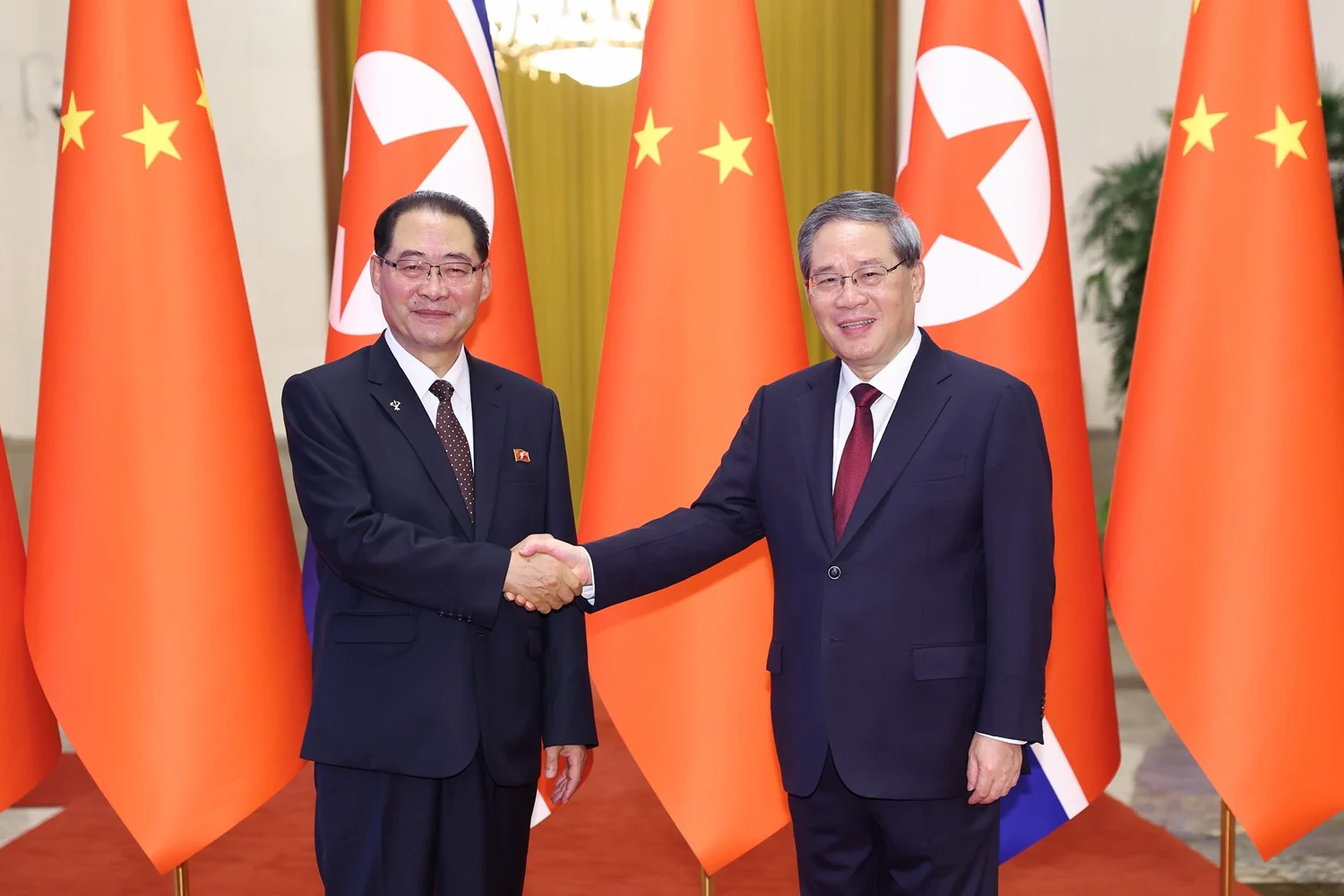
Jokes aside, there is no denying that there are points of convergence and cooperation between the states referenced in these groupings. The reporting that accompanies the axis of malice story, for example, identifies a shared interest in the sanctions-busting “shadow” oil trade as a key area of cooperation among Russia, China, and Iran. Russia and China are cooperating on defense industrial issues, while Russia has built stronger ties with both Iran and North Korea due to its war in Ukraine and the search for cheap drones and easily replaceable domestic labor. There is a very clear case to be made that the bilateral relationships between many of these countries have grown stronger in recent years, to the detriment of U.S. national security.
Skeptics of the axis notion, however, would argue that many of these areas of cooperation were themselves driven by U.S. sanctions policy, not sought out by the states in question. There are clear tensions between Moscow and Beijing when it comes to North Korea, while China has been remarkably reticent in supporting either Russia’s war in Ukraine or Iran’s war with the United States. The evidence of growing bilateral ties between states is not matched by evidence of a common front among these states. Looked at holistically, many of their actions can just as easily by explained as states that find their interests—at least temporarily—pointing in the same direction.
Regardless of whether the skeptics or proponents of a more integrated partnership among these states are correct, this is an important debate. Indeed, it’s vitally important for U.S. policymakers to understand the scope and extent of cooperation between potentially adversarial states. The axis framing itself, however, is fundamentally unhelpful in moving these debates forward.
For one thing, formulations like axis of upheaval and axis of malice are less descriptive than prescriptive: They always suggest the worst, and push policymakers toward the most hawkish options. Consider the description of growing China-Russia trade ties as “collusion.” Were the U.S. to engage in such trade with any of its allies, this would be considered perfectly normal behavior. Indeed, think tank papers are published every day in Washington talking of ways to increase resilience among the U.S. and its allies. The states under discussion here are often bad actors in world affairs, but adjectives like malice or upheaval suggest Manichaean actors implacably opposed to the United States with no nuance involved.
The all-or-nothing nature of this framing also makes it more difficult to have discussions about the actual extent and scope of coordination between these states. By portraying them as a unified front—and by framing the debate as whether or not there is an axis—discussion often glosses over more interesting and potentially useful questions: Where specifically are these states cooperating? Are there limits to that cooperation? Are there issues on which they compete or where their interests diverge?
Perhaps most importantly, the notion of an axis of unfriendly states overlooks questions about how we got to this point—and whether this set of affairs must necessarily endure. At least some of the recent collaboration between these states has been shaped by U.S. policy choices, from sanctions and export controls on Russia and China, to the war in Iran and its effects in raising global oil prices. U.S. policymakers may still judge these policies to be worth the cost, yet it is fundamentally misleading to suggest that Russia, China, Iran, and others are pulling together purely to oppose the United States, when at least some of that coordination is a response to U.S. actions.
To put it another way: The idea of an axis of upheaval attempting to overturn global order strips the United States of its agency and replaces it with predestination. This is particularly important when it comes to the policy responses. An axis of aggression cannot be reasoned with and it cannot be split apart, leaving little for the United States to do other than resist it. A more nuanced understanding of why these states cooperate—and where their common cause might fail—offers opportunities for the U.S. to undermine that alignment. If we understand the causes of adversaries’ alignment, we might be able to predict or even prevent it.
It’s easy to see why the language of the axis persists: It sells. But there’s a reason why such headlines should be relentlessly mocked. They deny us the ability to have a nuanced debate and reduce our policy options to an unsatisfying binary. For those who take U.S. foreign policy seriously, it’s past time to retire the axis of evil for good.
