


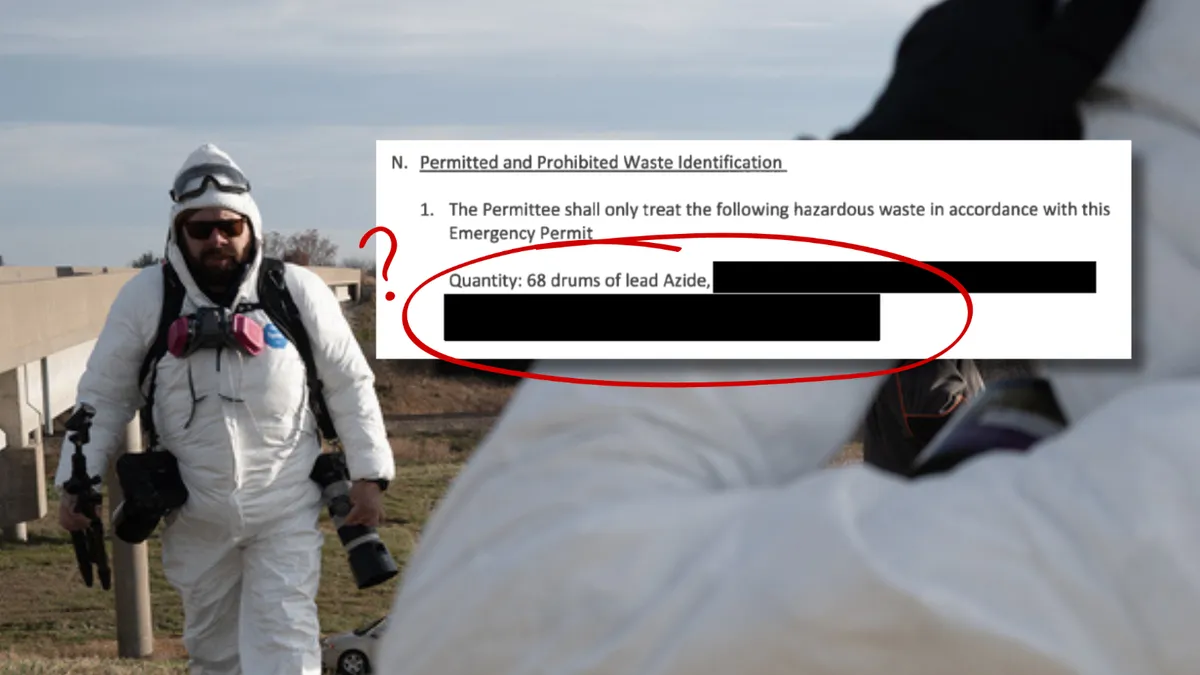
- The claim that the U.S. Army intended to detonate more than just lead azide during a planned explosion in in Middletown, Iowa, in November remains under investigation.
- The rumor stems from an authentic emergency permit issued by the EPA to the Army. The permit contained redacted text, which the Environmental Protection Agency noted was for “critical infrastructure security purposes at the request of Department of Army.”
- It’s unclear whether the redacted portions pertained to other material that was detonated, contained further details related to the lead azide or something else.
- Snopes will update this report if, or when, additional information surfaces. We have reached out to the Army and the EPA and are waiting for responses.
On Nov. 25, the U.S. Army destroyed 68 barrels of lead azide, a highly explosive compound, in Middletown, Iowa. Officials announced the blasts were successful, and according to the Environmental Protection Agency, its real-time air monitors had not detected any airborne lead more than an hour after the detonation.
In the days leading up to the explosions — which raised widespread alarm due to the public health risks — a rumor spread online that the Army actually planned to detonate more than lead azide, according to a redacted document.
A screenshot of the purported “Emergency Permit” spread across social media, apparently showing that in addition to 68 drums of lead azide, the Army was permitted to treat other, hidden materials as “hazardous waste.”
“Is the 68 barrels of lead azide not even the most scary, dangerous, poisonous part?!” One X post read (archived).
The document was real. It was an emergency permit issued by the EPA to the Army, allowing it to treat the lead azide cache as a hazardous material (clearing the way for the military to move forward with the detonation plan) “upon the EPA’s finding of an imminent and substantial endangerment to human health and the environment.”
Because it remains unclear what text was redacted, Snopes has left this claim unrated. We reached out to the Army and the EPA. We will update this story if we receive a response.
On Page 2, the permit read:
Name: Lead Azide
Hazardous Waste Codes: D003 (reactivity), D008 (toxicity characteristic for lead)
CAS Number: 13424-46-9
DOT Shipping Classification: Hazard Class 1.1A, UN0130
Quantity: There are 68 drums of Lead Azide, [REDACTED]
On Page 12 (Section IV.N.1), it read:
N. Permitted and Prohibited Waste Identification
1. The Permittee shall only treat the following hazardous waste in accordance with this Emergency Permit
Quantity: 68 drums of lead Azide, [REDACTED]
[REDACTED]
Another widely circulated screenshot apparently showing the lead azide properties alongside heavily-redacted details related to what appeared to be other materials. That image also was authentic — it was sourced from another EPA document (PDF page 74).
It’s unclear whether the redacted portions pertained to other material that was detonated, contained further details related to the lead azide or something else.
On Nov. 23, the EPA noted that “the permit and permit application materials contain redacted elements for critical infrastructure security purposes at the request of Department of Army.”
In our questions to the EPA and Army, we asked why the redacted information was considered a security threat and whether the public should be concerned about what, if anything, else was detonated along with the lead
