


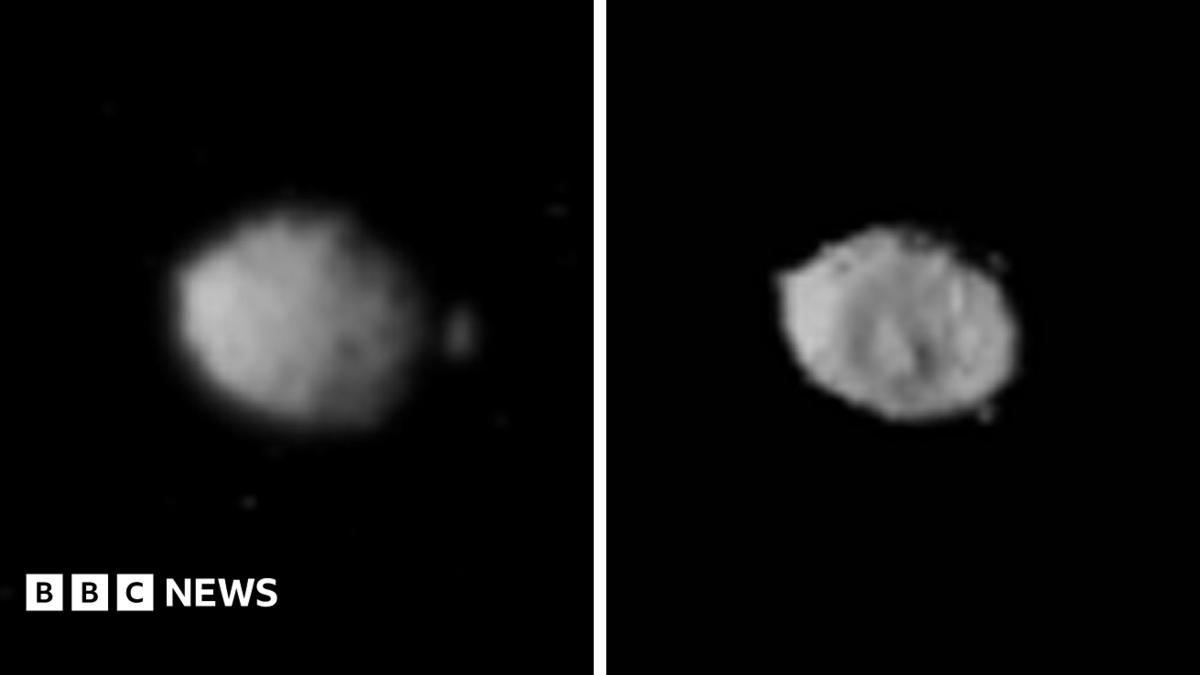
A key objective of the Hera mission is to measure the mass of Dimorphos, in order to work out how effective the spacecraft’s shove was.
This information would be vital if we ever spotted a space rock that was on a collision course with Earth.
“It would help us to predict what would happen if we had to hit another asteroid,” said Prof Simon Green, a planetary scientist who is on Hera’s science team.
“We [could] measure its properties and say: ‘Well, we need this mass of spacecraft, travelling at this speed, this early, in order to deflect it enough so that it misses the Earth’.”
Hera’s arrival on the scene is helping scientists answer many more questions too.
Not only did the collision alter the shape of Dimorphos, it also changed the way it moves.
“Before the Dart impact, Dimorphos was more like our own Moon – so it was always showing the same face to Didymos, and it was behaving quite nicely,” explained Raducan.
“Now it’s very, very chaotic – it’s tumbling. Imagine a barrel that you throw down the stairs, and the barrel is rolling and it’s moving, and basically that’s what Dimorphos does right now around Didymos.”
Hera has also taken detailed images of Didymos, revealing its surface in detail.
“The gravity at the surface of Didymos is about 40,000 times less than the gravity on Earth,” said Naomi Murdoch, who is on the Hera mission team.
“We can already see some fascinating and complex geology. We can see regions of boulders.
“The smallest details that we can make out in these images are about 3m in size. So that means that all the boulders that you can see with your eyes are at least 3m big, and some as big as 10m. So what we’re seeing here is boulders the size of cars and buses sitting on a world with almost no gravity.”
