


In the small eastern German city of Dessau, if the far-right Alternative for Germany (AfD) party has its way, a century-old vision for the future may soon belong to the past.
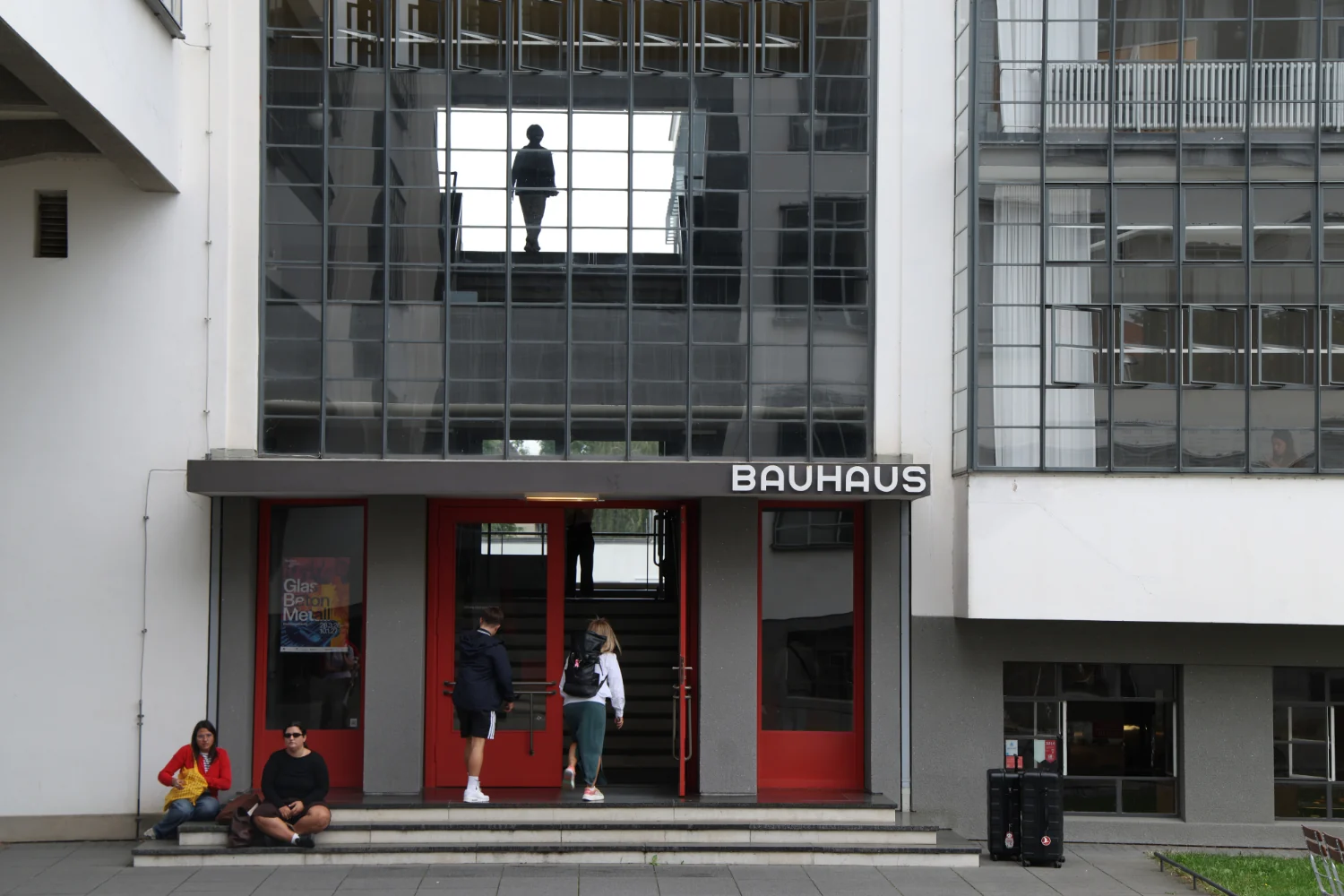
A short walk away from the main train station, past typical German architecture of beige stucco and pitched, red-tiled roofs, flat-roofed, modernist structures of concrete and glass appear, leading to a building with “BAUHAUS” spelled down one gray side. Designed by pioneering modernist architect Walter Gropius, the building in Dessau opened as a school for architecture, craft, and industrial design on Dec. 4, 1926—one with ambitions to create a new aesthetic for the modern world. With its steel-framed windows and a bright red entrance door, the Bauhaus school building is an iconic symbol of early 20th-century modernism.
It’s also a symbol of Nazi persecution. In 1932, the school closed under pressure from state Nazi officials that denounced the Bauhaus as un-German, internationalist, and a hotbed of “cultural Bolshevism.” (It briefly operated in Berlin, until it fell to Nazi pressure there, too.) Many of its members fled the Nazi regime and are now considered some of the last century’s most influential luminaries of art, architecture, and design.
Nazis burn anti-German literature in Berlin on May 11, 1933.
Clear, simple, and functional, Bauhaus’s influence has been a key German cultural export for more than a century. Yet Hans-Thomas Tillschneider, a culture policy spokesman for the AfD, considers it an “Irrweg der Moderne”—“a wrong turn of modernity.” For years, he has targeted the Bauhaus, arguing that it stands for “deracination” and “dislocation of architecture” in favor of a “globalist” architectural vernacular. The Bauhaus was not only an aesthetic movement, he suggests, but a deeply political—and dangerously anti-German—project that must be combatted for the sake of German identity today.
In September, the AfD swept the state elections of Saxony Anhalt, where Dessau is located, which means that Tillschneider—who’s been a member of Saxony Anhalt’s parliament for a decade—may soon be in a position to realize his ambitions for recasting German culture. And those ambitions extend far beyond the Bauhaus.
The AfD’s electoral victory put it within reach of forming Germany’s first far-right state government since World War II, with the power to determine educational and cultural policies for the region. Right now, its 39 seats in the 83-member parliament leave it three votes short of an absolute majority (although other parties have ruled out a formal coalition). The party is hoping its candidate for state premier, Ulrich Siegmund, will be officially confirmed by the state legislature in early December.
If the AfD successfully forms a government, there may be significant cuts to funding for a host of cultural institutions in the state, including the Bauhaus Dessau Foundation, which operates in the school’s original building (which is now mostly converted into a museum). The AfD has not only positioned itself as the hardline party on immigration, but more broadly as a party seeking to culturally reform Germany. And, for the AfD, broad swathes of what has long been recognized as German culture are simply “un-German.”
For a party rooted in the former East, much of the offending inheritance belongs to the postwar West. Germany’s self-image as an internationalist, socially liberal state and leader by example in reckoning with its Nazi past have defined reunified Germany. The AfD, by contrast, wants to treat Nazi Germany as a historical aberration. In this sense, the AfD’s cultural policies are not only restorative of neglected aspects of German history, as it likes to claim, but a revisionist effort to redefine substantial parts of the country’s recent past.
Asked in an email which major German cultural figures belonged in the national canon, Tillschneider had a ready taxonomy. Thomas Mann, the Nobel laureate who became a prominent opponent of Hitler from exile, yes. But Günter Grass and Heinrich Böll, both Nobel-winning novelists whose work helped shape West Germany’s critical examination of its past and present, would be forgotten along with “the whole postwar lot.”

German author Thomas Mann at his home in New York City in January 1943.Fred Stein Archive/Getty Images
He similarly dismissed much of the work of Rainer Werner Fassbinder—a leading figure in New German Cinema whose films examined the cruelties and compromises beneath postwar prosperity—as bound to its time. Leni Riefenstahl, the filmmaker who notoriously made propaganda films for the Nazi regime, received a more favorable assessment. The continuing interest in her work outside official channels, he argued, suggested that the filmmaker’s innovations would endure.
For Tillschneider, the distinction was not simply between artists who had opposed Nazism and those who had accommodated or served it. It concerned what their work could offer Germans now. “We don’t want to ban it,” he said of art he considered anti-German. “But art that turns against Germany cannot claim a right to continued support from the German taxpayer.”
Tillschneider’s hostility to modernism is not confined to Dessau. Berlin’s Neue Nationalgalerie, designed by the Bauhaus’s last director, Ludwig Mies van der Rohe, and opened in West Berlin in 1968, is “a hideous lump,” he said. The government quarter inspired a more physical response: “I regularly feel like throwing up when I walk behind the Reichstag and see those bland cubes of steel, glass, and concrete,” he wrote.

The Neue Nationalgalerie, a museum of 20th-century art, in Berlin on Aug. 29, 1969. Hedrich Blessing Collection/Getty Images
While these judgments represent the personal preferences of one far-right politician, they may also soon determine how government money is spent. This is of outsized importance in Germany, where cultural infrastructure is in large part sustained by public funding.
Since the September state election, the AfD has already sought substantial cuts to theater funding. In October, its city council faction proposed plans to reduce Theatre Magdeburg’s annual municipal subsidy by up to 7 million euros.
While the party presented the proposal as a response to the city’s financial difficulties, in the months preceding the election, the theater’s general director, Julien Chavaz, publicly rejected the idea that theater should enact a conservative program and warned that to attack theater is itself “anti-German.” The city council rejected the AfD’s motion in November, signaling the resistance the AfD’s cultural policies still face.
Tillschneider’s arguments echo a broader AfD campaign against the place of national self-criticism in German public life. In a speech in 2017, the AfD’s hard-right ideological standard-bearer, Björn Höcke, demanded a “180-degree turn in our policy of memory.” He called the monument to murdered Jews in Berlin a “monument of shame,” and attacked the framing of Germany’s defeat in World War II as liberation from Nazism.
In 2023, AfD cultural spokesman Marc Jongen argued in the federal legislature that Germany increasingly reduced being German to “an exclusively negative self-image” and his faction proposed reorienting cultural policy toward “positive” sources of national identity. Tillschneider gives that ambition specific cultural targets, identifying the writers, institutions, and forms of remembrance he believes should lose public support or prominence: “We must finally arrive at an identity unburdened by the Nazi era,” he wrote.
And Tillschneider—who could have a say in setting cultural and educational policy in any AfD-led government in Saxony-Anhalt—is happy to provide reading lists to achieve that goal. In our email exchange, he called for state assistance for contemporary writers such as Jörg Bernig and Uwe Tellkamp. Bernig, an award-winning poet and novelist, and Tellkamp, whose novel The Tower won the German Book Prize, have become controversial for their criticism of immigration policy and allegations that German cultural life marginalizes conservative views.
He recommended renewed attention to Martin Heidegger, the influential philosopher who joined the Nazi Party and whose writings contain antisemitic passages, and praised projects that adapted German poetry and folk songs for contemporary audiences.
Tillschneider also gave Ernst Jünger, the author of the World War I memoir Storm of Steel and a leading voice of radical nationalism during the Weimar Republic, a stronger claim to the canon than either Grass or Böll, saying his work should be read in schools and he should be publicly commemorated. (Jünger himself refused to join the Nazi Party.)

German author Ernst Jünger at his home in Wilflingen, Germany, in February 1974.Sven Simon Archives/Getty Images
His recommendations were notably not exclusively literary; he praised a version of Goethe’s “Heidenröslein” set to a techno beat.
Asked whether the postwar tradition of national self-criticism was itself part of German culture, Tillschneider acknowledged that it was. But its German origins did not establish its value. “This tradition of self-criticism is, of course, German,” he wrote. “The question is whether it ought to belong to Germany, whether we can make use of it to sustain our identity.”
That position helps explain his dismissal of much of Germany’s postwar cultural inheritance. The capacity to question Germany, including the incongruities between its democratic present and its authoritarian past, has itself traditionally been understood as a national achievement of modern German culture. What Tillschneider considers exhausted or destructive in Germany’s culture of self-examination could equally be understood as one of postwar Germany’s enduring cultural accomplishments.
As for National Socialism, Tillschneider said it should continue to be studied in schools, universities, memorial sites, and among research institutions. But it should become a historical subject, rather than a tool for interpreting the present or future. The reality of National Socialism, he argued, should leave older German traditions untainted by association.
Tillschneider treats his own tastes as expressions of national identity, while treating art that challenges that identity as political. He’s quick to describe his aesthetic preferences as a neutral standard; departures from them become ideology. In our email exchange, he called for public funding to support predominantly “pure,” apolitical art. But greater attention to nationalist writers, or to art organized around German identity, did not strike him as a departure from that principle. “National identity is not a political subject,” he wrote.
For Barbara Steiner, director of the Bauhaus Dessau Foundation, the AfD’s political accusations against the Bauhaus today, like those of the Nazis 100 years before, are fundamentally mistaken. She emphasized that, for all its modernist ambitions, the Bauhaus had never been politically uniform, much less stridently anti-German.
During a visit to the museum in early October, I struggled to find the radicalism that so offends the AfD. The exhibitions I saw foregrounded materials and production, giving an institution that had sought to transform everyday life a surprisingly subdued presentation. The Bauhaus, however, remains indelibly political to Tillschneider. It should, he argued, have developed traditional building practices to meet new human needs instead of seeking a rupture with the past.
But according to Steiner, the Bauhaus Museum and foundation is an authentic expression of 20th-century German history. “I would say the Bauhaus is German and not German at the same time. It’s both,” Steiner said. “Without the Weimar Republic, there would have been no Bauhaus. Without [East Germany], it would not have been reopened.”
Moreover, Steiner insists, the movement is deeply rooted in German tradition at the local, national, and international level. “The Bauhaus had—and still has—a great many connections to Dessau, to the region, but also to the world,” she said. “I cannot separate them.”
