


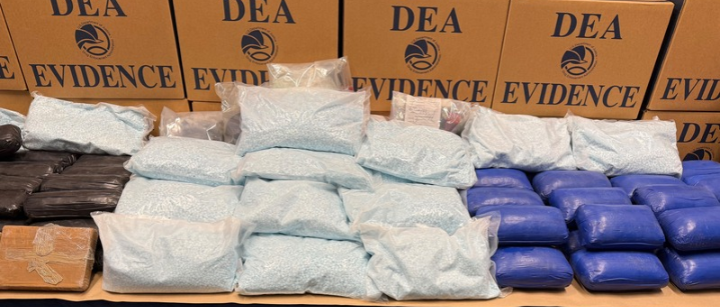
Trump administration officials, and the president himself, have taken credit for a decline in fatal overdoses, citing a “sealed” or “secure” border and actions against cartels, including airstrikes on alleged drug boats. But overdose deaths were already falling when Trump took office, and experts told us there’s little evidence his enforcement policies have been major drivers of that trend.
In some statements, the White House has also misleadingly referred to a 40% drop in overdose deaths “from the Biden-era peak” — without mentioning that more than half of the decline happened while Joe Biden was still president.
The release of the latest drug-death figures from the Centers for Disease Control and Prevention this month, which showed fatal overdoses continuing to decline, prompted celebratory statements from the White House.
President Donald Trump’s immigration policies are “crushing the overdose crisis,” the White House said in a Nov. 16 news release, adding that “overdose deaths have now declined for 18 straight months under President Trump. After Democrats refused to secure the border and allowed cartels to flood American communities with poison, that pipeline is now being choked off.”
“It’s because of President Trump’s common-sense policies, like securing our borders, dismantling and eliminating narco-terrorist organizations, and employing primary and early prevention efforts within our communities that thousands of American lives are being saved each year,” Sara Carter, director of the White House’s Office of National Drug Control Policy, said in a separate news release the same day.
Those statements echo how Trump himself has talked about the fentanyl crisis in recent months. In rallies and other appearances before and after the Nov. 3 midterm elections, he’s repeatedly talked about reducing the flow of drugs over the southern border and striking alleged drug boats off the coast of Latin America. At an Oct. 21 rally in South Carolina, for example, he claimed drugs coming across the border were “down 67 percent,” while military strikes on drug boats had nearly eliminated trafficking by sea.
“Each one of those boats will kill 5- to 10,000 people,” he said. “So you can’t feel that bad when you see those rockets go right through the middle of it.”
(We’ve written before that his claims about how much he’s reduced the quantity of drugs flowing into the country are not supported by the available data, which measure only what authorities seize and not the total amount of drugs entering the U.S.)
Vice President JD Vance similarly linked declining overdose deaths to the administration’s border policies at a campaign rally in Maine in August.
“We helped keep drugs out of Maine communities,” he said, citing the state’s declining overdose fatalities. “We sealed the border, and that’s what happened, my friends. And that’s why we did it.”
While fatal overdoses have indeed declined during Trump’s time in office, it’s a continuation of a trend that began in 2023. Experts are still debating the reasons for that decline. Better access to treatment, wider availability of overdose-reversal drugs, China’s moves to restrict fentanyl precursor chemicals during the Biden era and a depleted population of at-risk individuals are among the proposed explanations.
Drug-policy experts told us there’s little evidence that Trump’s border policies, boat strikes or other enforcement actions have had a major impact on U.S. overdose-death rates.
“The fall in overdose deaths started in 2023, and the greatest decline so far was in 2024,” Katharine Harris, a fellow in drug policy at Rice University’s Baker Institute for Public Policy, told us by email. “They have continued to decline while Trump has been in office, but the trend was already well underway.”
Jonathan Caulkins, a professor and drug-policy expert at Carnegie Mellon University, said it’s not unusual for an administration to overstate its effectiveness on this issue.
“Essentially every presidential administration, at least since the creation of the Office of National Drug Control Policy [in 1988], has spun news on the drug front to claim credit and say we’re wonderful,” he said.
Drug Death Drop Started Under Biden
Overdose deaths skyrocketed in the U.S. over the past several decades, as successive waves of the opioid crisis — first prescription painkillers, then heroin and later fentanyl — took hold.
The crisis became especially deadly once fentanyl, a highly potent synthetic opioid, began to supplant heroin in the U.S. in the 2010s. According to CDC data, drug deaths rose from around 53,000 in 2015 to more than 112,000 in the 12 months ending in August 2023. Most of those deaths were linked to opioids.
Then, for reasons researchers are still working to understand, the trend reversed itself. Overdose deaths have been falling since August 2023, marking the first sustained decline since the opioid crisis began. According to the CDC, fewer than 66,000 Americans died of drug overdoses in the 12 months ending in June 2026, the most recent data available. That’s down 41.5% from the peak in mid-2023.
Around two-thirds of that decline happened during the Biden administration, with annual overdose deaths falling below 80,000 as of January 2025. But the White House has sometimes cited that stat in a way that misleadingly suggests the decline came entirely during Trump’s term.
“Border security, crushing drug cartels, and law & order policies have led to a massive drop in drug overdoses from the Biden-era peak,” the White House said in an Oct. 23 social media post, which featured an image of Trump under the words “40% drop in drug overdoses.”
Similarly, the Nov. 16 news release quoting Carter was subtitled “Overdose Deaths Plunge 42% from Biden Era Peak” and said the latest CDC figure “represents an approximately 41.5% decrease in total drug overdose deaths compared to the peak under the previous administration.”
Neither mentions that most of the decline happened before Trump took office.
Trump made a state-specific version of this claim on Oct. 17 at a midterm rally in Kentucky, where he claimed that “fentanyl overdoses in Kentucky are down almost 80% from the Biden era.”
A White House official told us Trump was referring to the decline in synthetic opioid deaths in Kentucky since the 12 months ending in November 2021, when they peaked at 1,739. According to CDC data, they’ve since fallen to 444 as of the year ending in June 2026, a 74.5% drop. As with the national numbers, most of that decline — about two-thirds — happened before Trump took office.
Impact of Trump’s Border, Enforcement Policies
In touting their progress on the overdose crisis, Trump and the White House have largely emphasized policies like securing the border, airstrikes on alleged drug boats and other efforts to target cartels. (Carter also cited “primary and early prevention efforts.”)
Drug-policy experts told us there’s little evidence those policies are the main reason overdose deaths are falling, though some said it’s possible they’ve had some effect on the margins.
“The shock that started the decline in overdose deaths came in mid-2023, before the current administration took office, so its border policies can’t explain the first 18 months or so of the decline,” Greg Midgette, an associate professor of criminology and criminal justice at the University of Maryland, told us in an email.
As for why the decline has persisted, he said, “Border enforcement is one of maybe two dozen plausible contributors, none of which is obviously the main driver. Unfortunately, there isn’t evidence yet that lets us separate their effects.”
Harris, the Rice University expert, said Trump’s crackdown on illegal border crossings would not have had a large effect on the drug supply, since that’s not how most drugs enter the country.
“Most drugs are seized at legal points of entry, so additional enforcement against unsanctioned border crossings is unlikely to have a measurable impact on the drug supply,” she said. The vast majority of people caught smuggling fentanyl across the border are U.S. citizens, according to an analysis of government data by the American Immigration Council, a nonprofit advocacy group that provides legal representation to immigrants.
Better drug detection and enforcement measures at the border can make a difference, though “sealing” the border is the wrong metaphor, said Caulkins, the Carnegie Mellon professor. Because drugs are so compact and easy to smuggle in passenger cars or commercial vehicles, it’s impossible to cut off the flow entirely, but making it harder to move drugs across the border can drive up the price.
But we “do not have any evidence on whether or not the current administration is doing a better or a worse job at that,” he said, in part because of limitations in federal data. The DEA stopped sharing detailed price data on illicit drugs in 2017, and a series of reports that tracked spending and other characteristics of illicit drug markets hasn’t been published since 2019.
Trump, in recent rallies and other appearances, has focused in particular on his administration’s airstrikes on alleged drug-smuggling boats in the Caribbean and East Pacific, at times suggesting they are saving thousands of American lives.
But experts told us it’s highly unlikely the airstrikes — which many legal experts and human rights groups describe as violations of international law — have made a dent in the country’s overdose crisis. As of late October, there have been 72 U.S. military strikes on boats killing 244 people, according to the New York Times’ tracking of these incidents.
“There is very little evidence that the airstrikes on alleged drug trafficking boats have had an effect on the drug supply, much less overdose deaths,” Harris told us. “The shipping routes targeted by those strikes are primarily used for cocaine, not fentanyl, and a recent analysis showed that the cocaine supply in the US has remained stable.”
She’s referring to an analysis from the Drug Enforcement Administration that, according to a Washington Post report, concluded the strikes had not affected the price or supply of cocaine in the U.S. after an initial disruption, as traffickers adjusted their methods.
Fentanyl, which remains the biggest driver of U.S. overdose deaths, mostly enters the U.S. by land from Mexico, Caulkins said.
We asked the White House for evidence that its policies have reduced overdose deaths. The White House official didn’t cite any, but provided a list of actions the administration has taken to crack down on the flow of drugs, including designating cartels as foreign terrorist organizations, sanctioning entities involved in supplying the Sinaloa Cartel and using tariffs to pressure China into tightening restrictions on precursor chemicals that labs in Mexico use to make fentanyl.
“The Trump administration has adopted many very good policies in Mexico, and in fact I would say that the policy in Mexico is a big improvement in comparison to the Biden years,” said Vanda Felbab-Brown, a senior fellow at the Brookings Institution who has directed research on the global drug trade.
That includes getting the Mexican government to step up its enforcement efforts against the cartels and shift from a narrower focus on taking out top cartel leaders to dismantling cartels’ operational layers and targeting government corruption.
“However, that has not translated in effect on supply,” she said, noting that fentanyl continues to enter the U.S. and there’s no evidence of a shortage.
“There is no indication whatever that the decline in fentanyl overdoses is linked to supply-side measures during the Trump administration related to the border,” she said.
Trump’s tariff-related diplomacy with China, meanwhile, has achieved little when it comes to fentanyl, she said. Chinese companies are major suppliers of ingredients that cartels in Mexico use to synthesize the drug. Last year, China agreed to impose restrictions on certain precursor chemicals in exchange for tariff relief. But Felbab-Brown said those steps had already been underway after China made similar promises to the Biden administration.
“So essentially, China won the diplomacy and was able to double-count the deliverables that it had promised the Biden people” by “freshly counting them as big deliverables for tariff reductions to the Trump administration,” she said.
Untangling the Causes of the Drug-Death Decline
So what does explain the decline in overdose deaths over the past three years? Researchers have proposed a number of possible causes, but there’s no consensus yet.
Some point to greater access to treatment, including medications like methadone and buprenorphine that have been shown to greatly reduce the risk of overdose, and the increasing availability of the overdose-reversal drug naloxone.
Others have advanced the idea of a “supply shock,” stemming from steps China took starting in 2023 to tighten controls on fentanyl precursor chemicals. That may have disrupted the U.S. fentanyl supply, at least in the short term.
Caulkins, who coauthored a paper proposing that theory, said sudden constrictions in supply tend to cause temporary disruptions, but the market generally adjusts as long as demand remains. So while he thinks this may help explain the initial drop, it’s unlikely to be the only factor behind a downward trend that’s lasted nearly three years.
Another potential explanation is that there are simply fewer people left who are susceptible to overdose. That’s partly due to the grim fact that so many have already died. But it’s also the result of two positive trends, said Dr. Daniel Ciccarone, a professor of addiction medicine at the University of California San Francisco.
“One is, people are entering treatment and recovery as well,” he said. “So the attrition is both deaths and people leaving the scene.” At the same time, fewer young people are taking up fentanyl use, he said, resulting in a shrinking population of people who are at risk.
Other factors could include a post-COVID-19 “return to normal” or people adopting less risky behaviors while using, such as making sure someone is around to call 911 or administer naloxone if needed, among various other things.
“The correct answer at the moment is, we don’t know,” Ciccarone said. He and others said it’s likely not just one thing, but a combination of some or all of those factors.
“It’ll be a multifaceted ideological explanation,” he said. “There’s no magic bullet here.”
Editor’s note: FactCheck.org does not accept advertising. We rely on grants and individual donations from people like you. Please consider a donation. Credit card donations may be made through our “Donate” page. If you prefer to give by check, send to: FactCheck.org, Annenberg Public Policy Center, P.O. Box 58100, Philadelphia, PA 19102.
