


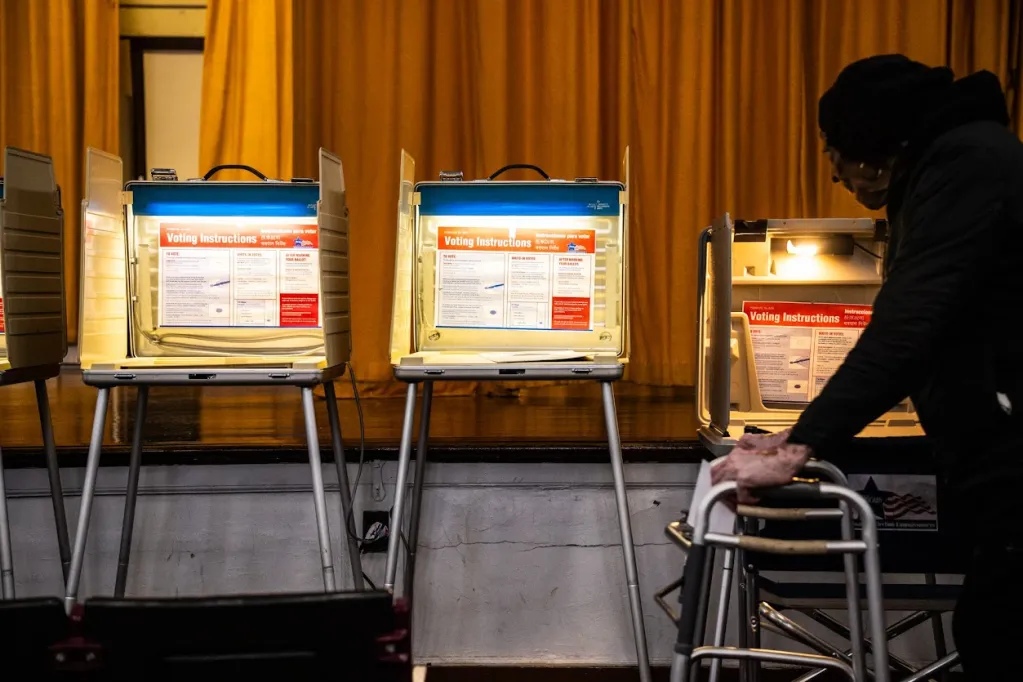
All Cook County Circuit Court judges on the ballot won retention this year, according to certified election results from the Cook County clerk and the Chicago Board of Elections. But many received considerably less support than in prior elections, suggesting that retention is becoming less of a formality.
Judicial retention was often a part of the ballot some voters skipped, with the drop-off of voters far steeper in the past. In 1998, about 36% of voters who weighed in on the first judge did not weigh in on the last one. This year, that number was about 7%.
With information about judges only a search away, many are making deliberate choices, including voting no, particularly in the city, said Albert J. Klumpp, a researcher and expert in Cook County judicial elections.
Nineteen of the 61 judges on the ballot received less than 70% of yes votes, a record low. Judges need 60% approval from voters to remain on the bench.
Four won retention with even slimmer margins: Tiesha L. Smith, Ursula Walowski, Lorraine Murphy, and Maritza Martinez all had less than 65% support, according to certified results. Smith held the lowest showing at 60.33%.
By Klumpp’s analysis, roughly 3 in 4 voters marked yes or no on the typical judge this year. In 2000, it was fewer than half.
To measure participation, Klumpp added up the yes and no votes each judge received, found the median among all 61 judges and divided it by the number of voters who cast a ballot.
The results split sharply between Chicago and the suburbs. Had Chicago voters alone decided the outcome, four judges would have lost retention: Smith, Walowski, Murphy, and Martinez. In the suburbs, all four won.
For decades, nearly every judge on the ballot received over 70% of the vote. That began to change in 2018, when Judge Matthew Coghlan became the first judge in nearly three decades to lose retention after a history of harsh sentences and a “Dump Coghlan” community campaign.
The typical judge’s support has held steady, which suggests voters are voting against specific judges more often than they used to, according to Klumpp.
No single factor explains that shift, Klumpp said. He pointed to several, from changes in where voters get their information to lower turnout, which tends to attract voters who are more educated on candidates.
Klumpp’s analysis estimates the number of voters who used each source, such as judicial guides, bar association ratings, and newspapers, then scales that up to the total number of ballots cast to compare elections.
His results show that in the early 2000s, roughly 100,000 people in Cook County used outside information to help decide how to vote on judges. Now, his estimates point to over 350,000 people consuming such media.
The internet changed what it takes to vote no on a judge, Klumpp said. Voters who once showed up unprepared can now “pull out their phone and do a few Google searches,” he said.
Those outside sources, he said, are often independent guides, such as Injustice Watch’s Judicial election guide and the Girl, I Guess Progressive Voter Guide. Injustice Watch, a nonprofit newsroom, began its guide in 2016. Girl, I Guess, an online voter guide whose founder, Stephanie Skora, says she bases its ratings largely on Injustice Watch reporting and community tips, first published in 2018.
Paul Gulyas, who says he has been a Cook County voter for the past two decades, said he came across Girl, I Guess in 2024 and has used the guide to inform his retention vote ever since.
Judicial votes used to be a guess or a half-filled ballot for Gulyas. Now he feels informed, in part because the Girl, I Guess guide feels like “a real person put this together,” he said. He also pointed to its grassroots nature.
The location of that engagement has also flipped. Suburban Cook County once led the city in retention participation, Klumpp said. Using regression analysis, his estimates now show city voters as more likely to fill out the entire retention section and consume outside information.
That shift may help explain the divide in the results, he said.
Gulyas said he sees retention elections as one of the more direct ways to affect his own neighborhood and has stopped treating it as an afterthought.
“It’s everything,” he said.
The post Every Cook County circuit judge wins retention, but voter scrutiny is growing appeared first on Injustice Watch.
