


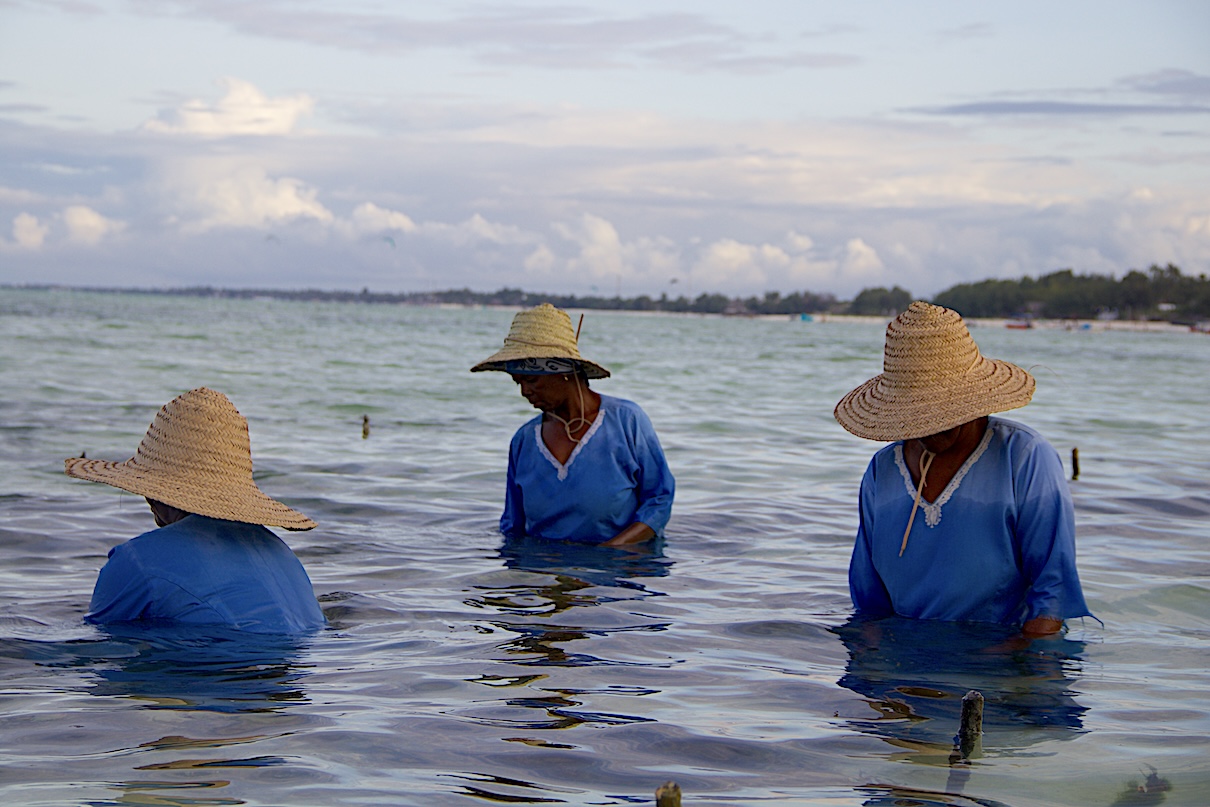
- On the Tanzanian island of Zanzibar, thousands of women work among the tides to cultivate an important natural resource: Seaweeds.
- But this ‘seaweed economy’ is not immune to pressures brought by climate change, disease, and changing environmental conditions affecting many other marine economies across the world, so a partnership between the national government, the U.N., and NGOs is working to ensure its future.
- “The future of this industry will not be secured by hope alone. It will be secured by bringing science into traditional knowledge and practices through partnerships and investment,” the authors write.
- This article is a commentary. The views expressed are those of the authors, not necessarily of Mongabay.
Along Zanzibar’s coastline, thousands of women rise with the tides to cultivate one of our islands’ most important natural resources. Day after day, they wade into the ocean, tending lines of seaweed that support households, strengthen communities, and contribute to a sector that has long been a source of livelihoods and opportunity.
Their work reflects a remarkable combination of skill, perseverance, and adaptation. For decades, these women have sustained an industry that has connected Zanzibar to global markets while providing income in coastal communities. As climate change reshapes marine ecosystems and global demand evolves, the resilience of these farmers offers an important foundation on which to build the next chapter of the seaweed economy.
Each of us is directly connected to this work: Mwinyi serves as First Lady of Zanzibar, Kurbiel leads the U.N. Joint SDG Fund, which supports Zanzibar’s seaweed sector, and Krusoe founded AltaSea, which has participated in international efforts to advance research and investment in the sector.
We come to this issue from different backgrounds, but we share a common conviction: Zanzibar’s seaweed farmers are not the challenge facing the industry. They are its greatest asset. The opportunity before us is to ensure that research, innovation, infrastructure, and investment evolve alongside their commitment and expertise.
Across the world, agricultural and marine industries are increasingly turning to science to address the pressures created by climate change, disease, and changing environmental conditions. Zanzibar’s seaweed sector is no exception.
Over several decades of cultivation, seaweed farmers have relied largely on propagating existing cultivated stock of Kappaphycus seaweeds (locally known as “cottonii”). While this approach helped establish and expand the industry, researchers are now finding that genetic diversity within cultivated varieties may have gradually narrowed over time. As ocean temperatures rise and environmental stress becomes more frequent, these challenges are becoming increasingly important to address.
The impact is already visible. Higher-value cottonii varieties that once thrived in shallow waters have become more difficult to cultivate in many areas, reducing potential earnings for farmers and increasing pressure on coastal livelihoods. Yet this is not simply a story of environmental loss. It is also a story of opportunity: An opportunity to apply science, research, and innovation to strengthen the sector’s future.
Recent collaborative research involving Tanzanian and international partners has revealed promising possibilities. Indigenous populations of Kappaphycus alvarezii still exist in the waters of Tanzania, offering researchers valuable insights into genetic diversity that may help improve the resilience of cultivated seaweed. Preliminary findings suggest that some of these naturally occurring populations may possess characteristics that could contribute to greater tolerance to disease and heat stress, while also supporting higher-value production.
This discovery is significant not because it offers a quick fix, but because it points toward a long-term pathway for strengthening the industry’s foundations.

Unlocking that potential will require sustained investment in science and innovation. Genetic assessment of wild and cultivated populations, preservation of genetic diversity through biobanking, and responsible breeding programs could help develop improved seedstocks capable of thriving in the environmental conditions of the future. Such investments are already transforming agricultural sectors around the world and can help position Zanzibar as a leader in sustainable blue economy innovation.
Encouragingly, the Revolutionary Government of Zanzibar has demonstrated a strong commitment to advancing the sector. Together with the United Nations Joint SDG Fund and other development partners, efforts are underway to strengthen domestic value addition, expand research capacity, promote climate-smart aquaculture training through pilot deep water plots using the tubular net farming method, and invest in facilities such as tissue culture laboratories, hatcheries, and cultivation centers. These investments can support improved seedstock development, applied research, and greater participation in higher-value markets, including products used in agriculture, cosmetics, pharmaceuticals, sustainable packaging, and advanced biomaterials.
Partnership is central to this transformation.
Government institutions, farmer organizations, research institutions, civil society organizations, private sector actors, and international partners each bring unique strengths. The role of development partners is not to replace national leadership, but to complement it by helping mobilize knowledge, financing, research partnerships, and technical expertise that can accelerate progress toward shared goals.
Most importantly, none of these advances diminish the role of farmers. On the contrary, they strengthen it.
Science is most meaningful when it improves everyday lives. For a seaweed farmer, that may mean access to stronger and more resilient seedstock. It may mean safer equipment and boats that enable farming in deeper, cooler waters. It may mean improved post-harvest infrastructure, better quality standards, access to finance, or stronger bargaining power in the marketplace. Ultimately, science succeeds when it helps ensure that hard work translates into greater income, stability, and opportunity.

That is why the future of Zanzibar’s seaweed sector must combine innovation with inclusion. Better biology alone will not create better livelihoods. Success will also depend on investments in farmer organizations, modern cultivation methods, post-harvest facilities, market access, and local processing capacity. Together, these efforts can help ensure that more value remains within Zanzibar and that farming communities share fully in the benefits of growth.
We have already seen what is possible when the right support reaches farmers. Across Zanzibar, initiatives have helped farming communities increase productivity, strengthen cooperatives, access financial services, and connect to new markets. These achievements demonstrate what can happen when determination is matched with targeted investment.
The women of Zanzibar have proven their resilience many times over. The responsibility now belongs to all of us, government, researchers, civil society, private industry, and development partners, to match that resilience with action.
The future of this industry will not be secured by hope alone. It will be secured by bringing science into traditional knowledge and practices through partnerships and investment. By bringing those elements together, Zanzibar has an opportunity not only to protect a vital sector, but to become a model for how coastal communities can thrive in a changing world.
Mariam Mwinyi is First Lady of Zanzibar. Jenny Krusoe founded the marine innovation NGO AltaSea at the Port of Los Angeles. Lisa Kurbiel is head of the U.N. Joint SDG Fund, an inter-agency program that incentivizes policy and financing to accelerate progress on the Sustainable Development Goals (SDGs) at the country level.
Banner image: The “Mwani Mamas” of Zanzibar work in shallow coastal waters where seaweed farming provides an important source of income for women and their families. Image courtesy of Kevin Gaines/Kelp Ark.
See related coverage:
A sea cucumber venture in Zanzibar seeks to balance business and conservation
Pemba’s new marine protected areas show the power of collaboration to meet 30×30 goal
In Indonesia’s Lombok, fishers find food security tied to mangrove reforestation
Citations:
Matoju, I., Le Masson, V., Montalescot, V., Ndawala, M. A., & Msuya, F. E. (2022). A resilience lens to explore seaweed farmers’ responses to the impacts of climate change in Tanzania. Applied Phycology, 3(1), 132-148. doi:10.1080/26388081.2022.2091951
Eggertsen, M., & Halling, C. (2020). Knowledge gaps and management recommendations for future paths of sustainable seaweed farming in the western Indian Ocean. Ambio, 50(1), 60-73. doi:10.1007/s13280-020-01319-7
Brugere, C., Msuya, F. E., Jiddawi, N., Nyonje, B., & Maly, R. (2020). Can innovation empower? Reflections on introducing tubular nets to women seaweed farmers in Zanzibar. Gender, Technology and Development, 24(1), 89-109. doi:10.1080/09718524.2019.1695307

