


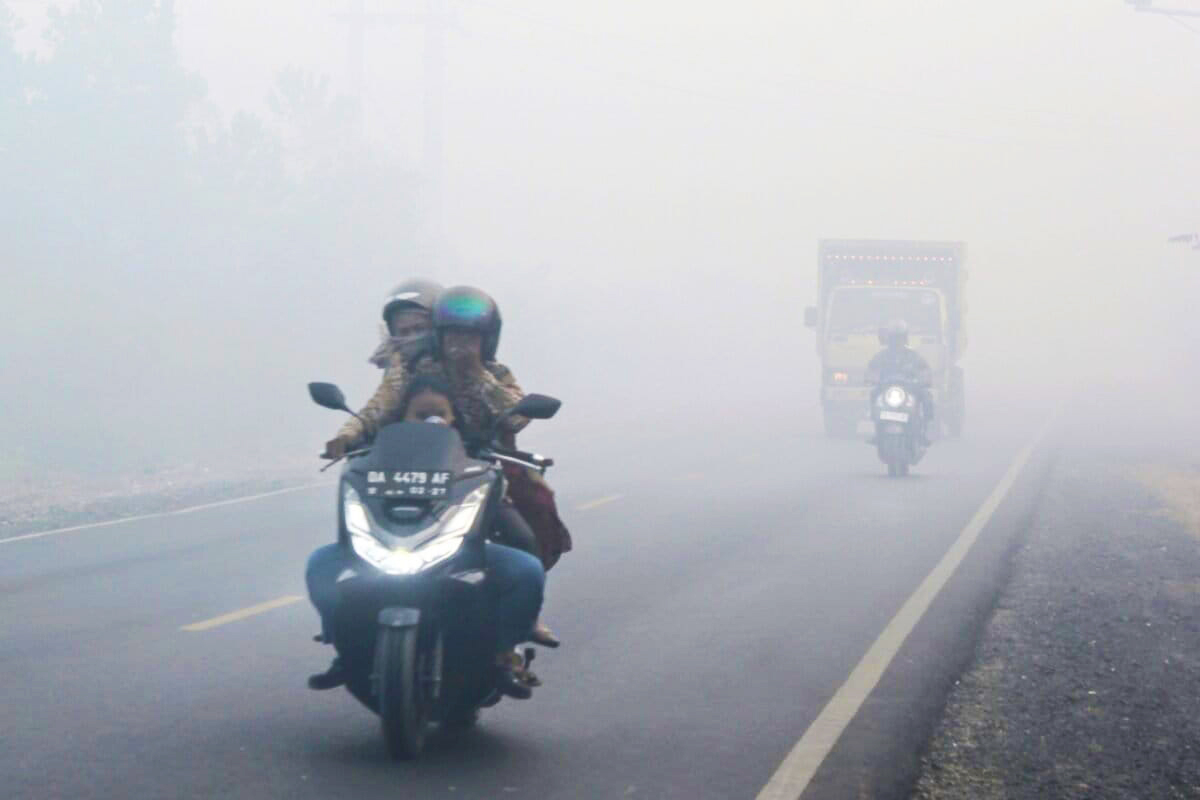
- Months-long wildfires and the resulting thick smog are taking a growing toll on public health in Indonesia, with residents reporting respiratory illnesses and even deaths.
- Indonesia’s Health Ministry recorded 333,470 acute respiratory infection cases in the six worst-affected provinces by Oct. 21, while nonprofit Centre for Research on Energy and Clean Air (CREA) has estimated that short-term exposure to wildfire-related air pollution contributed to 3,560 deaths in September — more than double its August estimate.
- The haze crisis is affecting millions across Indonesia and neighboring countries, with residents in Singapore and Malaysia reporting health problems and authorities recording increases in respiratory illnesses.
- Health experts warn that repeated exposure to fine-particle pollution can cause long-term medical problems and call for stronger public-health protections and a shift from reactive to preventive policy in handling wildfires.
JAKARTA — Michael’s 20-month-old daughter began coughing and had shortness of breath in early October, as thick haze from wildfires blanketed Balikpapan, the capital of Indonesia’s East Kalimantan province.
He and his wife took the toddler to a private hospital, where she was diagnosed with pneumonia. An X-ray showed an infiltrate in the upper part of the girl’s left lung.
“We were told that one factor that could have contributed to the illness was the smoke, which has also been getting thicker in Balikpapan,” Michael told Mongabay Indonesia on Oct. 14, 2026.
With the air quality index reaching “unhealthy” levels in the city, the couple limited their daughter’s time outdoors.
A day later, more than 100 kilometers (62 miles) away, in the East Kalimantan city of Samarinda, a 14-month-old baby died after suddenly experiencing shortness of breath.
The family of the toddler, Yazlyn Syanindita, suspects she died because of the thick smog enveloping the city.
“Her shortness of breath was so sudden,” Yazlyn’s grandfather, Sarno, told Mongabay Indonesia. “She had no previous illnesses.”
Her mother Cindy, 25, said what happened to her daughter shouldn’t happen to other children and urged the government not to downplay the impact of fires.
“The government must not turn a blind eye,” she said, as quoted by BBC Indonesia. “Don’t say the haze isn’t severe. Many people are suffering from acute respiratory infections. Yesterday, in the inpatient ward, I saw three toddlers struggling to breathe.”
Health risks also extend to those fighting the fires. At least 10 people, including firefighters, have lost their lives while battling wildfires in Indonesia’s Borneo, Sumatra and Java.
One of them is Nurdin, a 51-year-old volunteer firefighter in South Kalimantan province. He died after developing chest pain and shortness of breath while battling a blaze in South Kalimantan province on Oct. 21.
Amat, one of his colleagues, said Nurdin had appeared healthy before setting out to fight a blaze behind a local government office. “He complained of chest pain, so I told him to rest first,” Amat said, as quoted by DetikNews. “We gave him oxygen, but he kept saying that his chest hurt.”
Nurdin’s condition deteriorated as colleagues took him to a nearby clinic. He reportedly lost consciousness several times and experienced convulsions before arriving at the clinic, where he was pronounced dead.
Dr. Amalia Dewi, head of the clinic, said Nurdin arrived without signs of life. Based on the circumstances and information from his colleagues, she suspected “smoke poisoning” as the cause of death, local media Monitor Indonesia reported.
Amalia also said Nurdin appeared to be wearing an ordinary dust mask rather than respiratory protection designed for fire smoke. Other volunteers at the site had experienced breathing difficulties.
While the publicly reported information does not establish a definitive cause of Nurdin’s death — whether it was smoke inhalation, carbon monoxide poisoning, a cardiac event or another condition — his death nonetheless raises questions about the protection and medical support available to firefighters working in hazardous conditions.
Wider health crisis
Yazlyn and Nurdin died as a wider health crisis has gripped Indonesia: Authorities have recorded a rise in acute respiratory infections as ongoing wildfires send haze across populated areas for months.
Indonesia’s Health Ministry recorded 333,470 acute respiratory infection (ARI) cases between Aug. 18 and Oct. 21 in the seven Sumatra and Kalimantan provinces worst affected by wildfires. Among them, more than 75,170 cases affected children aged 5 and younger.
The government has not released any data on haze-related fatalities. However, local media have reported cases of children and adults, including a teacher and an online motorcycle driver, who died in smog-choked areas after experiencing difficulty breathing.
The nonprofit Centre for Research on Energy and Clean Air (CREA) says that short-term exposure to fine-particle pollution from Indonesia’s wildfires contributed to an estimated 3,560 deaths in the country in September 2026 — more than double its estimate of 1,700 deaths in August.
The calculations are based on pollution modeling and epidemiological data, not a count of individually confirmed haze-related deaths.
In its latest report, published on Oct. 29, the NGO estimates that toxic wildfire haze accounted for 94% to 99% of air pollution-related deaths in four Kalimantan provinces and for more than 80% in multiple provinces in Sumatra.
Critics say the government had ample time to prepare, pointing out that in March, months before Indonesia’s dry season, the country’s research and innovation agency warned about the possibility of an extreme El Niño event.
However, the government still slashed the 2026 budget for the national disaster management agency, BNPB, by 75%.
According to CREA, the budget cut has severely constrained the BNPB’s ability to deliver emergency response.
“We knew [El Niño] was coming, but the government didn’t do anything,” CREA analyst Katherine Hasan told Mongabay by phone.
Historical data also suggests that the fire crisis is very likely to worsen as the dry season progresses, she added.
Despite the increasing health risks, the Indonesian government has not declared the wildfire and haze crisis a “national disaster.”

Growing health burden
Exacerbated by the “super” El Niño event, the ongoing wildfires are set to be Indonesia’s biggest in recent years.
According to an assessment by technology consultancy TheTreeMap, using Sentinel-2 satellite imagery, the fires affected about 1.9 million hectares (4.7 million acres) of land across Indonesia between January and September 2026 — an area 38% greater than the number during the same period in 2019.
The sharp uptick in hot spots began in July, about a month after meteorologists confirmed the arrival of El Niño. The resulting haze has affected millions of residents, not only in nearby Indonesian cities and villages, but also in neighboring countries including Singapore, Malaysia, the Philippines and Timor-Leste.
An estimated 40 million people across Sumatra and Kalimantan provinces had been exposed to haze over the preceding two months, Greenpeace said in September.
In Palangka Raya, the capital of Central Kalimantan province, where air pollution indexes have been hovering between “unhealthy” and “hazardous” levels since August, more than 11,000 cases of acute respiratory infection (ARI) have been logged this year, broadcaster Metro TV reported on Oct. 13.
Videos shared on social media in October show yellow-orange haze shrouding Central Kalimantan, including Palangka Raya. At one point, the sky turned red.
Dr. Faber Kristian Munthe, a pulmonologist in the provincial capital, said in early October that respiratory infections and asthma cases had increased over the preceding one to two months, putting pressure on health workers.
“It’s like COVID-19 in 2020,” he said during a virtual press conference organized by Greenpeace Indonesia on Oct. 5. “The crisis doesn’t affect only certain individuals; it affects the entire population, especially people with risk factors, such as children and older people, as well as those with comorbidities such as asthma and cardiovascular disease.”

Transboundary haze
Across the border, residents in neighboring Singapore and Malaysia have also been living with transboundary haze.
Speaking at the Greenpeace Indonesia press conference, Muhammad Syahir, a Kuala Lumpur resident, said his daughter had been hospitalized after developing a cough, phlegm, chest congestion and difficulty breathing.
“When I brought her to the hospital, she was diagnosed with bronchitis,” he said. “As a parent, it’s really sad for me to see.”
After five days in hospital, she was discharged and advised to continue wearing a mask because her lungs remained sensitive, he said.
Malaysia’s Health Ministry reported on Oct. 15 that upper respiratory tract infections jumped by 167%, asthma surged 127%, and conjunctivitis increased 83% from Sept. 6 to 12, based on monitoring at 78 selected ministry facilities nationwide. URTI cases rose almost 60% from Sept. 8 to Oct. 4.
A report commissioned by the Federation of Malaysian Manufacturers estimated that the haze crisis cost the country 8 billion Malaysian ringgit ($1.97 billion) and that exposure to fine particulate from fires contributed to 1,700 deaths.
By Oct. 18, Singapore had recorded 14 consecutive days of unhealthy air, matching the duration of the 2015 haze crisis, according to local newspaper The Straits Times.
Singapore’s Ministry of Health said there had been a “slight uptick” in visits to emergency departments and polyclinics during the haze, without giving a numerical total, the newspaper reported.
General practitioners and telemedicine providers reported increases of 10% to 30% in patients with symptoms associated with haze, including runny noses, sore throats, conjunctivitis, asthma and other respiratory complaints.
On Oct. 12, the city-state reactivated subsidies for medical treatment for haze-related conditions, including asthma, bronchitis, conjunctivitis, chronic obstructive pulmonary disease and upper respiratory tract infections.
The last time it activated the haze medical scheme was in 2015, when the country was hit by smog from Indonesia’s wildfires.

Lasting impacts
Health experts warn that repeated exposure to fine-particle pollution from wildfires can have long-term effects.
At a webinar on Oct. 27, Herawati Supolo-Sudoyo, a trustee of the Indonesian Open Science Voice Foundation and chair of the Indonesian Academy of Sciences’ Commission on Medical Sciences, said long-term exposure to PM2.5, fine particles in the air including smoke and ash, is associated with cardiovascular disease and other serious health effects, while exposure during childhood can affect development.
Dr. Feni Fitriani Taufik, a pulmonologist specializing in occupational and environmental lung disease with the Indonesian Society of Respirology, who also spoke at the webinar, gave a similar warning. “The smoke may disappear and subside, but the acute inflammation it causes can still pose long-term threats,” she said.
Studies have linked pollution from wildfires to lasting declines in lung function and an increased risk of cancer, Feni added.
Herawati said responses to fires have too often focused on extinguishing hotspots without giving equal attention to the health of people exposed to haze.
“More than 333,000 ARI cases in two months, including tens of thousands among children, are a stark warning that becoming accustomed to smoke does not make our bodies immune to it,” she said. “Public health protection must continue from before the smoke arrives until after the skies clear.”
Dr. Marsen Isbayuputra, an occupational medicine specialist at the University of Indonesia, called for early warnings based on air-quality readings and for health facilities to prepare for surges in respiratory illness.
“We need to shift the viewpoint from being reactive to more preventive and preventative,” he said at the webinar.
Besides protecting people from smog, “the main priority must still be preventing forest fires in the first place,” Marsen added.
Banner image: Commuters on the road try to shield their noses from the thick haze as they drive through Banjar district, Indonesia’s South Kalimantan province, in September 2026. Image by Riyad Dafhi Rizki/Mongabay Indonesia.
FEEDBACK: Use this form to send a message to the author of this post. If you want to post a public comment, you can do that at the bottom of the page.
Children’s health at risk in south Borneo as El Niño intensifies Indonesia wildfires
In Southeast Asia, residents grapple with life under Indonesia’s wildfire haze
Cite this article
Hans Nicholas Jong (2026). Experts warn of long-term health risks as Indonesia’s wildfire haze takes a growing toll. Mongabay Conservation news. DOI: https://doi.org/10.66709/news-334640

