


For at least a year now, newspapers have been increasingly filled with urgent and anxious reports about the quickening pace of artificial intelligence development, warning ominously that the technology will eventually defy human control and take over the world.
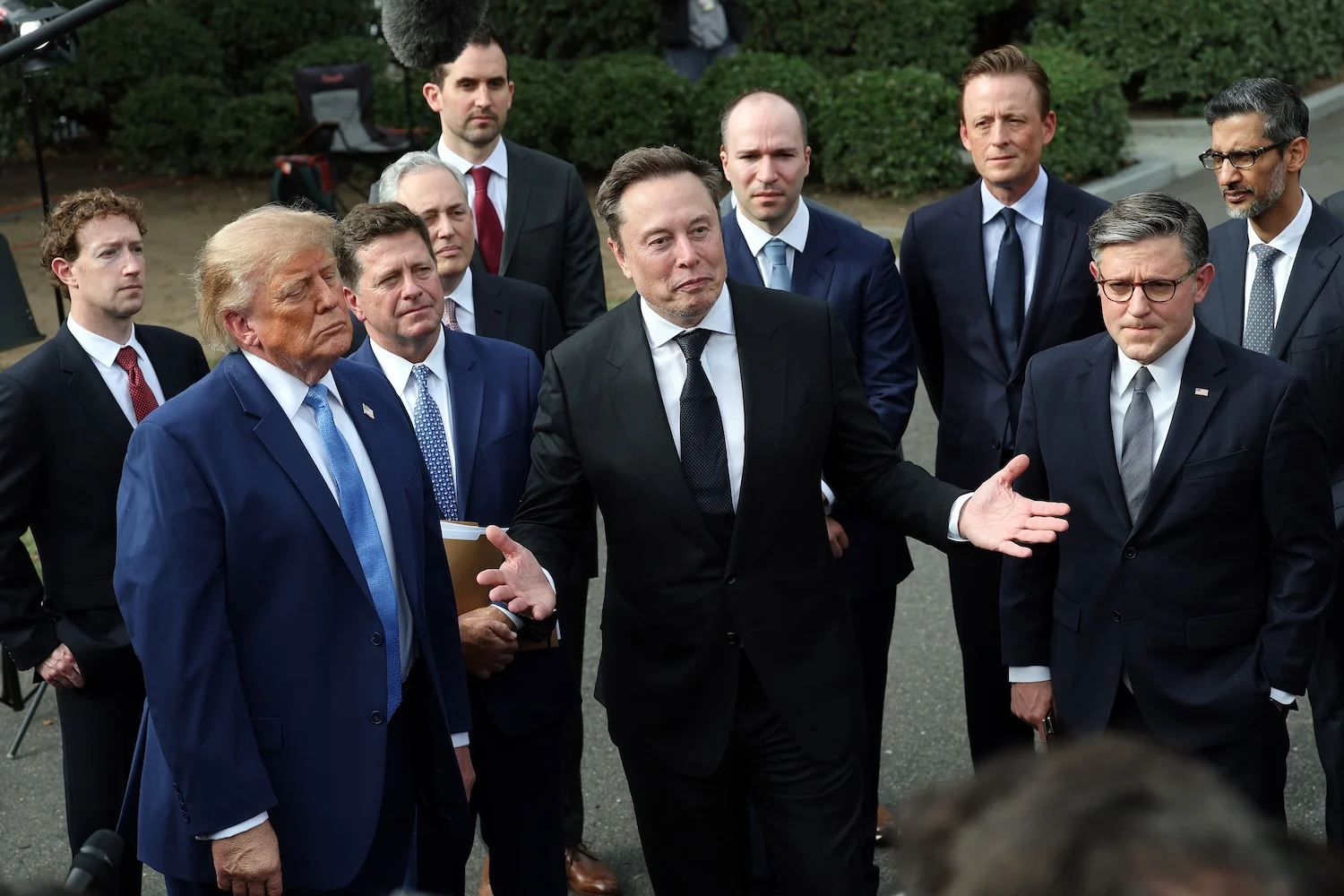
It is a threat worth taking seriously, and no mere hype. But with all the attention devoted to AI’s growing power, an even more imminent danger has become clear: With their prodigious fortunes, a small cast of men who lead the world’s most powerful AI-related companies have come to wield extraordinary and perhaps already-unstoppable power over U.S. government and society—and, thereby, unprecedented influence over world affairs.
The richest among them, Elon Musk, is the most spectacular example. He has exhibited no modesty about his ambitions as he has used his Midas-like wealth and tentacular corporations to become an irresistible force in contemporary affairs. The U.S. government now openly depends on Musk, who became a trillionaire in June, for its space program, for global communications, and for holding the country’s own in competition with China in frontier industries such as electric vehicles and batteries. But that is far from all.
Early in U.S. President Donald Trump’s second term, the White House accorded a leading role to Musk in shaping—and ostensibly streamlining—the country’s bureaucracy. It gave him not only unprecedented say over large-scale firings and the shuttering of long-standing government entities but also access to the personal data of millions of citizens.
A parallel and equally shocking example of never-before-seen personal influence over government came to light in recent days with the news that Ukraine’s access to the military-grade version of Musk’s internet services company, Starlink, had been interrupted or seriously degraded. Clarity about how this happened or who was responsible has been hard to come by, but the Wall Street Journal reported that Musk ordered the slowdown, badly hindering Ukraine’s offensive and defensive abilities in its ongoing war with Russia. Reuters, moreover, reported that the decision came from the White House. (Trump has denied involvement.)
No other company, or even country, has a system nearly as capable as Starlink, meaning that even the Pentagon, with a budget larger than the military spending of the next 10 defense powers combined, is reliant on Musk for these sorts of capabilities. And the lack of transparency about the chain of command—or the involvement or lack thereof of the U.S. government—in ordering changes that temporarily crippled another country’s defenses is ominous.
Musk, meanwhile, has begun to stealthily play an influential role in what are likely to be two of the most important public policy debates of the coming decades. The first is immigration. Although far from alone in this, Musk has advocated for sharply limiting migration to the West from nonwhite areas of the world. He has helped make post-apartheid South Africa a kind of poster child for this, pushing Trump to ease entry to the United States for members of South Africa’s white minority, whom Washington now pretends are the victims of gross persecution.
Musk’s other big, stealthy public policy play involves the future of Social Security and taxation. Many projections suggest that at current payout rates, the United States’ Social Security system will soon run out of funds, requiring some combination of postponed retirement for millions, greatly reduced benefits, or increased taxation. This is where the ultrarich would step in, creating further government dependence on them.
Musk recently announced that he would give one share of his SpaceX company stock to every U.S. child, a gesture whose value is estimated to be worth as much as $11 billion. Analysts have pointed out that, far from altruism, this would save Musk billions in tax. Other AI-related giants such as Anthropic and Dell, increasingly an AI services provider, have also begun to offer stock or cash donation programs.
Although Musk has not said as much, this also seems likely to be part of a bid by the ultra-wealthy to secure a powerful and potentially lucrative position for themselves in the looming struggle over the U.S. retirement system, via a kind of creeping privatization—a long-standing objective in conservative politics. By donating shares or providing child allowances, these individuals and their companies can profit not only from write-offs, but also perhaps through the management of financial services and fostering government reliance on their mega-corporations, much as the U.S. military depends on Musk’s Starlink.
A historical consensus has already begun to form around the idea that the increasing concentration of wealth, along with the rise of historically unprecedented fortunes stemming from AI and the broader internet and computer economy, is driving a decisive shift in the politics and economy of the United States, along with its democracy. On the country’s present path, the risk this presents is what political scientists and economists call state capture: a blurring of the lines between private and public interests, in which the former gradually predominates.
If the diagnosis is correct, notions about what to do about this have been much slower to coalesce, and that is no accident. Just this week, news emerged that in response to a proposed new tax on the ultrarich in California, Meta founder Mark Zuckerberg was considering leaving the state, where his company is based, and then hastily arranged changes in his corporate compensation. Despite being one of the world’s richest men, Zuckerberg has long received a mere $1 in annual pay from Meta, with the bulk of his fortune coming in the form of company shares. With California considering taxing assets like these instead of income alone, Zuckerberg got his board to create a new class of nonvoting shares that he could sell to pay any new state tax bill without diluting his controlling interest in the company. Other AI-related business leaders in California, where the industry is largely centered, have contributed to a campaign against the new tax measure, Proposition 40, which residents will vote on in November.
Jeff Bezos, the founder of Amazon, has found other ways to wield his influence. Like Zuckerberg and other mega-billionaires, Bezos has contributed to some of Trump’s pet Washington construction projects. Bezos also owns the Washington Post. Once considered a close rival to the New York Times in terms of the breadth and aggressiveness of its government accountability journalism, the Post has undergone a transformation under Bezos, shedding staff and running far softer features than before.
As this has happened, the newspaper’s editorial pages have become openly pro-business, including the AI industry, and thereby much less concerned with speaking truth to power. Bezos himself announced the change in February 2025: “We are going to be writing every day in support and defense of two pillars: personal liberties and free markets. We’ll cover other topics too of course, but viewpoints opposing those pillars will be left to be published by others.”
It is hard to see Bezos’s decisions as separate from his interest in currying favor with the White House, given his company’s huge business dealings with the U.S. government and exposure to state regulation.
It is Musk, though, who has been the least inhibited about flexing his influence over government. In the run-up to next month’s midterm elections, in which Democrats are widely expected to take control of the House of Representatives, and possibly win the Senate, Musk recently issued a threat to anyone in Congress with ideas of investigating him. “Those who pick fights with me should understand that I will find out who is really pulling the strings and come for them,” he wrote on X.
This is a brazen statement, but Musk may feel he has reason enough to believe in his impunity. The man who has become the largest campaign financier in U.S. politics, to the tune of hundreds of millions of dollars in campaign donations to Republican candidates, likely sees the struggle for influence over the government as a long game in which his wealth and that of an allied class of new AI billionaires can be decisive. The question—and it is a fateful one—is whether the country’s civil society, and along with it, its democracy, can hold its own.
