


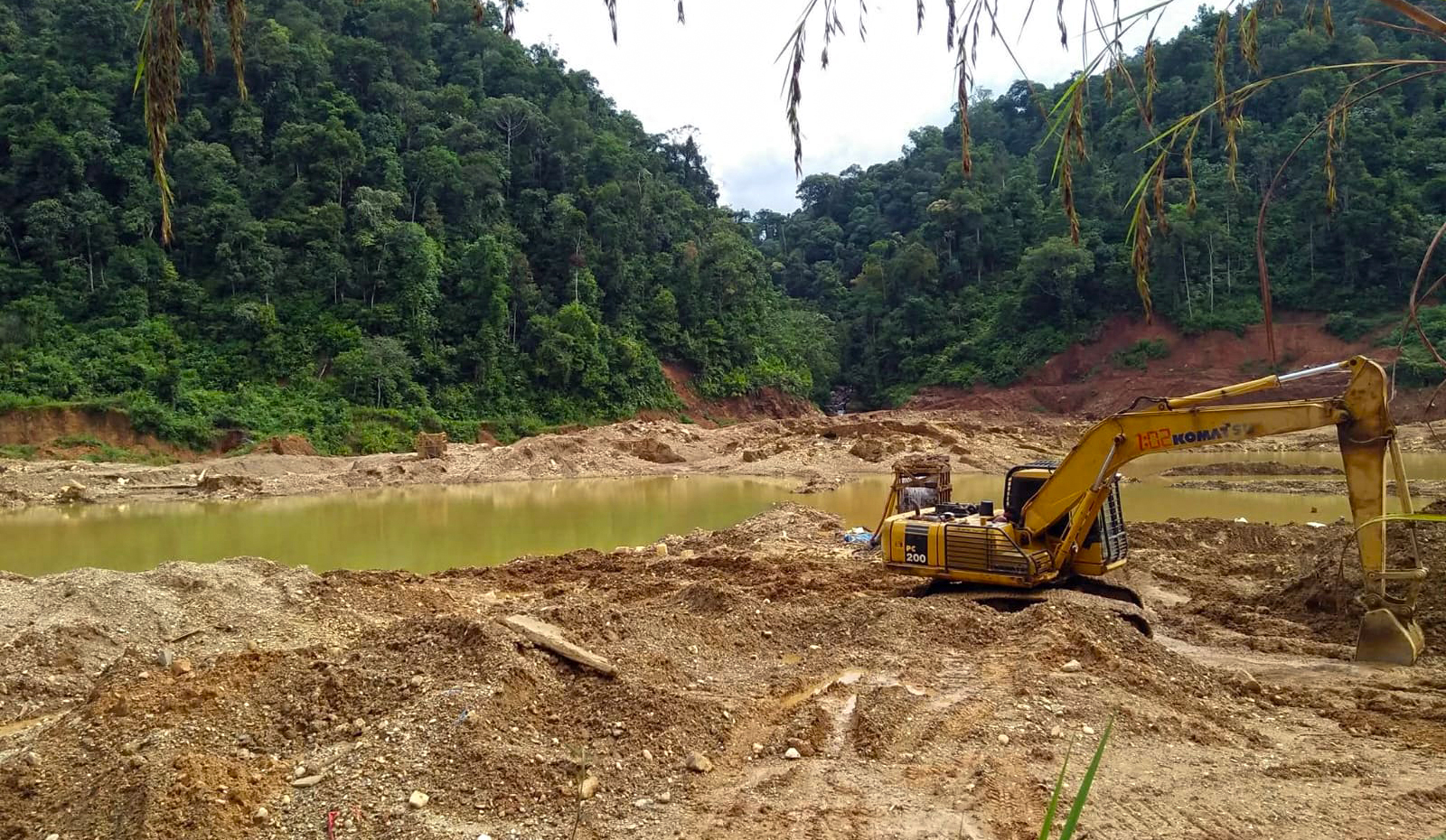
- A recent mining landslip in South Solok district on the Indonesian island of Sumatra buried four miners, after nine were killed in a similar incident in the same province in May.
- Globally, more than 20 million people work in the so-called artisanal and small-scale mining sector, many exposed to environmental disasters and dangerous levels of mercury, a potent neurotoxin used to separate gold from ore that causes permanent neurological and physical harms.
- International gold prices remain at an historically high value amid global inflationary pressures and geopolitical tensions, potentially incentivizing more people to enter illegal mining despite the significant health and environmental risks.
PADANG, Indonesia — Four gold miners were killed after a hillside in the Jorong Jujutan forest of Sumatra’s South Solok district gave way in the early hours of Oct. 6.
The landslide marked the latest fatalities in the so-called artisanal and small-scale gold mining (ASGM) sector, which has killed more than 50 people in just one of Indonesia’s 38 provinces in the last15 years, according to the country’s largest environmental pressure group.
Local authorities identified the latest victims as Dani, Defriadi, Rafli and Zul Fatrianto. The men were recovered at around 5 a.m., approximately four hours after the fatal landslip.
“The other workers who were nearby attempted to give assistance, but the thick layer of mud and rocks made it impossible to save the four,” the chief of South Solok district police Andreanaldo Ademi told Mongabay Indonesia.
Illegal gold mining accidents have repeatedly led to loss of life in Indonesia, including recent landslides that buried miners in the West Sumatra districts of Sijunjung, Solok, South Solok and West Pasaman districts.
The West Sumatra office of the Indonesian Forum for the Environment (Walhi), Indonesia’s largest environmental nonprofit, has recorded 52 deaths among miners in the last 15 years. However, Tommy Adam, director of Walhi’s chapter in West Sumatra, said the true number could be far higher.
Global challenges and framework
At least 20 million people work in the informal and illegal gold mining sector across around 80 countries, facing risks ranging from workplace accidents to long-term health damage from mercury exposure. The toxic metal is widely used to separate gold from raw ore.
Countries are in the process of developing and implementing national action plans under the Minamata Convention on Mercury to phase out mercury use in sectors such as dentistry and illegal gold mining.
The convention takes its name from Minamata, a Japanese city where industrial mercury pollution caused severe poisoning among local communities.
This month, the UNESCO office in Sudan heard new evidence from the Sudanese Environment Conservation Society of mercury contamination caused by an illegal sector comprised of 2 million miners in the war-torn country.
In September, the Global Environment Fund–supported planetGOLD programme convened in Panama to advance new non-mercury technology as well as the effort to bring illegal miners into the formal sector.
Indonesia has recently seized major shipments of mercury, while authorities are pursuing plans to bring informal mining operations into the formal sector through a system of special licenses
West Sumatra’s energy and mining agency previously estimated up to 300 illegal mines were operating across the province, costing the state around 6 trillion rupiah ($332 million).

Officials say the figure, from just one of Indonesia’s 38 provinces, reflects the extent of the challenge facing policymakers and law enforcement.
Indang Dewata, a professor at Padang State University, which is located in the West Sumatra capital, said the ecological damage from excavation and mercury use would be felt for years to come.
In May this year, nine miners were killed in West Sumatra after torrential rain triggered the collapse of a 30-meter (100-foot) cliff face at an illegal gold mine.
The head of the village where that disaster took place said the high price of gold was likely driving young men to the illegal trade.
Shifts in the global economy alongside new geopolitical risks pushed the price of gold above $5,600 per troy ounce in January, more than three times the price before the coronavirus pandemic began in early 2020.
“Simplifying this tragedy into an incident involving local people manually digging for gold is an effort to downplay organized environmental crime into making it appear like a normal individual disaster,” said Tommy Adam, the head of Walhi’s West Sumatra office.
Andreanaldo, the South Solok police chief, said authorities have sought to implement a crackdown on mines in the district of around 180,000 people, which is one of 19 such local governments in West Sumatra province. This has included raids inside forests and seizure of excavators.
However, some illegal mining operations have proved nimble by resuming operations after authorities completed their field inspections.
“This is indeed a challenge for us in South Solok,” Andreanaldo said. “However, we remain fully committed to enforcing the law against illegal mining.
Banner image: Illegal gold mining activity in the Pamong Besar River, Sangir, South Solok. Image by Vinolia/Mongabay Indonesia.
This story was first published here in Indonesian on Oct. 16, 2026.
Tapanuli orangutans face mining, landslides, and fire threats — with no recovery plan

