


Welcome to Foreign Policy’s South Asia Brief.
The highlights this week: India’s Cockroach movement grows as thousands of people march in New Delhi this week, an Iranian official’s visit to Islamabad highlights the importance of the Iran-Pakistan relationship, and violence flares again in Pakistan’s Balochistan province.
India’s Youth Protests Grow
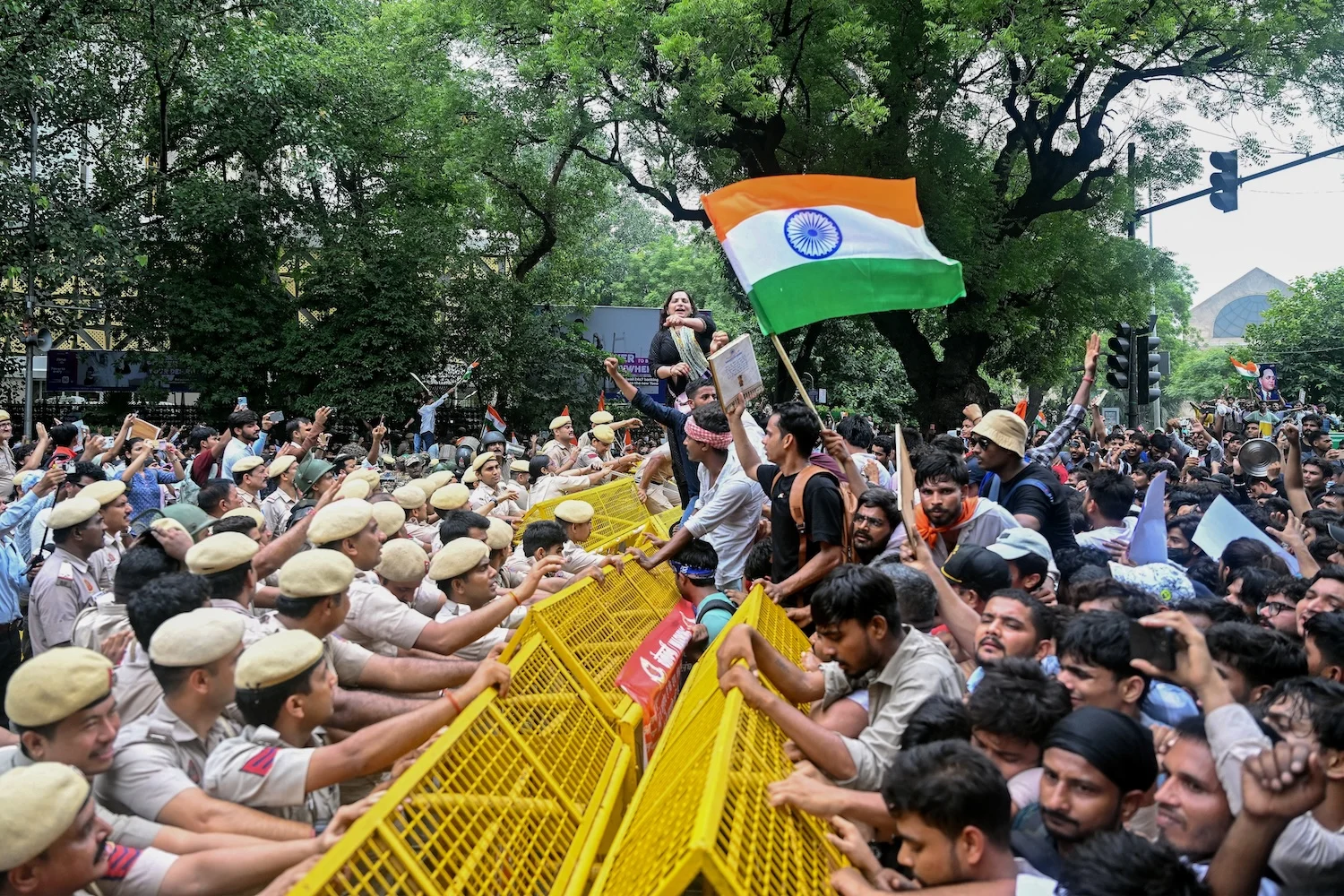
On Monday, thousands of protesters marched to Parliament in New Delhi, demanding the resignation of India’s education minister. Security forces responded with tear gas and batons, but demonstrators continue to stage sit-ins in the capital. The protest marked one of the biggest yet affiliated with the Cockroach Janta Party movement, which initially emerged as online satire.
The satirical party has racked up millions of followers on Instagram and held protests in various cities in recent weeks. However, they are unlikely to morph into a mass youth-led movement like those that ousted governments in Bangladesh, Nepal, and Sri Lanka in the last few years for a few reasons.
The Cockroach movement currently focuses on narrowly defined issues, mainly tied to education policy. The number of protesters is small relative to the tens of thousands who participated in India’s anti-corruption movement in 2011 or the campaign against sexual violence in 2012. (In Foreign Policy, Salil Tripathi writes about a veteran activist fasting in solidarity with the current protesters.)
Further, Prime Minister Narendra Modi’s government is considerably more popular than those targeted by protests elsewhere in South Asia. Still, what’s playing out on India’s streets this week is deeply significant for Indian politics.
The Cockroach Janta Party is one of the few major anti-government campaigns to emerge during Modi’s 12-year rule. Others include farmers’ protests over agricultural reforms—which were later repealed—in 2020-21 and demonstrations against a new citizenship amendment law that critics accused of discriminating against Muslims in 2019-20.
The main trigger for this week’s protests was the recent leak of answers to India’s medical school entrance exam, affecting around 2.2. million aspiring doctors who have had to retake the exam. The news of the leak was followed by at least a dozen reported suicides among students.
The movement underscores the large number of young people who are angry at Modi; some protesters on Monday also called for the prime minister to resign. It also reflects long-standing concerns about youth unemployment, a persistent policy challenge. There is a lot at stake for young people if problems in the education sector itself threaten their pathways to employment.
The Cockroach Janta Party also reflects a regional trend of young people taking to the streets because of grievances about education.
In Nepal, protesters have accused the National Examination Board of negligently checking a 12th grade exam, condemned new taxes for private school tuition, and railed against a ban on university student unions. In Bangladesh, students have launched campaigns calling for a wave of education reforms.
All three countries face large youth bulges, long-standing grievances against the education sector, concerns about insufficient jobs, and a widespread feeling among young people that the state doesn’t treat them with dignity. (In May, India’s Supreme Court chief justice likened some unemployed young Indians to “cockroaches,” which inspired the party’s name.)
These movements pose considerable challenges to their governments, even if the protest campaigns don’t constitute a direct threat to their power. For leaders in Bangladesh and Nepal, there is strong pressure to address public demands, as each government was just elected this year—not long after mass movements ousted previous administrations.
In India, the Cockroach movement delivers a blow to Modi’s Bharatiya Janata Party (BJP), which has sought to telegraph strength since the 2024 elections, when the party won a third straight term but had to form a coalition government for the first time. It has also provided a spark to a weak political opposition, whose leaders on Tuesday rallied in front of Modi’s residence to condemn the crackdowns on protesters.
A string of state election victories for the BJP this year, coupled with India’s strong economic performance, has helped the party’s cause. But this week, New Delhi is getting an unpleasant reminder that when it comes to politics, nothing should be taken for granted.
What We’re Following
Iran’s interior minister in Pakistan. Iranian Interior Minister Eskandar Momeni visited Islamabad this week to meet his Pakistani counterpart, Mohsin Naqvi, as well as Pakistani Prime Minister Shehbaz Sharif and army chief Asim Munir. On Monday, the two interior ministers pledged to increase bilateral trade to $10 billion and discussed cross-border infrastructure.
Momeni’s meetings, of course, also focused on the Iran war, for which Pakistan remains a mediator. But his public remarks about economic cooperation are a reminder of the importance of Iran-Pakistan ties. Though often fragile, the relationship has become more stable in recent years, paving the way for Tehran to accept Islamabad as a mediator.
The relationship also has a key new envoy: On Monday, Imran Ahmed Siddiqui began his mission as Pakistan’s ambassador to Iran. He previously represented Pakistan in Bangladesh.
Violence flares in Balochistan. Last week, separatist militants ambushed a security convoy in the province of Balochistan in southwestern Pakistan, killing at least five civilians. It was the third attack on Pakistani security forces in Balochistan in two weeks. Earlier attacks this month killed at least 11 soldiers and 27 police officers.
Balochistan’s decades-long insurgency is rooted in grievances about state repression and exploitation of local resources. The latest rash of attacks prompted Pakistani police and soldiers to launch a joint operation in the province, with dozens of militants reportedly killed. Officials said the military campaign is going well.
Balochistan has seen this before: Insurgents ramp up attacks on state targets, the state responds with military operations, and invariably the same vicious cycle plays out again. Recent developments, from a life-in-prison sentence for a prominent Baloch rights activist to Islamabad’s intensifying efforts to court critical minerals investors, have further galvanized the region.
A growing number of Pakistani analysts, including a former security official in Balochistan, have argued that military approaches aren’t working and that there needs to be a dialogue with militants and local communities. But to this point, Pakistani officials remain wedded to a kinetic approach, with no indication of a shift.
Bangladesh’s World Cup anguish. Though South Asia rarely sends teams to the FIFA World Cup, there is considerable interest in the soccer tournament in the region. In Bangladesh, this translates to striking zeal for a single team: Argentina. It’s not a simple case of bandwagoning; Bangladeshis’ love for the squad can be attributed to timing, technology, and one of Argentina’s soccer greats.
As the Athletic detailed this week, the story begins in the mid-1980s, when color TV arrived in Bangladesh. This coincided with the 1986 World Cup, which showcased the heroics of Argentine legend Diego Maradona, and then the 1990 tournament, in which Maradona and Argentina lost the final.
Argentina’s magical 1986 quarterfinal defeat of England—which colonized Bangladesh—before going on to win the tournament, as well as the team’s heartbreaking loss to West Germany in the 1990 final, seeded Bangladesh’s passion for a soccer powerhouse nearly 11,000 miles away.
Under the Radar
Nepal’s brain drain is well known, with 3,000 people leaving the country every day in recent years for education and work. That’s a significant figure in a country of just 30 million people.
New government trade data released recently shows how one small component of this brain drain—students leaving for universities abroad—can have affect the country’s fragile economy. As the Kathmandu Post noted this week, these students’ education expenses now constitute the largest driver of Nepal’s service trade deficit, even amid a surge in tourism revenue and IT exports.
The silver lining is that the quiet expansion of Nepal’s IT sector—marked by impressive developments in software development, graphic design, and digital freelancing—could eventually create a critical mass of jobs, reduce outflows of young people, and prompt some who study abroad to return home to work.
Nepal’s IT sector is estimated to be growing at a rate of 15 to 20 percent per year.
FP’s Most Read This Week
Regional Voices
In the Indian Express, scholar and FP columnist C. Raja Mohan argues that India’s current foreign-policy challenges are similar to those it faced in 1991. “Simultaneous upheavals in the Middle East and Europe in 1991 shattered India’s economic and strategic assumptions,” he writes. “Today, the two regions are again compelling Delhi to reconsider the foundations of its national strategy.”
In the Express Tribune, former energy executive Syed Firasat Shah warns that Islamabad faces a looming water crisis. “The city’s population continues to grow, new housing societies are emerging and commercial activities are expanding,” he writes. “However, there appears to be no comprehensive and coordinated strategy to address the increasing pressure on groundwater resources.”
In Prothom Alo, journalist Shahiduzzaman laments the poor state of farmers’ health in Bangladesh: “A nation cannot achieve lasting food security if the people cultivating its fields are exposed to preventable diseases, hazardous working conditions, and inadequate healthcare.”
